
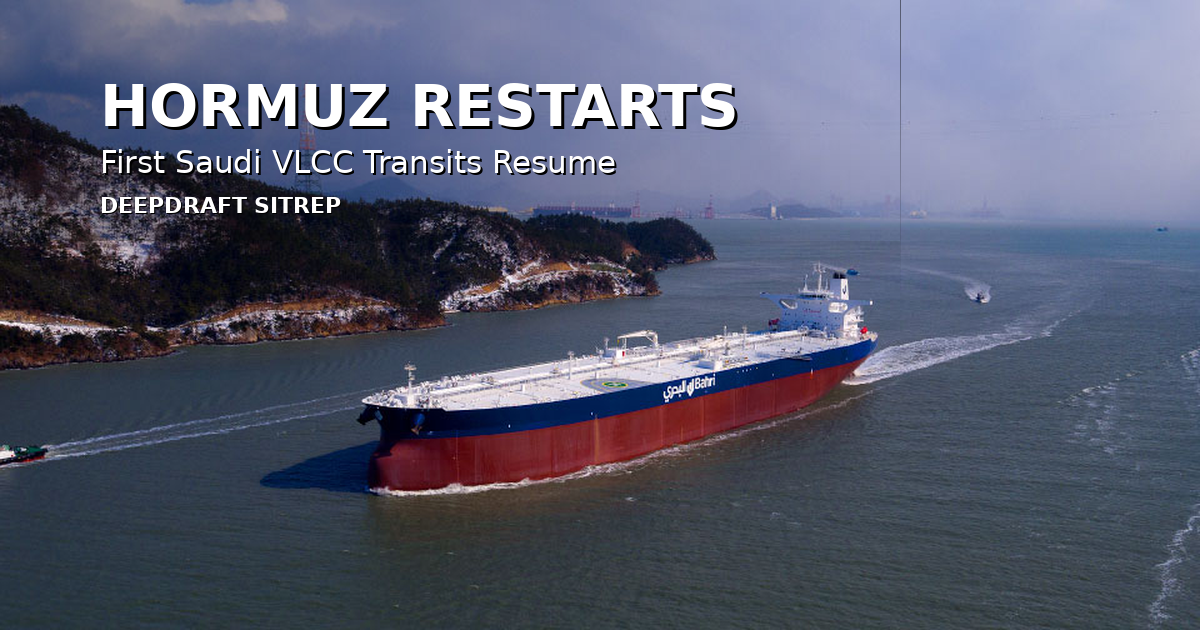
Hormuz is moving again, but Gulf shipping has not normalized.
Saudi VLCC transits, failed Basrah fixtures and mine-clearance warnings now define the restart.
1. Hormuz Restart: Saudi VLCCs Resume Strait Transit
• Three Saudi-flagged Bahri supertankers carrying about 6 million barrels of crude transited the Strait of Hormuz after the U.S.-Iran interim deal was signed.
• U.S. officials said blockade enforcement on Iran-linked maritime traffic had been lifted, with Vice President JD Vance saying about 12.5 million barrels moved through Hormuz overnight.
• Reuters reported additional signs of restart activity around Fujairah, Qatar LNG flows and other Gulf energy movements.
• The restart is operationally significant, but not a return to normal scheduling, underwriting or fixture confidence.
2. Basrah Fixtures Show Commercial Recovery Has Not Started
• PetroChina failed to secure a VLCC for late-June Basrah crude loading despite the reopening signal.
• Indian Oil also failed to attract bids for an Iraqi crude shipment to Paradip and declared force majeure on the cargo.
• Reuters reported offers near three times pre-war levels, with security uncertainty still pricing into Gulf tonnage.
• Charterers should treat Gulf crude liftings as available only after vessel, insurer, route and laycan confirmation.
3. Container Market Pressure Adds a Separate Supply-Chain Signal
• Drewry’s World Container Index rose 12% to USD 3,969 per 40ft container on June 18.
• The composite index is now at its highest level in 18 months.
• Rate growth was driven by Transpacific and Asia-Europe lanes, keeping container desks exposed to schedule, space and surcharge volatility.
• Operators should separate Gulf tanker restart decisions from container procurement, where pressure remains route-specific and rate-led.
4. Safety, Mine-Clearance and Traffic-Control Layer
• INTERTANKO and insurance-market voices continue to call for security assurances, mine-clearance clarity and legal certainty before full normalization.
• Iran has signaled it will continue issuing permits and directing traffic during the 60-day negotiation period, although no fees are expected during that window.
• Masters should maintain enhanced bridge watchkeeping, VHF discipline, AIS policy compliance, ECDIS route checks and full log preservation during Hormuz transits.
• DPA/CSO teams should require documented voyage authorization before accepting Gulf orders that depend on rapid post-blockade normalization.
Strategic Summary & Actions Required
• Masters transiting Hormuz should treat the reopening as conditional and preserve AIS, VDR, VHF, voyage orders and security communications.
• Ship managers should require fresh risk assessments covering mine clearance, permit instructions, naval contact, crew briefings and emergency escalation.
• Charterers and operators should not assume Basrah, Fujairah, Qatar or Iran-linked cargoes are commercially normalized until tonnage, insurance and laycan positions are confirmed.
• Insurers, P&I teams and legal desks should review war-risk, sanctions, deviation, off-hire, force majeure and unsafe-port language before approving Gulf exposure.
• Container procurement teams should price the separate Drewry rate surge into Asia-Europe and Transpacific commitments.
Operational Status
CRITICAL RED – Hormuz Restart / Conditional Gulf Transit / Basrah Fixture Failure / Mine-Clearance and Insurance Uncertainty
Latest DeepDraft Analysis
Settebello Was Not Sacrifice. It Was a Recruitment Failure
Three Indian seafarers died on MT Settebello. The analysis turns the casualty into a recruitment, deployment, sanctions-screening and voyage-authority failure.
Related DeepDraft Articles & Analysis
Sources
Reuters, Drewry, INTERTANKO, Lloyd’s Market Association, The DeepDraft
This update is part of the DeepDraft SITREP series covering developing maritime operational situations.

Leave a Reply