
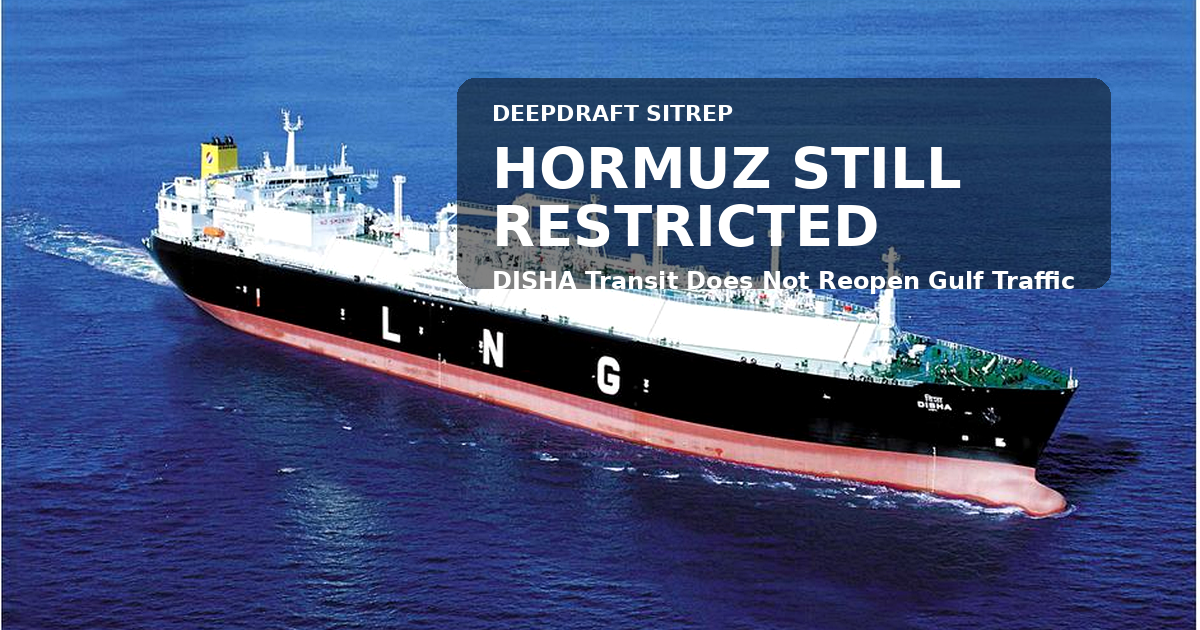
A ceasefire framework has been agreed, but maritime operations have not returned to normal.
Security advisories keep Hormuz under restricted passage conditions until June 19.
1. Hormuz Remains Operationally Closed Until June 19
• A U.S. advisory issued on June 15 stated the blockade of Iranian ports remains in effect until the ceasefire agreement is fully implemented, expected on June 19.
• Operators were advised not to attempt transit until explicit authorization is issued.
• Isolated vessel movements do not amount to routine commercial reopening. In the meantime, LNG carrier Disha has passed through Hormuz, becoming the first visible test transit under the emerging reopening framework.
• Masters, operators and charterers should continue planning on the basis of restricted passage conditions.
2. Mine-Clearance Bottleneck Continues to Delay Normal Operations
• Maritime security reporting indicates mine-clearance remains a prerequisite before routine commercial traffic can resume.
• Clearance operations may require several weeks before confidence in safe navigation is restored.
• Traffic levels remain significantly below normal despite the diplomatic breakthrough.
• Any mine-related casualty or navigation incident would immediately delay wider reopening.
3. Operators Hold Position Despite the Agreement
• Maersk welcomed the diplomatic agreement but has not announced any operational change in the region.
• Japanese shipowners and other industry groups continue awaiting additional guidance expected around June 19.
• Charterers should not yet assume normal voyage execution, laycan performance or unrestricted Hormuz routing.
• Insurance, war-risk and voyage-approval decisions remain tied to security confirmation rather than political announcements.
4. Navigation and Security Layer
• JMIC reporting continues to indicate reduced commercial traffic through the area.
• Vessels remain cautious on routing, navigation integrity and regional security conditions.
• GNSS interference remains a bridge-management consideration across parts of the wider operating area.
• Masters should preserve passage plans, VDR records, AIS data and all routing, authorization and security communications.
Strategic Summary & Actions Required
• Masters should continue treating Hormuz as restricted until formal authorization and routing guidance are issued.
• Ship managers should maintain enhanced voyage-risk assessments covering mines, navigation integrity, crew readiness and contingency anchorages.
• Charterers and operators should preserve contractual protections covering delay, deviation, off-hire and force-majeure exposure.
• Insurers, legal teams and DPA/CSO departments should require documented security clearance and voyage authorization before approving transit.
Operational Status
CRITICAL RED – Active Blockade Advisory Until June 19 / Restricted Hormuz Transit / Mine-Clearance Constraint / Continued Routing and Insurance Uncertainty
Latest DeepDraft Analysis
Settebello Was Not Sacrifice. It Was a Recruitment Failure
The Settebello deaths expose a failed crew-supply chain, where Indian seafarers carried sanctions, blockade and war-risk exposure created ashore.
Related DeepDraft Articles & Analysis
Sources
Reuters, UKMTO/JMIC, Maersk, BIMCO, The DeepDraft
This update is part of the DeepDraft SITREP series covering developing maritime operational situations.



Leave a Reply