
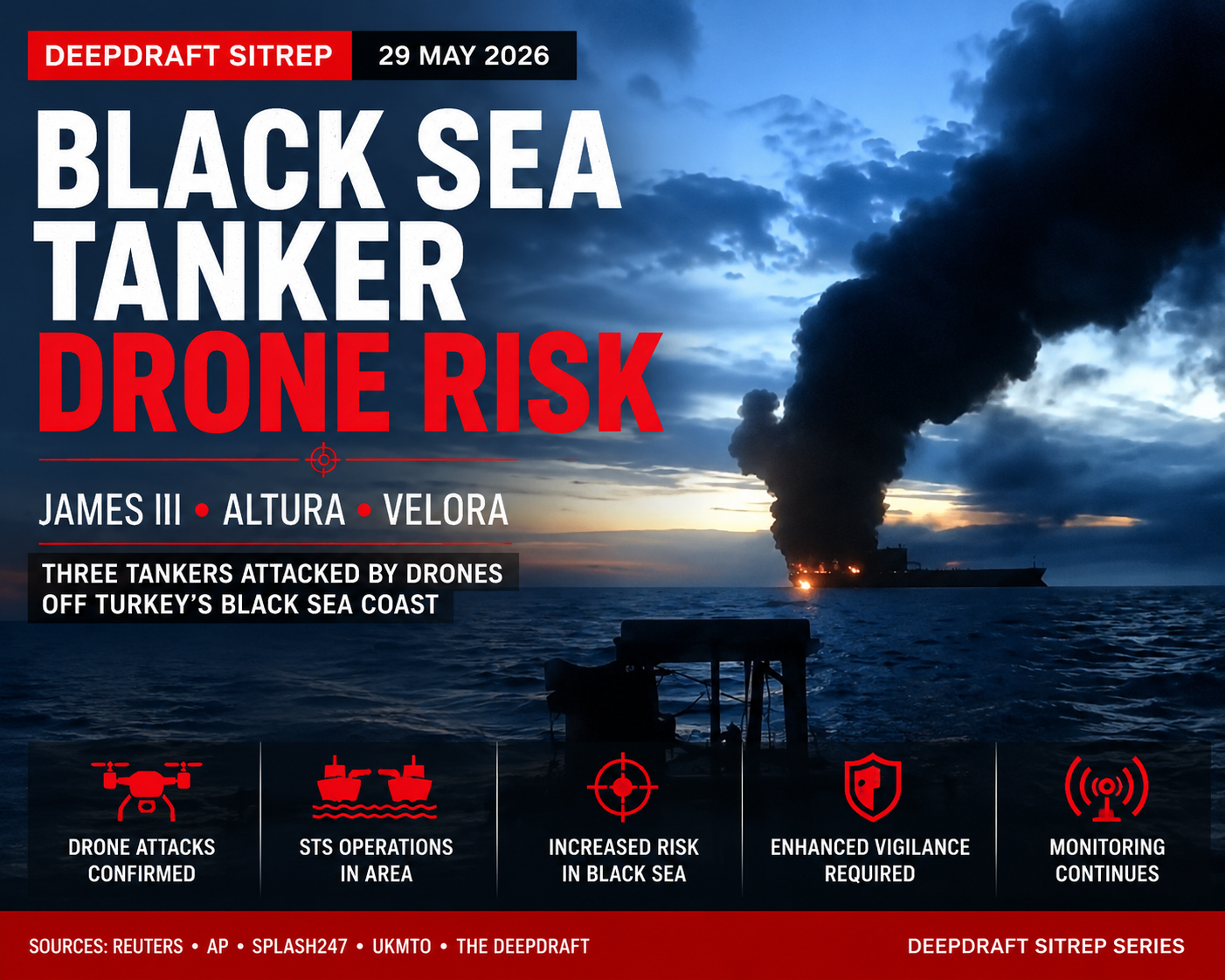
Three tankers were attacked by drones off Turkey’s Black Sea coast, with two hit during STS operations.
The day’s operating picture now spans Black Sea security, Hormuz military escalation, U.S. cabotage pressure, Gulf pollution exposure and Indo-Pacific maritime-security alignment.
1. Black Sea Tanker Attacks: James II, Altura and Velora Hit Off Turkey
• Reuters, citing shipping agency Tribeca, identified three tankers attacked by drones near Turkey’s northern Black Sea coast on May 28.
• The Palau-flagged James II was in ballast about 50 miles north of Turkeli when attacked.
• Altura and Velora, both Sierra Leone-flagged, were attacked nearby while conducting ship-to-ship operations, also in ballast.
• Associated Press linked all three tankers to Russia’s shadow-fleet trade. James II was identified as owned by Marshall Islands-based James Navigation, while Altura and Velora were linked to Turkey-based Pergamon Shipping.
• All crew were reported safe, Turkish coastal-safety boats were dispatched, and no party had claimed responsibility at the time of reporting.
2. Hormuz Escalation: U.S. Strikes and Iranian Drones Reopen Strait-Risk Planning
• The U.S. military carried out new strikes in Iran, targeting a Bandar Abbas military site and downing four Iranian one-way attack drones near the Strait of Hormuz.
• A U.S. official said the Bandar Abbas target was a ground-control station preparing to launch a fifth drone.
• Washington described the action as defensive and tied to protection of forces.
• President Donald Trump rejected an Iranian media report that Iran and Oman would jointly manage Hormuz, saying the waterway would remain open.
• Splash247’s “dangerous new phase” framing is useful as maritime trade interpretation, but the operational hard facts remain the drones near Hormuz, U.S. strikes at Bandar Abbas and continuing uncertainty over Strait security management.
Reading this as a maritime insider, seafarer, or enthusiast?
Subscribe to The DeepDraft for maritime analysis, daily SITREP updates, weekly briefings, and operational signals worth watching.
3. Jones Act Waiver: U.S. Fuel Shipping Relief Shows Limited Price Impact
• U.S. Jones Act waivers allowed about 50 fuel shipments, totaling roughly 10 million barrels, to move on foreign-flagged ships between U.S. ports.
• Reuters analysis estimated the waiver’s gasoline-price benefit at about 6.6 cents per gallon, limiting its consumer-price effect.
• The maritime signal is domestic but operationally relevant: waiver-driven foreign-flag movement changes coastal tanker availability, voyage economics and cabotage exposure for U.S. fuel distribution.
• Charterers, operators and compliance teams should separate political advocacy from voyage facts. The waiver supports a logistics-impact assessment, not a security lead.
4. Olympic Life: Gulf of Oman Explosion Remains a Safety and Pollution Reference Point
• UKMTO Warning 062-26 reported an external explosion 60 nautical miles east of Muscat, Oman, on the port side aft of a tanker, close to the waterline.
• The vessel was identified as Olympic Life, a Greek-owned VLCC operated by Springfield Shipping and owned by Olympic Shipping & Management.
• The tanker was not carrying cargo, was heading out of the Gulf of Oman, and remained stable and operational after being struck by an unidentified object.
• Bunker fuel discharge was reported after the blast. Springfield Shipping said a sheen was observed and the spill had been contained.
5. Indo-Pacific Security Layer: Japan and Philippines Move Toward Intelligence-Sharing Pact
• Japan and the Philippines plan to begin negotiations on a classified-information sharing agreement to support expanded defense cooperation.
• The agreement could ease Japanese transfer of military equipment to Manila, including warships, amid South China Sea and Taiwan-area tensions.
• The maritime relevance is indirect but operationally meaningful: stronger Japan-Philippines intelligence sharing may improve maritime-domain awareness, patrol coordination and defense-equipment transfer capacity in contested waters.
• This is not a shipboard alert today, but it affects the future operating environment around the South China Sea and Philippine approaches.
Strategic Summary (For Masters & Ship Managers)
• Black Sea tanker operations now require renewed risk review for STS work, ballast movement, drifting, anchoring and Turkey-adjacent transit.
• Hormuz remains operationally unstable because U.S. strikes, Iranian drones and Bandar Abbas activity keep Strait security tied to military action, not only permissioning or traffic levels.
• Jones Act waiver effects should be treated as a commercial and cabotage-planning issue, especially for fuel movements, tanker availability and contract exposure.
• Gulf of Oman operators should keep Olympic Life as a pollution and damage-control reference case: even non-cargo VLCC transits can generate bunker-spill exposure after external impact.
Advice / Actions Required
• Masters: increase bridge and deck vigilance during Black Sea STS, ballast passages, drifting and anchoring, especially near Turkey’s northern Black Sea approaches.
• Ship managers: require updated security approval for Black Sea and Hormuz-related voyages, with specific review of drone threat, emergency response, machinery-space damage control and pollution reporting.
• Charterers/operators: re-check war-risk allocation, deviation rights, off-hire wording, STS permissions, sanctions warranties and Jones Act exposure before accepting affected employment.
• DPA/CSO and compliance teams: circulate James II, Altura, Velora and Olympic Life as watch-list case references, and verify current Reuters, UKMTO, sanctions and coastal-state updates before issuing voyage instructions.
Operational Status
RED – Black Sea Tanker Drone Attacks / Hormuz Military Escalation / Gulf of Oman Pollution Exposure / U.S. Cabotage and Indo-Pacific Security Signals Active
Latest DeepDraft Analysis
Sources
Reuters, Associated Press, UKMTO, Splash247, The DeepDraft
This update is part of the DeepDraft SITREP series covering developing maritime operational situations.



Leave a Reply