
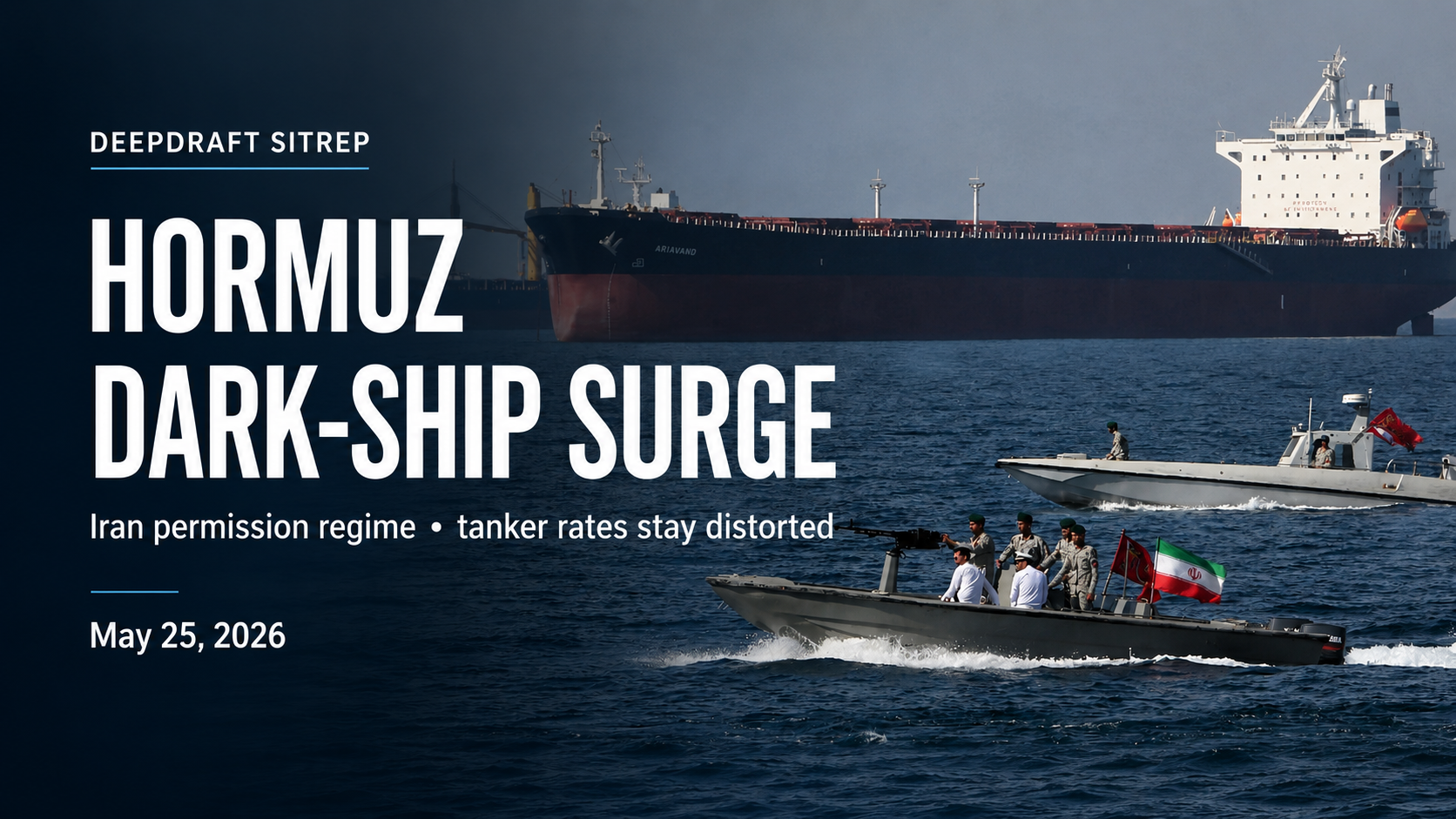
Hormuz is moving, but not normalizing.
Industry safe-transit guidance now sits beside dark-ship activity, AIS degradation, Iranian permissioning, selective crude exits and long-duration flow warnings. The operational signal is no longer whether vessels can move through the Strait. It is whether they can move safely, transparently, legally and commercially under a controlled-passage environment.
1. Hormuz Transit Guidance: Reopening Creates Its Own Navigational Hazard
ICS, BIMCO, INTERCARGO, INTERTANKO, IMCA and OCIMF have issued joint guidance for vessels transiting the Strait of Hormuz.
The guidance matters because it confirms that any reopening surge is now a bridge-level risk, not only a diplomatic or market issue. Hundreds of vessels remain unable to transit, and a sudden release of delayed traffic could create congestion, close-quarters situations, ambiguous routing instructions and heightened pressure on masters in an already contested waterway.
For operators, the message is clear: Hormuz cannot be treated as a routine chokepoint simply because limited movement has resumed.
2. Dark Movement and AIS Degradation Keep the Strait Operationally Opaque
The guidance is only half the story.
The stronger operational concern is that vessels are moving through a zone where visibility, AIS integrity and traffic transparency remain degraded. Windward reported a sharp increase in dark activity around Hormuz, while recent tracking continues to show transits occurring without full visibility.
This converts Hormuz from a security issue into a compliance, navigation and insurance problem.
Masters should treat AIS as advisory only in the Strait, Gulf of Oman and Persian Gulf approaches. Bridge teams must maintain radar plotting, visual verification where available, parallel indexing, soundings awareness and manual navigation discipline. Owners and insurers should assume that dark movement will complicate casualty reconstruction, sanctions screening, deviation disputes and seaworthiness arguments.
3. Permissioned Passage: Hormuz Is Open Only Through Control
Reuters has reported that Iran is consolidating control around Hormuz through island checkpoints, diplomatic arrangements, IRGC-linked vetting and, in some cases, fee or service mechanisms.
That means passage is no longer defined only by geography. It is defined by clearance.
The commercial risk is significant. If a vessel can pass only after permission, coordination or payment exposure, then owners, charterers, insurers and banks must consider sanctions clauses, voyage-order authority, war-risk terms, off-hire exposure, demurrage, deviation rights and payment compliance before committing a Gulf voyage.
This is the core operating reality: Hormuz remains permissioned, not normalized.
4. Selective Crude Exits Show Movement, Not Recovery
Recent crude movements show that some cargoes are clearing the Strait.
Reuters reported that three supertankers carrying about 6 million barrels of Middle East crude exited Hormuz for Asia. That is operationally important because it proves that oil cargoes can still move under controlled conditions.
But it does not prove restoration.
Selective crude exits are a relief valve, not a full reopening. Traffic remains far below normal, confidence remains weak and charterers still face uncertainty over clearance timing, routing authority, escort expectations, insurance approval and destination risk.
For tanker desks, the correct assumption is conditional movement, not free passage.
5. Market Distortion: Tanker, Container, Dry Bulk and Gas Signals Remain Linked to Hormuz
The disruption is now feeding into wider freight and logistics pricing.
Tanker earnings remain elevated because Gulf exposure is still being priced as a restricted, high-risk voyage. VLCC rates near the $100,000-per-day range show that physical movement alone is not enough to normalize the market when clearance, insurance and security risk remain unresolved.
Container and gas markets are also carrying the shock. SCFI strength, blank sailings, capacity shortages and VLGC earnings pressure show that Hormuz is no longer isolated to crude. The chokepoint has become a broader freight-cost and supply-chain risk.
ADNOC’s warning that full Hormuz oil flows may not return before the first half of 2027 gives the market a longer planning horizon. Operators should not price this as a short crisis. They should plan for an extended permissioned-transit environment.
Strategic Summary
Hormuz remains the dominant maritime signal.
The issue is not guidance alone. The issue is that guidance has arrived while the Strait remains partially opaque, permissioned and commercially distorted.
Limited crude exits are positive, but they do not restore normal navigation. Dark movement, AIS degradation, Iranian clearance mechanisms and elevated freight pricing all point to the same conclusion: vessels are moving through Hormuz, but only inside a constrained operating model.
For masters and managers, this means Hormuz transit requires full company, flag, insurer, charterer and security alignment before execution.
For charterers, Gulf-linked fixtures must be priced against delay, clearance failure, deviation, war-risk premium and sanctions exposure.
For insurers, the key question is shifting from whether a ship entered a war-risk area to whether the vessel had a defensible transit plan, verified routing authority and resilient navigation procedures.
Advice / Actions Required
Masters should not treat Hormuz as normalized. Transit should be conducted only after company, flag, CSO, insurer and recognized coordination-channel approval.
Bridge teams should brief for AIS unreliability, GNSS/GPS interference, dark traffic, small craft, drone risk, mine risk, congestion and abort points before entering the Strait or its approaches.
Owners and managers should verify whether any clearance or permissioning process applies to the vessel’s flag, ownership, cargo, charterer, insurer, destination and sanctions profile.
Chartering teams should review war-risk, deviation, off-hire, force majeure, demurrage, laycan, sanctions and payment clauses before accepting Gulf-linked orders.
Insurers and P&I clubs should treat dark-transit exposure and degraded navigation integrity as live underwriting issues, especially for high-value tanker, LNG, LPG and container tonnage.
Operational Status
CRITICAL RED — Hormuz Permissioned Transit / Dark Movement and AIS Degradation / Selective Crude Exits / Tanker and Freight Market Distortion / Long-Duration Flow Risk Active
DeepDraft Analysis
Sources
Reuters, BIMCO, ICS, INTERTANKO, INTERCARGO, IMCA, OCIMF, Windward, Lloyd’s List, Trading Economics, DeepDraft
This update is part of the DeepDraft SITREP series covering developing maritime operational situations.




Leave a Reply