
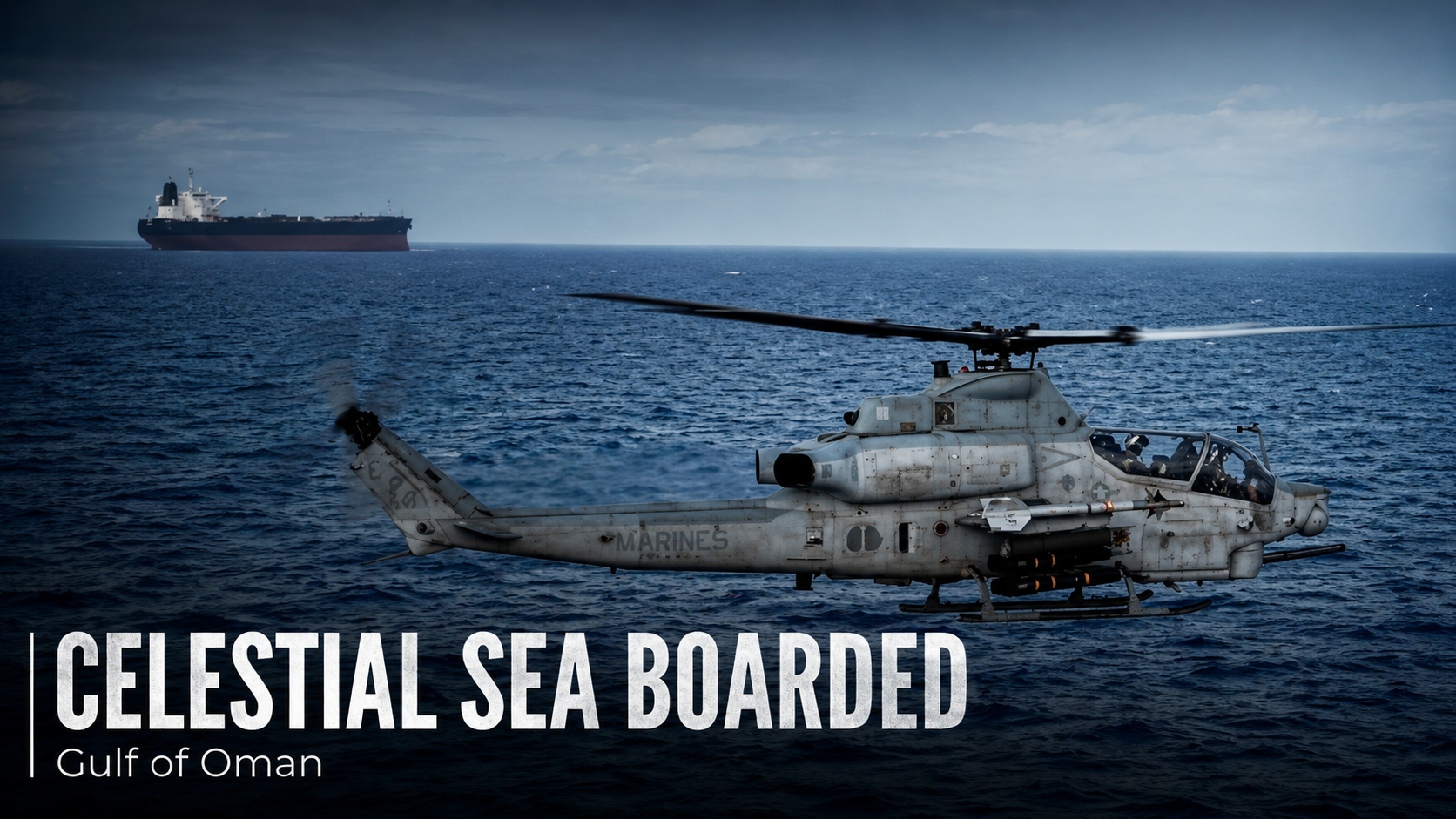
U.S. forces boarded and redirected the Iranian-flagged M/T Celestial Sea in the Gulf of Oman.
The same 24-hour cycle produced a separate Bonny casualty, with two vessels grounded and five crew injured.
1. Gulf of Oman Boarding: Celestial Sea Interdicted
• U.S. military personnel boarded the Iranian-flagged oil tanker M/T Celestial Sea in the Gulf of Oman on May 20, 2026.
• The vessel was suspected of violating a U.S. blockade while en route to an Iranian port.
• U.S. forces searched the tanker, released it and instructed the crew to alter course.
• AP reports this was at least the fifth commercial vessel boarding since the blockade began in mid-April.
2. Bonny / Onne Collision: Two Vessels Grounded, Five Crew Injured
• MV Maersk Valparaiso collided with oil tanker MT Lady Martina at Bonny Inner Anchorage near Onne Port in Rivers State.
• NIMASA said the incident occurred on May 20, 2026, at about 1130 hours.
• Five crew members on MT Lady Martina sustained injuries and were evacuated to the FOB Bonny sickbay for medical treatment.
• MT Lady Martina reportedly drifted ashore and grounded along Bonny Channel, while MV Valparaiso remained grounded at Bonny Inner Anchorage pending damage assessment and investigation.
3. Tanker Market Signal: Urals Freight Weakens on Tonnage Overhang
• Freight rates for Russian Urals crude shipments to India weakened in mid-May as tanker availability increased and vessel supply shifted into the Atlantic market.
• Reuters reports Aframax shipping costs from Primorsk to India fell from more than USD 18 million to as low as USD 13 million.
• Suezmax rates on the same route were reported near USD 16 million.
• Novorossiisk to India freight slid to about USD 18 million, down from USD 20 million to USD 21 million.
4. Safety / Pollution Layer: Bonny Response Moves Into Damage and Spill Control
• NIMASA reported an oil spill within the affected area after the Bonny collision.
• Deep Blue Project response assets were deployed to the scene, including 10 armed personnel aboard DB 214.
• The casualty creates immediate local exposure for anchorage movement, pilotage coordination, damage assessment, pollution control and salvage planning.
• Vessels calling Bonny / Onne should confirm channel status, anchorage restrictions and casualty-response limits through local agents before arrival.
Strategic Summary (For Masters & Ship Managers)
• Gulf of Oman passages involving Iran-linked cargo, flag, ownership or destination require boarding-readiness and strict document control.
• Masters should preserve voyage instructions, cargo papers, AIS records, VDR data and all bridge communications in case of interdiction review.
• Bonny / Onne movements require local confirmation on grounded vessels, oil-spill response, anchorage availability and channel restrictions.
• Tanker desks should price the Urals freight reset where Gulf disruption, Atlantic tonnage availability and India-bound fixtures affect voyage economics.
Operational Status
CRITICAL RED – Gulf of Oman Boarding / Bonny Grounding and Pollution Response / Urals Freight Reset / Active 24-Hour Operational Change
Latest DeepDraft Analysis
MEPC 84 deferred the Net-Zero Framework but adopted the North-East Atlantic ECA, turning regulation into fuel planning, recordkeeping and PSC exposure.
Sources
Reuters, Associated Press, NIMASA, Ships & Ports, The DeepDraft
This update is part of the DeepDraft SITREP series covering developing maritime operational situations.


Leave a Reply