
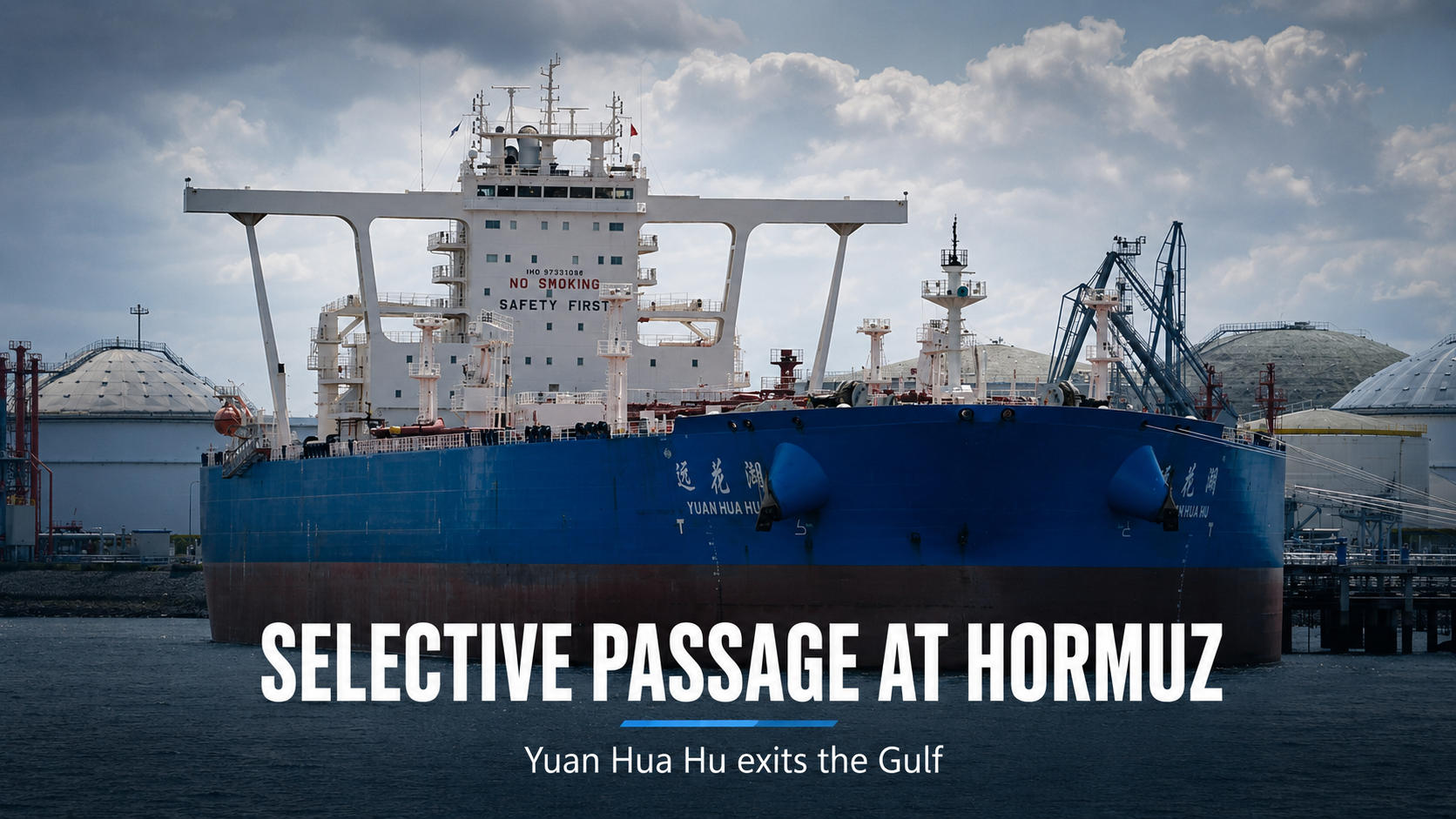
A Chinese supertanker has exited Hormuz after more than two months inside the Gulf.
Selective tanker passage is now the strongest operational signal in the blockade environment.
1. Chinese Tanker Exit Confirms Selective Hormuz Passage
• Yuan Hua Hu, a Chinese supertanker carrying about 2 million barrels of Iraqi crude, exited the Strait of Hormuz and anchored in the Gulf of Oman near a U.S. Navy blockade zone, according to Reuters vessel-tracking data.
• The tanker is owned by COSCO Shipping Energy Transportation and chartered by Sinopec’s Unipec, with Basrah Medium crude loaded in early March.
• Reuters reported this is the third known Chinese oil tanker passage through the strait since the war began on February 28, 2026.
• Other Chinese-linked movements cited by Reuters include Cospearl Lake, He Rong Hai and Xiang Jiang Kou, confirming that passage is constrained but not fully static.
2. Diplomatic Layer: U.S.-China Toll Position Targets Iran’s Chokepoint Leverage
• Senior U.S. and Chinese officials agreed that no country should be allowed to charge shipping tolls in the Strait of Hormuz, according to a U.S. State Department statement reported by Reuters.
• The toll issue is operationally relevant because it would convert transit permission into a monetized access regime for tankers, LNG carriers and containerized Gulf trade.
• AP reported President Trump travelled to Beijing for talks with President Xi after weeks of U.S. efforts to push China to use its leverage over Iran to reopen the strait.
• China has also urged Pakistan to step up U.S.-Iran mediation, reinforcing Islamabad’s role as a live intermediary in the Gulf transit dispute.
3. Commercial, Market and Energy-Supply Impact
• The International Energy Agency warned that global oil supply will fall short of demand in 2026 because of the Iran war and Hormuz disruption, with global supply expected to decline by 3.9 million bpd.
• Reuters reported the IEA now projects a 1.78 million bpd full-year supply shortfall, with a second-quarter deficit of about 6 million bpd.
• Cumulative Middle East supply losses have exceeded 1 billion barrels, with more than 14 million bpd shut in, according to Reuters reporting on the IEA assessment.
• U.S. CPI rose 0.6% in April, with annual inflation posting its largest gain in three years as energy costs drove broad price increases.
4. Environmental and Port-Risk Layer: Kharg Island Slick Remains Source-Disputed
• Satellite imagery showed a large slick west of Kharg Island, Iran’s key crude export hub, with analysts pointing to possible vessel discharge or pipeline leakage.
• Iran denied a terminal leak and said the slick was caused by tanker wastewater discharge, according to TradeWinds reporting on Copernicus Sentinel imagery from 8 May.
• Reuters separately reported M.V. Barakah, a UAE-owned ADNOC-operated tanker, leaked a small amount of bunker fuel off Oman after an Iranian drone strike on 4 May.
• Spill response remains constrained by the security environment, increasing exposure for Gulf fisheries, desalination intake planning, port contingency teams and coastal-state pollution response.
5. Security Signal: Kuwait/Bubiyan Incident Raises Sabotage-Watch Level
• Kuwait said it foiled an infiltration operation by members of Iran’s IRGC near Bubiyan Island, while Iran denied hostile intent and said sailors entered Kuwaiti waters due to a navigation-system malfunction.
• The Wall Street Journal reported Gulf states are increasing operations against alleged Iranian sabotage networks, including the Kuwaiti interception near the country’s largest island.
• Bubiyan is operationally sensitive because it sits close to northern Gulf infrastructure, Kuwaiti waters, Iraqi approaches and traffic connected to the Shatt al-Arab operating area.
• The incident should be treated as a confirmed regional security claim but not as proof of an executed sabotage attack.
Strategic Summary (For Masters & Ship Managers)
• Hormuz is no longer a simple closure story. It is becoming a selective-access regime where nationality, cargo, diplomacy and naval posture may affect passage.
• The Yuan Hua Hu transit confirms some crude movements can still occur, but the route remains exposed to security, toll, inspection and blockade risk.
• Kharg and Oman spill reports add pollution-response and port-intake risk to the security picture, especially for Gulf coastal operators and tanker interests.
• Chartering, insurance and fleet-control teams should price Hormuz as a prolonged operational constraint, not a temporary deviation event.
Advice / Actions Required
• Masters: verify latest UKMTO, flag-state, company and naval guidance before any Gulf movement and preserve complete security-message logs.
• Ship managers: review Hormuz transit authorization, war-risk coverage, pollution-response plans, crew-change exposure and emergency deviation authority.
• Charterers and operators: document delay, deviation, toll-risk, bunker escalation, port rotation changes and force majeure triggers in Gulf-linked fixtures.
• Compliance teams: monitor any U.S.-China-Iran toll arrangement, sanctions interface, cargo-permission regime or naval notification requirement before authorizing passage.
Operational Status
CRITICAL RED | Selective Hormuz Passage / Gulf Transit Politicized / Toll, Projectile, Spill and Sabotage Risk / Voyage Authorization Required
DeepDraft Update
Latest Weekly Analysis: ECDIS certificates prove completion, not competence. Real bridge safety depends on recent system familiarity, maker-specific practice and operational confidence under workload.
Sources
Reuters, UKMTO, AP, Al Jazeera, The National, TradeWinds, Wall Street Journal, IEA
This update is part of the DeepDraft SITREP series covering developing maritime operational situations.



Leave a Reply