
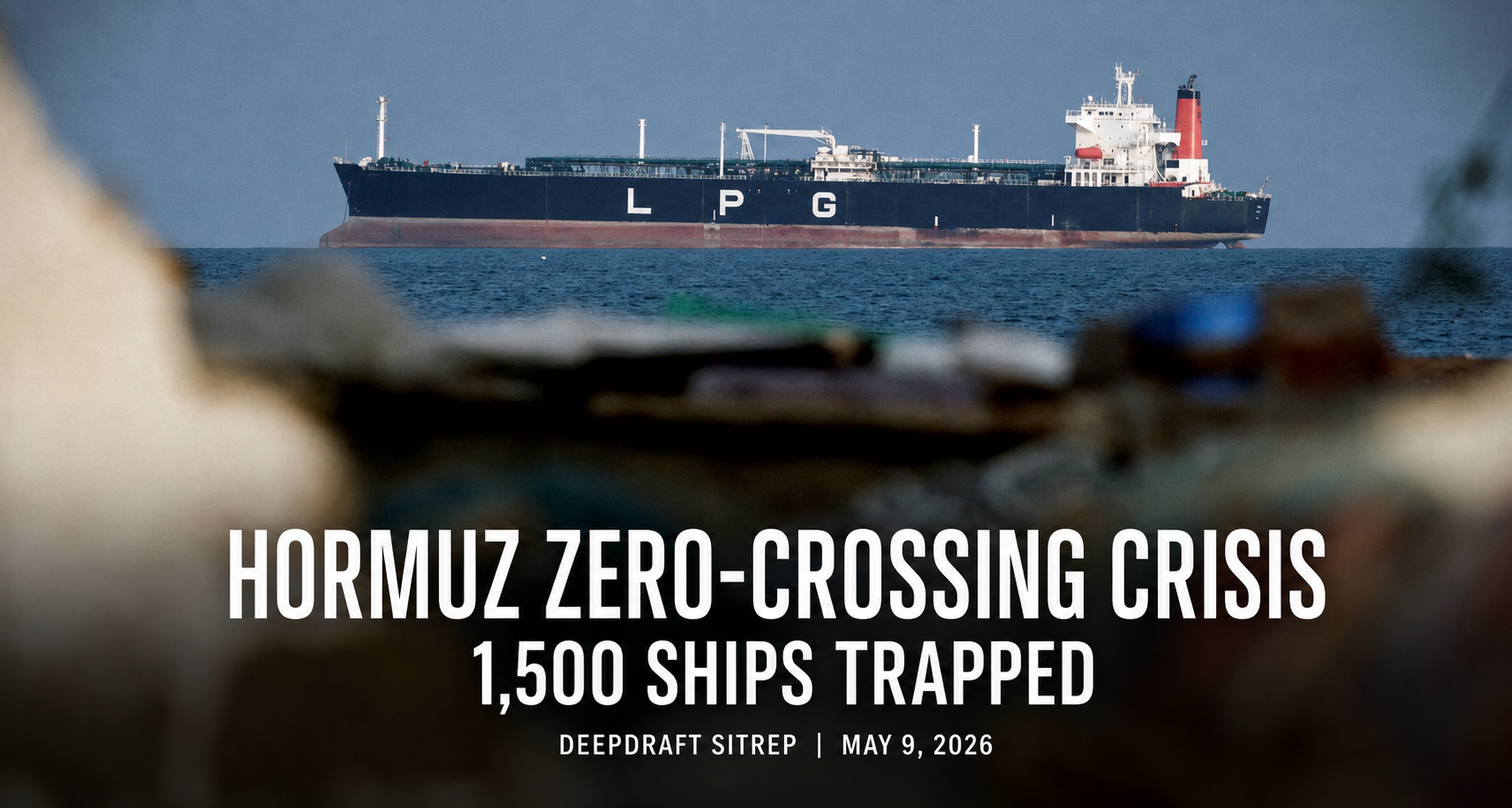
Registered commercial movement through Hormuz has collapsed into a zero-crossing crisis.
The operational issue is now trapped tonnage, crew exposure, mine risk and blockade enforcement.
1. Hormuz Zero-Crossing Crisis
• Commercial shipping through the Strait of Hormuz has halted for three consecutive days, according to S&P Global Intelligence reporting cited by WSJ.
• No commercial vessels operated by registered shipping companies have crossed the Strait since Tuesday, while smaller local or shadow-fleet movements continue to appear in the area.
• JMIC reports Strait of Hormuz traffic remains significantly reduced, with several new security-related incidents recorded in the latest 48-hour reporting window.
• IMO-linked reporting says approximately 1,500 ships and 20,000 crew are trapped in the Gulf, making this a fleet-management and crew-welfare issue, not only a transit-risk event.
2. Gulf Tonnage, Anchorages and Bridge Teams
• Vessels at Gulf anchorages, terminals and waiting areas now face prolonged exposure before any verified exit window.
• JMIC reports multiple vessels received VHF Channel 16 instructions to vacate anchorage areas closer to the Strait of Hormuz or risk consequences.
• The affected fleet includes tankers, gas carriers, container ships, dry cargo tonnage and support vessels whose commercial schedules depend on a safe Hormuz exit.
• Masters should treat unverified movement instructions, anchorage warnings and route-direction messages as security events requiring company, CSO, flag and UKMTO/JMIC validation.
3. Commercial, Insurance and Charterparty Exposure
• The commercial baseline has shifted from delayed passage to non-availability of normal registered transit.
• Chartering desks now face immediate exposure on laycan performance, voyage warranties, demurrage, off-hire, deviation rights, war-risk clauses and cargo-delivery timelines.
• MOL said three of its vessels transiting Hormuz in April did not pay Iranian transit fees, reinforcing that proposed toll or safe-passage payments remain a sanctions and compliance risk for owners and charterers.
• Drewry’s World Container Index increased 3% to USD 2,286 per 40ft container on 7 May after three weekly declines, driven by higher Transpacific and Asia-Europe freight rates.
4. Security, Technical and Safety Controls
• JMIC continues to report a CRITICAL maritime threat environment across the Arabian Gulf and Strait of Hormuz area, with traffic reduction linked to recent security incidents.
• Reuters reported a cargo vessel was struck by a projectile in the Strait of Hormuz, citing UKMTO, confirming that projectile risk remains inside the active transit area.
• Mine threat, projectile exposure, VHF intimidation and localized navigation degradation should be treated as a combined bridge-risk picture.
• Bridge teams should maintain manual-positioning readiness, visual and radar cross-checks, disciplined AIS procedures, VHF logging and immediate escalation of suspicious instructions or electronic anomalies.
5. HMM Namu Fire Adds Casualty Risk to Gulf Waiting Areas
• South Korea opened an investigation into the Panama-flagged, Korean-operated HMM Namu after an engine-room explosion and fire while anchored near the UAE.
• Earlier Reuters reporting identified 24 crew on board, including six Korean nationals, and said the fire broke out in the engine room.
• The cause remains under examination, including whether external action or malfunction was involved.
• The case does not displace the Hormuz transit freeze, but it reinforces casualty-response, evidence-preservation and anchorage-risk requirements for vessels held in Gulf waiting areas.
Strategic Summary (For Masters & Ship Managers)
• Hormuz has shifted from high-risk passage to a trapped-tonnage operating environment where normal registered commercial transit cannot be assumed.
• Masters should manage Gulf waiting time as an active security condition, not routine anchorage delay.
• Operators and charterers should reprice Gulf-linked voyages against blocked transit, delayed clearance, deviation cost, toll-payment exposure, war-risk exposure and laycan failure.
• Fleet managers should issue immediate bridge guidance covering VHF threats, GNSS degradation, manual navigation, anchorage movement, casualty response and security-reporting discipline.
Advice / Actions Required
• Masters should verify all movement instructions through company security channels, UKMTO/JMIC reporting routes, flag guidance and local authorities before shifting position or attempting transit.
• Ship managers should review war-risk cover, P&I notification requirements, charterparty clauses, deviation authority, emergency towage options and crew-endurance limits for every Gulf-exposed vessel.
• Chartering desks should model a zero-transit Hormuz scenario for demurrage, off-hire, missed laycan, bunker deviation, Iranian toll exposure and cargo-delivery risk.
• Compliance teams should preserve voyage records, VHF logs, security advisories, AIS status changes, routing instructions, insurer approvals and any payment-related correspondence before Gulf movement.
Operational Status
CRITICAL RED – Zero-Crossing Crisis / Registered Commercial Transit Frozen / Mine, Projectile and Blockade-Enforcement Risk / Trapped Tonnage and Crew Exposure
DeepDraft Update
Latest Weekly Analysis: UAE Leaves OPEC: From Quotas to Chokepoints in the New Gulf Crude Map
https://thedeepdraft.com/2026/05/04/uae-leaves-opec-gulf-crude-map-fujairah-hormuz-tanker-routes/
Sources
UKMTO/JMIC, WSJ, Reuters, Drewry, The DeepDraft
This update is part of the DeepDraft SITREP series covering developing maritime operational situations.



Leave a Reply