
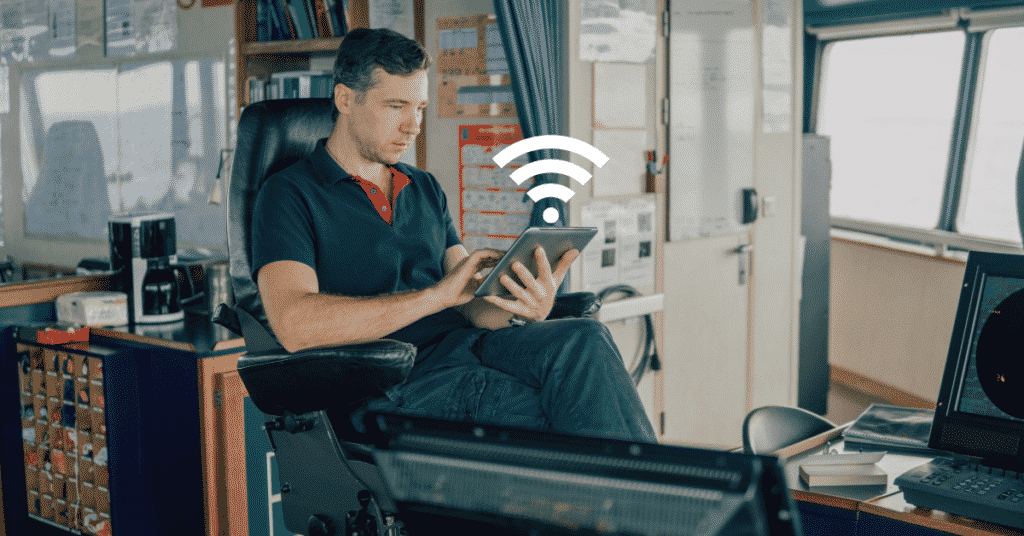
In a recent officers seminar where digital detox was one of the subjects, it offered valuable insights into individual behaviour and lifestyle impacts. It also opened up a parallel discussion that is highly relevant to seafarers, where the same issue plays out inside a safety-critical, high-consequence operating environment. From a Master’s standpoint, the question is not just digital detox but operational integrity.
The industry has solved one of its oldest problems: isolation. High-speed Low Earth Orbit systems, such as Starlink, mean ships are no longer cut off. Crew welfare and retention have improved. But from the bridge, this is not just a welfare upgrade; it is a fundamental change in the operating environment.
With download speeds up to 300 Mbps and latency dropping to 20-5- milliseconds, the distraction environment ashore now exists onboard, inside a continuously operating system. The “waiting time” that once defined maritime internet has effectively disappeared. Streaming, video calls, and continuous scrolling now carry the same cognitive experience as ashore.
At the same time, a quieter question is emerging onboard and ashore:
Has the solution to isolation introduced a new layer of operational risk?

The Shift: From Isolation to Continuous Connectivity
Introducing unlimited internet onboard triggered two distinct reactions.
One group raised immediate operational concerns. Watchkeepers, they argued, need to be adequately rested as per MLC requirements. The maritime system is built around structured watchkeeping cycles. If unrestricted internet leads to extended wakefulness, irregular sleep, or distraction, the integrity of the watch is directly affected.
The counterargument came from experienced seafarers and their position was straightforward. Addiction is not unique to the internet. It can exist in books, movies, or any other form of engagement. Therefore, restricting internet does not address the underlying human tendency.
There is truth in that argument but it does not fully account for what has changed.
This is not just access. This is frictionless, persistent, engineered engagement.

A Familiar Pattern: The Juice Story
Around 25 years ago, when I first joined as a cadet, packaged fruit juices in Tetra Pak form were introduced onboard. Mango juice quickly became the favorite. It was issued in small quantities, and naturally, crew found ways to take more. Extra servings were quietly arranged, and at times, entire packs would disappear at the provision stage itself.
Then a Master introduced a different approach. With the autonomy of that era, he removed the controls and placed the juices openly in the freezer.
The initial reaction was predictable. Consumption spiked initially, but it did not sustain. Within a short period, the demand stabilized, and over time, reduced significantly. Today, such products hold minimal attraction onboard.
The system normalized.
At first glance, this appears to offer a useful analogy for the current debate on internet access. Remove restriction, and behavior will eventually regulate itself.
But this is where the comparison begins to break down.
The juice was a passive commodity with a finite limit. Its appeal naturally declined with saturation. The smartphone, on the other hand, operates as an active system. It offers an infinite stream of content, continuously adapting to sustain engagement. While consumption of a physical product stabilizes, digital platforms are engineered to prevent disengagement.
Which is why the “normalization” argument only partially holds.

The Real Risk: Attention Fragmentation
The problem is not internet. It is attention fragmentation during operational duty cycles.
Recent behavioral research now quantifies what was earlier anecdotal. A 2026 study published in Computers in Human Behavior established that a single smartphone notification disrupts cognitive concentration for approximately 7 seconds. More importantly, the study concluded that frequency of interruptions, not total screen time, is the dominant factor in cognitive degradation.
In practical terms, this shows up as reduced vigilance during low-stimulus watch conditions, inconsistency in radar and ARPA monitoring, weaker discipline in ECDIS cross-checking, and slower anomaly detection.
From my experience across ships, both as a Master and an auditor, device policies vary wildly. Some rely entirely on the Master’s culture. In certain Far Eastern-managed fleets, I have seen AI-enabled setups where raising a phone to the ear instantly triggers an alert in the Master’s cabin and generates a log entry.
Neither approach fully works. The danger is not prolonged usage alone. It is repeated micro-disruption. The risk is not just visible usage. It extends to the residual cognitive load carried into the watch from prior digital engagement, and the anticipation of re-engagement afterwards.
This is situational awareness collapse in slow motion.

Even physical factors such as standing versus seated watchkeeping have already shown how small changes in posture reduce visual scanning and degrade lookout effectiveness. Read: Standing Watch vs Seated Bridge
The Hidden Multiplier
This has introduced a new category of risk: Self-induced, system-enabled fatigue.
A 2025 multi-method analysis on seafarers identified digital fatigue as a measurable phenomenon. Prolonged screen exposure and continuous digital interaction were directly linked to disrupted sleep cycles, reduced recovery between watches, increased mental fatigue, and a decline in situational awareness.
Supporting this, a 2025 review in Frontiers in Public Health confirmed that digital device usage directly interferes with sleep recovery patterns, particularly in watch systems built around four-hour cycles.
When attention fragments and fatigue accumulates, the impact moves beyond theory. It surfaces in incident investigations.

Across multiple jurisdictions, accident reports consistently point to the same underlying failure: loss of situational awareness driven by distraction during critical phases of navigation. In several cases, the use of personal mobile devices has been explicitly identified as a contributing factor.
This establishes a clear progression: Connectivity → Attention Fragmentation → Fatigue → Situational Awareness Loss → Incident Risk
Maritime safety bodies have already flagged this. Guidance from the UK’s Marine Accident Investigation Branch indicates that personnel distracted by personal devices can miss up to 50% of critical visual and audio information, even when it is directly in front of them.

The Human Argument: Freedom vs Control
There is a strong view, and a valid one, that internet usage should not be controlled by third parties. A duty superintendent ashore can remain online for extended periods and is still expected to respond effectively during emergencies. The same human principle applies onboard. At an individual level, this is correct. Responsibility ultimately rests with the person.
But a ship is not an office. It is a continuously operating system where performance is not judged by intent, but by outcome. Unlike shore offices, errors are not absorbed. They translate directly into physical consequences.
The question is whether operational systems can afford to ignore predictable patterns of human behaviour under conditions of fatigue, repetition, and cognitive load.
Current industry responses tend to fall into two extremes.
On one side is unrestricted access, introduced in the name of welfare, with little alignment to operational discipline. On the other is restriction-based control, framed as enforcement, which often undermines trust and morale. Both approaches are incomplete. One assumes ideal behaviour while the other assumes lack of professionalism.

This shift is already visible in how digital tools are informally shaping shipboard communication and decision-making. Read: The WhatsAppisation of Ship Operations
A Practical Model: Structured Freedom
The workable solution is not restriction. It is the structured integration of connectivity into operational discipline.
The objective is not to reduce access, but to align usage with the demands of a continuously operating system.
- Watch Integrity
Zero tolerance for personal device usage during watch. - Pre-Watch Transition
A defined buffer period before watch, where high-engagement digital activity is avoided to ensure cognitive readiness. - Post-Watch Recovery
Encouraging reduced screen exposure before rest periods to support sleep quality and recovery between watches. - Bandwidth Structuring
Not restriction, but intelligent allocation. Higher bandwidth availability during off-duty periods and controlled access during critical watch hours. This may require system-level support and software integration. - Leadership Signal
The behaviour of the Master and senior officers defines onboard culture. If discipline is not visible at the top, it will not exist below.

The final stage of any operation is where small human factor failures translate into real-world consequences.
The right to connectivity is no longer debatable. For seafarers, access to communication is as fundamental as access to air, food, and rest. It supports mental well-being, retention, and human dignity.
But rights do not eliminate operational boundaries.
Unlimited, unstructured access inside a safety-critical system introduces predictable human factor risks. The responsibility lies in designing its use within operational limits.
Access must be protected. Attention must be protected even more.
Media Section
Sources
Official Maritime Accident Investigation Reports
- UK MAIB: Accident Investigation Report 12/2019 (Grounding of general cargo vessel Priscilla)
- US NTSB: Accident Report DCA22FM030 (Collision between Bulk Carrier Bunun Queen and Offshore Supply Vessel Thunder)
- ATSB: Marine Investigation MO-2024-001 (Collision between container ship Maersk Shekou and tall ship STS Leeuwin II)
Maritime Regulations & Safety Guidance
- Maritime Labour Convention (MLC, 2006): Hours of work and rest requirements
- UK MAIB: Safety guidance on inattentional blindness and personal device distraction (50% awareness degradation metric)
Technical Data
- SpaceX / Starlink: Official Business and Maritime capability specifications for Gen-3 flat high-performance panels (350 Mbps download, 25ms latency)
Academic & Behavioral Research
- Computers in Human Behavior (2026): Study on cognitive disruption, interruption frequency, and the 7-second recovery baseline
- Frontiers in Public Health (2025): Review on digital device usage and sleep recovery interference in four-hour watch systems
- Seafarer Multi-Method Analysis (2025): Research identifying and measuring “digital fatigue” and situational awareness decline






Leave a Reply