
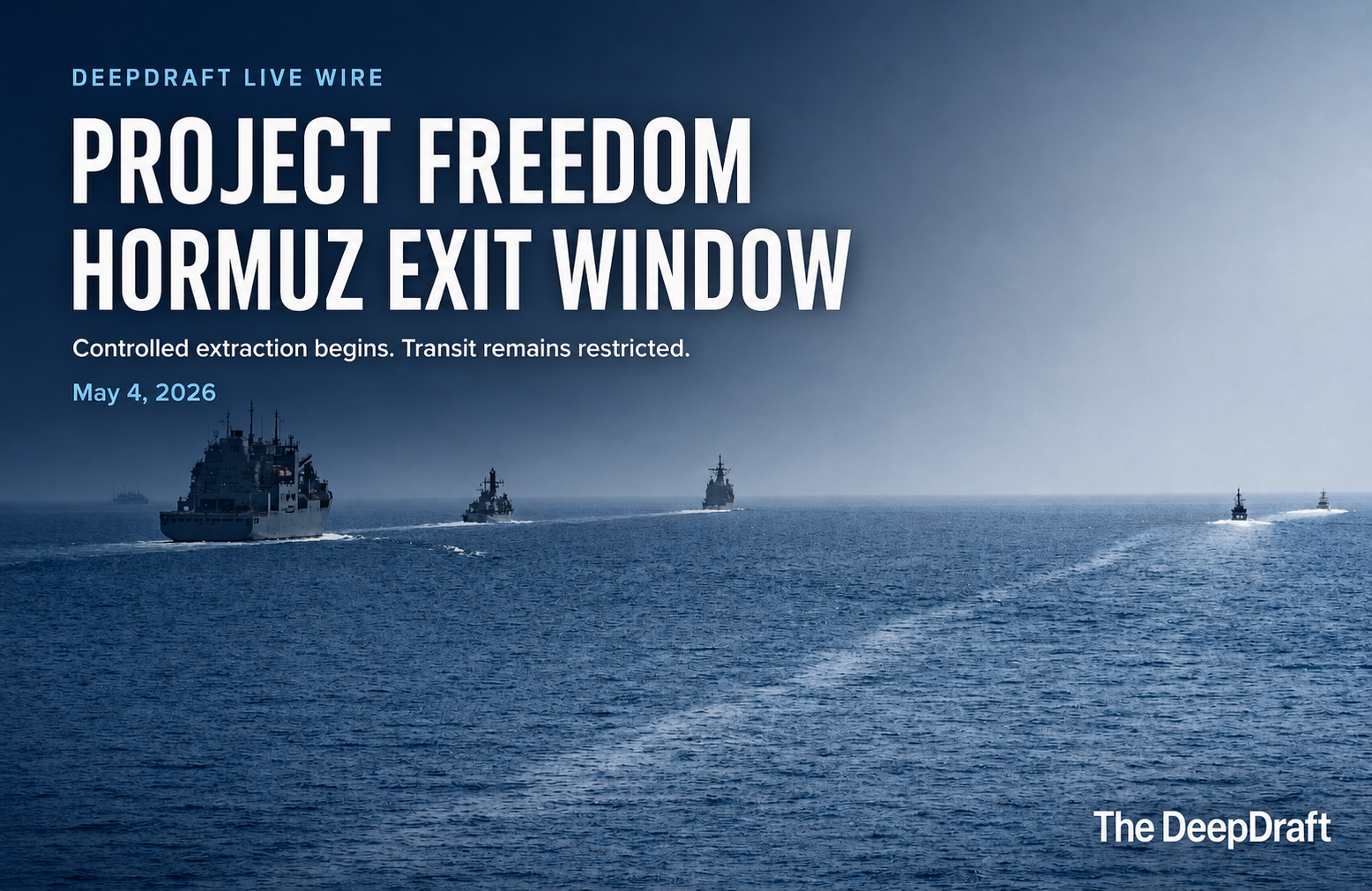
U.S.-led extraction of stranded neutral vessels begins today under Project Freedom, but the Strait of Hormuz has not reopened as a normal commercial corridor. The operating signal is controlled exit, not restored passage.
1. Project Freedom: Controlled Exit, Not Corridor Reopening
• The U.S. is moving into a guided extraction phase for stranded commercial vessels inside the Persian Gulf / Strait of Hormuz system.
• The mission targets neutral and innocent ships caught behind blockade conditions since late February.
• Commercial vessels are not resuming normal independent passage. They are being extracted under military coordination.
• The declared termination of hostilities does not remove the live maritime threat picture.
• Small-craft activity, inspection ambiguity, mine uncertainty, war-risk exposure, sanctions risk, and command-chain confusion remain active operational variables.
• Vessels escorted out should be treated as cleared for exit only, not as evidence that unrestricted Gulf trading has resumed.
2. Tactical Trigger: Small-Craft Incident Near Sirik
• The immediate risk marker is the 3 May small-craft incident west of Sirik, Iran.
• A northbound cargo vessel reported an attack or approach by multiple small craft near the Strait of Hormuz.
• Iran described the same event as a document check.
• That ambiguity is operationally significant.
• For the bridge, the problem is not the political label. It is that inspection, coercion, interdiction, and attack can appear the same until the situation has already developed.
• Masters should treat any small-craft approach inside the Hormuz operating area as a controlled-risk event requiring disciplined reporting, bridge-team readiness, and strict adherence to verified movement instructions.
3. Compliance and Regulatory Pressure: Safe Passage, CII, and MEPC 84
• OFAC has warned that Iranian demands for Strait of Hormuz safe-passage “toll” payments may create sanctions exposure.
• That risk applies whether payment is made through fiat currency, digital assets, offsets, informal swaps, third-party intermediaries, or in-kind arrangements.
• Any informal clearance, facilitation, toll, guarantee, donation, or third-party payment linked to Hormuz passage should be treated as a sanctions issue before action.
• MEPC 84 adds a second pressure layer for operators already dealing with disruption, diversion, and loitering.
• The new North-East Atlantic Emission Control Area expands NOx, SOx, and particulate matter compliance exposure.
• Ballast Water Management enforcement is moving beyond installation checks toward proof that systems are operating, maintained, and achieving D-2 standards.
• No confirmed Cape-detour carbon credit has been agreed that removes the operational CII impact of war-driven rerouting and loitering.
Strategic Summary (For Masters & Ship Managers)
• Project Freedom is an extraction operation, not a corridor reset.
• The Sirik small-craft incident confirms the tactical threat remains active.
• Iranian inspection claims and attack reports now occupy the same operating space.
• Gulf movements should remain under controlled-risk procedures until traffic density, threat advisories, war-risk pricing, and port rotation confidence normalize.
• Owners and operators should verify movement authority, convoy or guidance instructions, reporting chain, communications plan, insurance alignment, charter-party consequences, and sanctions exposure before committing to any Hormuz movement.
Operational Status
• CRITICAL RED – EXIT WINDOW ACTIVE / SMALL-CRAFT THREAT CONFIRMED / TRANSIT NORMALIZATION NOT ESTABLISHED / SANCTIONS RISK ATTACHED TO SAFE-PASSAGE PAYMENTS
DeepDraft Update
Weekly Insight: https://thedeepdraft.com/2026/04/27/vdes-and-ais-what-actually-changes-on-the-bridge/
Sources
Reuters, Associated Press, UKMTO, JMIC, U.S. Treasury / OFAC, Lloyd’s Register, IMO, The DeepDraft
This update is part of the DeepDraft Live Wire series covering developing maritime operational situations.




Leave a Reply