
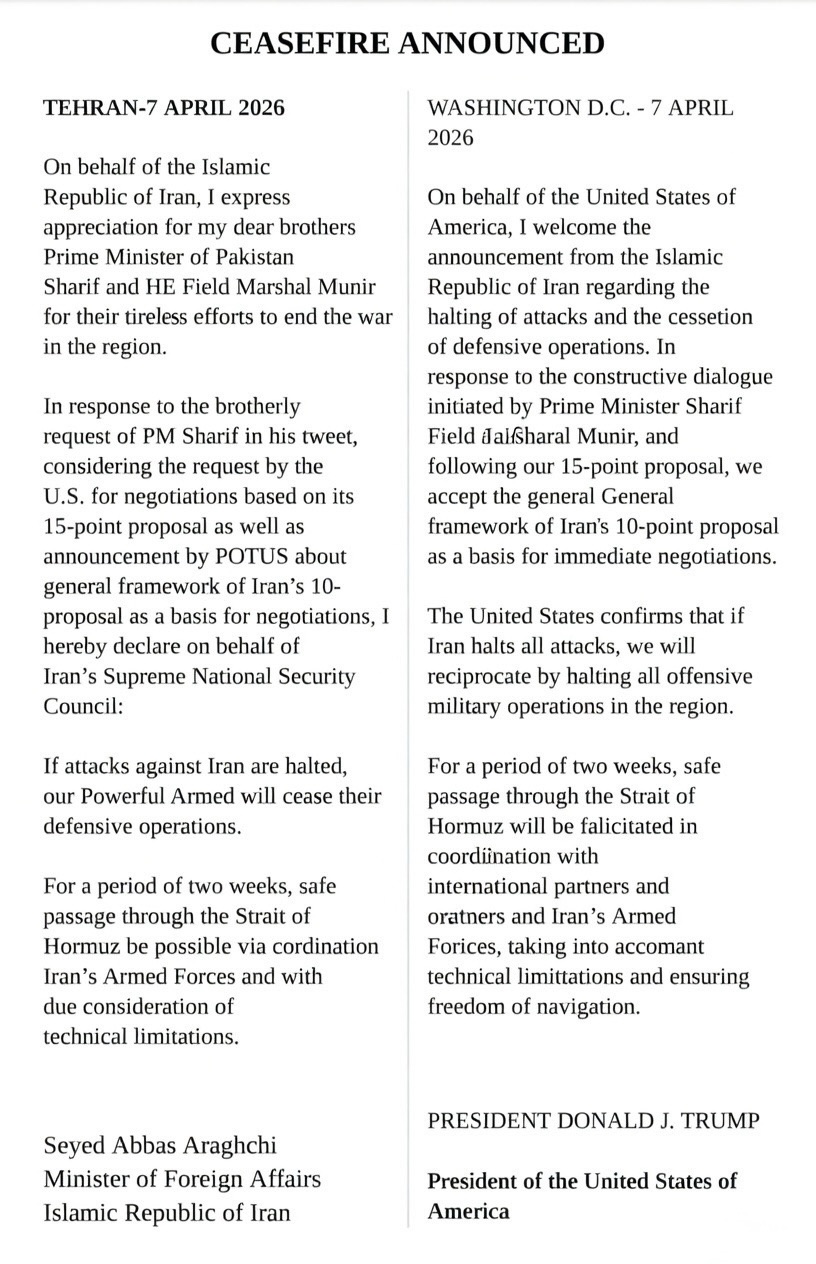
The maritime system has shifted from near-total kinetic disruption to a mediated de-escalation phase, with Iran confirming a limited-duration safe passage window through the Strait of Hormuz under coordinated conditions.
1. Kinetic Risk: Pakistan-Mediated Ceasefire.
– Iran has declared a 14-day safe passage window through the Strait of Hormuz.
– Transit is conditional and requires coordination with Iranian Armed Forces.
– Policy does not constitute full reopening; access remains controlled.
– Ceasefire is contingent on halt of attacks on Iranian territory and infrastructure.
– Agreement brokered through intervention by Pakistan PM Shehbaz Sharif and military leadership.
– Planned US strike campaign targeting infrastructure has been deferred.
2. Strategic Framework: Islamabad Negotiation Track.
– Formal negotiations scheduled to begin April 10 in Islamabad.
– Iran’s 10-point framework includes enrichment recognition and proposed $2 million transit fee per vessel.
– US 15-point framework focused on route reopening and regional stabilization guarantees.
– No alignment yet on enforcement or verification mechanisms.
– Current ceasefire assessed as transitional, not structural resolution.
3. Market Reaction: Price Correction and Transit Surge.
– Brent crude corrected from $113 peak to approximately $102–$105 per barrel.
– Market volatility reduced but remains sensitive to negotiation outcomes.
– Surge in transit requests expected as vessels attempt Hormuz re-entry.
– Coordination protocols likely to create queuing and transit delays.
– War Risk Surcharges expected to remain elevated until stability is validated.
4. Operational Adjustment: Controlled Passage Protocol.
– Vessels required to coordinate with regional VTS and Iranian authorities prior transit.
– Technical compliance conditions expected under “safe passage” framework.
– Potential clearance for salvage operations at Ras Laffan UXO site.
– LNG lifting disruption may begin partial normalization if access granted.
– Elevated risk of localized or non-state disruptions remains during transition phase.
Strategic Summary (For Masters & Ship Managers).
– Treat Hormuz transit as a controlled-access corridor, not a free navigation route.
– Do not initiate passage without confirmed coordination through flag state and regional channels.
– Expect congestion and sequencing delays under controlled transit protocols.
– Maintain elevated bridge vigilance despite ceasefire conditions.
– Align voyage planning with short-term window risk rather than structural reopening.
Operational / Market Status: AMBER – Hormuz: 14-Day Controlled Passage / Brent: $105 / Islamabad Talks: Pending (April 10).
DeepDraft Analysis (This Week):
GNSS interference and INS as a navigation fallback.
Sources: Iranian MFA (Seyed Abbas Araghchi), Pakistan PMO, Reuters, The Indian Express (April 8, 2026).
This update is part of the DeepDraft Live Wire series covering developing maritime operational situations.




Leave a Reply