
The maritime conflict triggered by the Gulf escalation has expanded well beyond the Strait of Hormuz. As of 5 March 2026, maritime security advisories, international media reporting, and regional authorities confirm incidents stretching from the Mediterranean to the Indian Ocean, while tightening war-risk insurance conditions are rapidly constraining commercial shipping in the Persian Gulf.
1. Mediterranean Escalation: Russian LNG Carrier Arctic Metagaz Destroyed
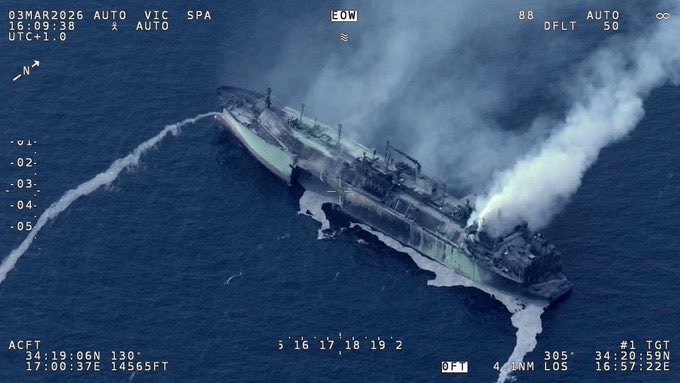
Maritime and international media reporting indicate the Russian-flagged LNG carrier Arctic Metagaz was destroyed following a drone strike in the central Mediterranean between Libya and Malta.
• Strike: Multiple unmanned aerial and naval drones reportedly struck the vessel, causing a catastrophic hull breach and fire.
• Cargo: The vessel was carrying approximately 61,000 tonnes of LNG at the time of the attack.
• Signal: The incident marks one of the first confirmed attacks on a Russian LNG vessel in international waters, significantly widening the maritime risk envelope beyond the Black Sea theatre.
2. Indian Ocean Theatre: Iranian Frigate IRIS Dena Incident off Sri Lanka
The crisis has extended into the Indian Ocean sea lanes south of Sri Lanka.
• Incident: The Iranian Navy frigate IRIS Dena was involved in a major naval incident south of Sri Lanka on 4 March.
• Casualties: 78 survivors were rescued, while more than 100 personnel remain missing, according to rescue reporting linked to Sri Lankan authorities.
• Rescue Operations: The Sri Lanka Navy conducted search-and-rescue operations, recovering survivors from the water.
The event confirms that naval activity related to the Gulf conflict is now affecting major Indo-Pacific shipping corridors.
3. Hormuz Incident: Container Ship Safeen Prestige Struck
A commercial shipping incident has been reported near the Strait of Hormuz approaches.
• Vessel: Container ship Safeen Prestige (1,740 TEU).
• Location: Approximately 2 nautical miles off the Omani coast.
• Damage: A projectile strike triggered an engine-room fire, forcing the crew to abandon ship.
• Status: All crew members were rescued.
The incident underscores that commercial vessels remain exposed to direct kinetic risk in the Hormuz approaches.
4. Strategic Energy Infrastructure Under Pressure
Energy infrastructure across the Gulf continues to face operational disruption.
• Ras Tanura: Saudi Aramco has halted operations at the Ras Tanura refinery and loading terminal following fires linked to intercepted drones earlier in the escalation.
• Tanker Security Program vessels: Stena Imperative and Stena Enterprise, both linked to the U.S. Tanker Security Program, remain non-operational following earlier strikes and security incidents in Gulf waters.
5. War-Risk Insurance Shock
The operational choke point is now shifting from missiles to insurance availability.
Major marine insurers including Gard, Skuld, and NorthStandard have issued war-risk cancellation notices and premium surges for voyages entering the Persian Gulf and Gulf of Oman.
• War-risk premiums are reportedly reaching 1–2% of hull value.
• Tanker and container operators are holding outside the Gulf awaiting insurance confirmation.
Insurance availability is rapidly becoming the primary constraint on Gulf shipping operations.
6. LNG Shock: QatarEnergy Halts LNG Production
QatarEnergy has issued a notice halting LNG production at its export terminals amid the regional security escalation.
• Operational Move: LNG loading operations have been suspended pending security assessments.
• Market Impact: Qatar accounts for roughly 20% of global LNG exports, meaning prolonged disruption could immediately tighten global gas supply.
Why It Matters for Maritime
The crisis has evolved into a multi-theatre maritime disruption.
• Hormuz: Transit reliability remains severely compromised.
• Indian Ocean: Naval incidents are appearing along major East-West sea lanes.
• Mediterranean: Energy shipping linked to sanctions regimes is increasingly exposed.
• Insurance markets: War-risk cover is becoming the decisive operational bottleneck.
• Global gas supply: Qatar’s LNG halt introduces a second energy shock alongside crude disruptions.
Operational Status:
CRITICAL / EXPANDING GLOBAL MARITIME SECURITY CRISIS
Sources:
Reuters / UKMTO / Lloyd’s List / Seatrade Maritime / Sri Lanka rescue reporting / energy sector reporting (5 March 2026)



Leave a Reply