
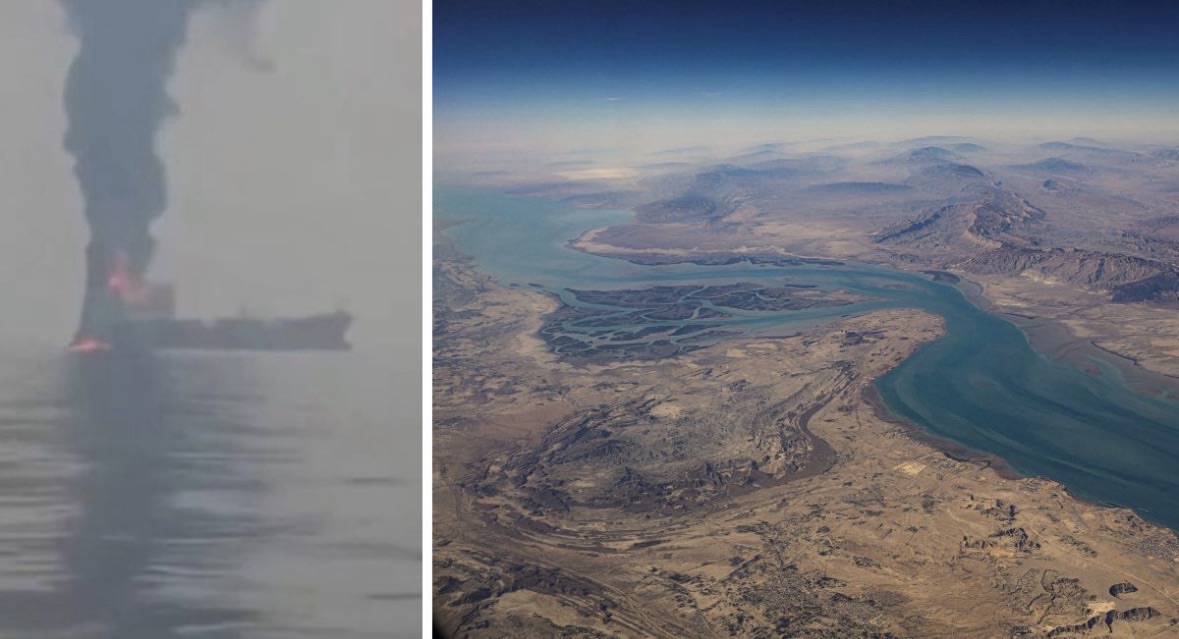
The transition from regional tension to high-intensity maritime warfare is complete. Following the Feb 28 U.S.-Israeli strikes on Iran, the world’s most vital energy corridor is effectively severed, with “safe harbors” across the Persian Gulf now designated as active combat zones.
1. Kinetic Supremacy: US Destroys Iranian “Hormuz Flotilla”
U.S. Central Command (CENTCOM) has confirmed the total destruction of 11 Iranian naval vessels in the Gulf of Oman during “Operation Epic Fury.” Declassified footage and satellite imagery confirm the sinking of the drone carrier IRIS Shahid Bagheri and the frigate IRIS Jamaran. CENTCOM has officially declared the Gulf of Oman a “Maritime Warning Zone,” asserting de facto sea control while warning of persistent asymmetric threats.
2. Direct Targeting: US-Flagged Stena Imperative and Stena Enterprise Hit
The Iranian Revolutionary Guard Corps (IRGC) has specifically targeted the U.S. Tanker Security Program (TSP) to disrupt military fuel chains.
• Stena Imperative (IMO 9666077): Struck by two aerial projectiles while berthed at Mina Sulman, Bahrain on March 2. The vessel suffered significant fire damage; while the crew survived, one shoreside shipyard worker was killed.
• Stena Enterprise (IMO 9734123): Also targeted in a coordinated drone swarm. This confirmed strike on a second U.S.-flagged TSP vessel demonstrates a deliberate Iranian strategy to eliminate U.S. sovereign logistical reach in the Gulf.
3. Infrastructure Paralysis: Ras Tanura Refinery and Terminal Shutdown
Saudi Aramco has shuttered the Ras Tanura refinery (550,000 bpd) and its offshore loading terminal following fires caused by debris from intercepted Iranian drones. This “precautionary” total shutdown removes 16% of the Kingdom’s refining capacity and the world’s largest oil export hub from the global market indefinitely, triggering a massive supply-side shock.
4. Human Cost: First Merchant Seafarer Fatality on MKD Vyom
V.Ships Asia and the Embassy of India have confirmed the conflict’s first merchant seafarer casualty. An Indian national was killed in the engine room of the Marshall Islands-flagged MKD Vyom (IMO 9284386) following a drone boat (USV) strike off Muscat on March 1. The vessel remains adrift 50NM off the coast as a major navigational hazard.
5. Insurance “Blackout”: Withdrawal of War Risk Cover
Effective 00:01 GMT, March 5, 2026, seven of the twelve major P&I Clubs (including Gard, Skuld, and NorthStandard) will officially withdraw War Risk cover for the Persian Gulf and Gulf of Oman. This move makes commercial transit legally and economically non-viable for the independent fleet, as any remaining specialist cover has surged to 1% of hull value.
Operational Impact & Present Status
We are facing a Dual-Chokepoint Crisis. With the Strait of Hormuz effectively closed (150+ tankers currently stranded) and the Red Sea under renewed Houthi threat, the Cape of Good Hope has become the only mandatory route for East-West trade.
• Transit Impact: Adds 10–14 days to global schedules.
• Cost Impact: Triggers $3,500+ Emergency Surcharges per container.
• Oil Impact: Brent Crude has spiked to $82/barrel, with volatility expected to increase as long-term blockage sets in.
Operational Status: CRITICAL / TOTAL SYSTEMIC DISRUPTION
Sources: US CENTCOM / UKMTO / Saudi Aramco / GIC Re / Argus Media / Lloyd’s List (March 3, 2026)




Leave a Reply