
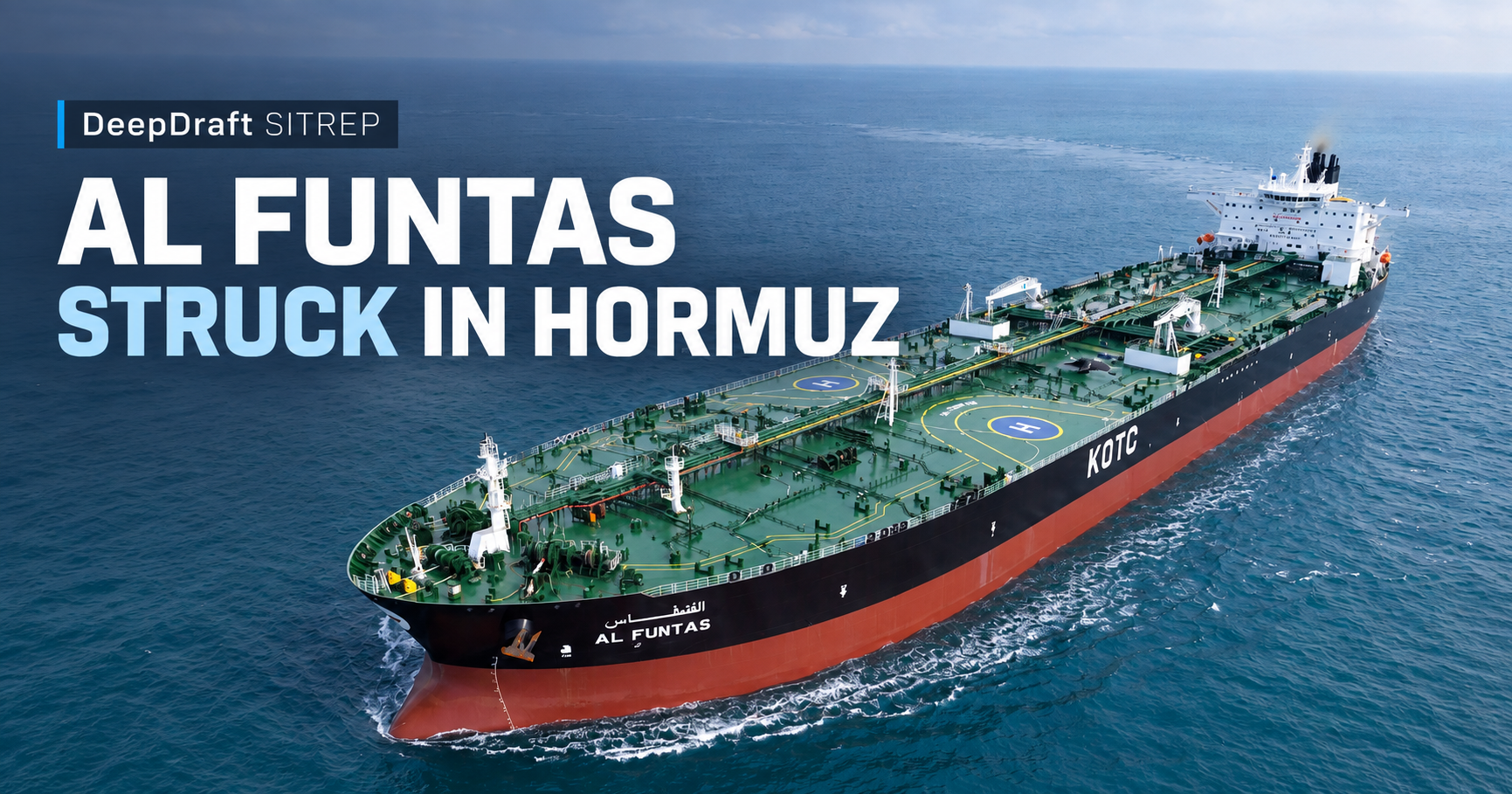
Kuwait Oil Tanker Company-managed VLCC AL FUNTAS was struck by a suspected projectile during a Strait of Hormuz transit, triggering an onboard fire before the vessel continued toward a port of refuge.
The same reporting cycle brought a fatal Somali piracy rescue and fresh fuel-routing shifts through Syria and Saudi Arabia’s Red Sea coast.
1. AL FUNTAS Projectile Strike Resets Hormuz Vessel-Level Risk
• Kuwait Oil Tanker Company-managed VLCC AL FUNTAS, IMO 9653408, was struck by a suspected projectile while transiting the Strait of Hormuz north of Khasab, Oman.
• The incident occurred late September 28 and was reported on September 29, placing a named Kuwaiti VLCC at the centre of the latest vessel-level Hormuz security event.
• The impact caused an onboard fire. Reporting said the fire was extinguished, all crew were safe and no environmental impact was reported.
• The vessel remained underway toward a port of refuge rather than becoming disabled inside the chokepoint.
• The casualty reinforces that physical passage through Hormuz does not remove projectile, fire, crew-safety, war-risk or voyage-authorization exposure.
2. MT HONOUR 25 Recovered After Five Crew Killed
• Puntland security forces recovered the Palau-flagged petroleum-products tanker MT HONOUR 25, which had been held by Somali pirates since April 21.
• The tanker was seized approximately 30 nautical miles off Puntland with 17 crew members aboard, including 10 Pakistani nationals.
• Puntland’s information ministry said pirates killed five crew members before the rescue operation: three Pakistanis, one Indian national and one Myanmar national.
• Four additional crew members were reported injured, while Puntland said 16 pirates were captured.
• The recovery follows another recent Puntland counter-piracy operation involving tanker SIBU 1, keeping Somali Basin and Gulf of Aden piracy preparedness operationally relevant.
3. Iraq Opens Baniyas Gasoline Route Around Hormuz
• Iraq has begun importing gasoline through Syria’s Mediterranean port of Baniyas as an alternative to fuel movements constrained by the Strait of Hormuz.
• The arrangement is reported as a three-month deal involving Qatari conglomerate UCC.
• Gasoline arriving at Baniyas is being transferred overland toward Iraq through the al-Tanf corridor.
• Syrian officials have indicated an objective of moving up to 200 fuel tanker trucks per day through the route.
• The development converts Baniyas from a contingency option into an active fuel-supply corridor, adding Mediterranean port, trucking, customs and inland-interface requirements to Iraqi fuel logistics.
4. Yanbu Loadings Resume as Saudi Red Sea Export Capacity Recovers
• Saudi Arabia has resumed crude and refined-product loadings at Yanbu following the restart of the East-West Pipeline.
• Pipeline operations resumed on September 22 after disruption following the September 11 drone attack.
• Tankers were reported loading nearly 10 million barrels at Yanbu and nearby Al Muajjiz as western export flows rebuilt.
• Current pipeline throughput has been estimated at approximately 2 million to 2.65 million barrels per day, with expectations that flows could rise toward 3 million to 4 million bpd.
• The recovery restores additional Red Sea export capacity, but throughput remains below the approximately 5.5 million bpd level reported before the September disruption.
Strategic Summary & Actions Required
• Masters conducting Hormuz transits should reinforce bridge, security, fire and damage-control readiness and preserve AIS, ECDIS, radar, VDR and communications records following any projectile, drone or military-contact event.
• DPA, CSO, insurance and operations teams should revalidate war-risk approval, routing instructions, emergency-port options and casualty-notification procedures before committing Gulf voyages.
• Charterers should separate physical availability of Hormuz passage from vessel-specific security exposure and review deviation, off-hire, laycan, delay and additional-premium consequences.
• Operators using the new Baniyas fuel corridor should verify port acceptance, inland transfer arrangements, insurance, documentation and cargo-custody interfaces across the Syrian-Iraqi route.
• Tanker and crude desks should track Yanbu loading schedules, East-West Pipeline throughput and Red Sea tonnage availability as Saudi western export capacity continues to rebuild.
Operational Status
CRITICAL RED — Hormuz Projectile Strike / Active VLCC Security Exposure / Alternative Fuel Routing / War-Risk and Voyage Authorization Pressure
Latest DeepDraft Analysis
Rumpon and Rope: Indonesia’s Hidden Propeller Fouling Hazard
Large thermocol fishing floats can hide submerged rope capable of fouling propellers during low-speed or drifting operations off Indonesia, creating a serious propulsion and maneuvering hazard.
Sources
UKMTO, Lloyd’s List, Reuters, Associated Press, The DeepDraft
This update is part of the DeepDraft SITREP series covering developing maritime operational situations.



Leave a Reply