
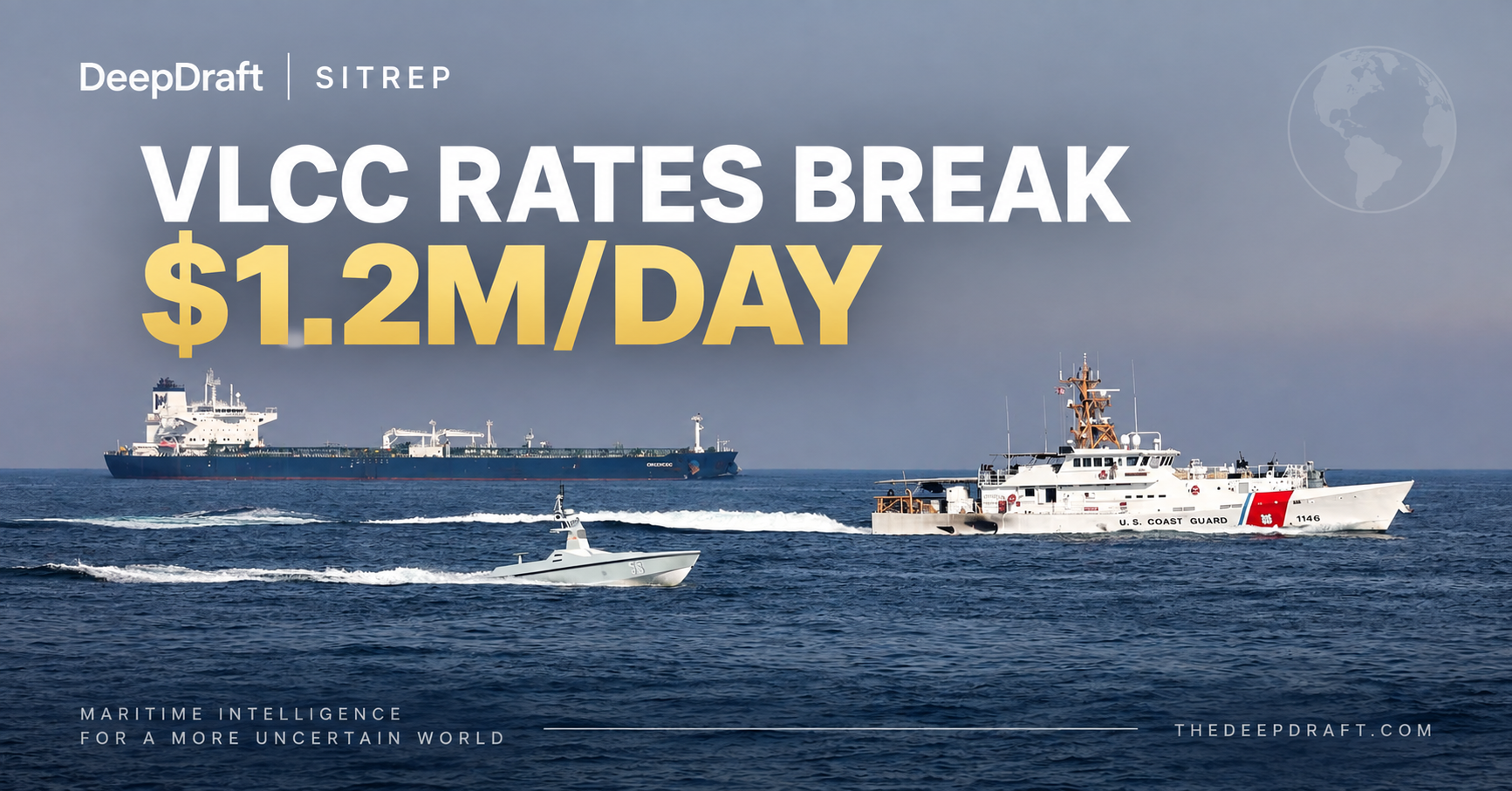
VLCC spot earnings have broken through $1.2 million/day as Hormuz disruption forces more ships into inefficient shuttle and STS trading patterns.
The freight spike is now changing fixture economics even as crude movements through the Gulf partially recover.
1. VLCC Earnings Break $1.2 Million/Day
• Gibson Shipbrokers reports TD3C earnings above $1.2 million/day, TD34 above $750,000/day, and TD22 around $400,000/day on an eco basis.
• The latest move materially exceeds DeepDraft’s September 19 marker of $870,947/day, confirming that the tanker market has moved into a new pricing range rather than simply holding an already elevated level.
• Gibson attributes the surge primarily to geopolitical disruption, restricted efficient vessel supply and the additional tonnage required to move barrels through fragmented Gulf trading patterns.
• Exceptionally high VLCC pricing is already pushing some demand toward Suezmaxes, creating a direct vessel-class substitution signal for charterers and cargo interests.
2. Hormuz Shuttle Trades Increase Vessel Demand Despite Lower Absolute Flows
• Gibson estimates Middle East crude and dirty-product exports have recovered by about 3.67 million bpd from the March to May average, although volumes remain below pre-war levels.
• Mainstream crude is increasingly moving through Hormuz aboard shuttle vessels before being transferred by STS in the wider Gulf of Oman onto other tonnage for onward voyages, particularly toward Asia.
• The combined VLCC count across the Arabian Gulf and Gulf of Oman has recently exceeded regional vessel supply seen before the war in January and February. Gibson says disruption is therefore requiring more ships to move fewer absolute barrels.
• AIS-based measurement remains incomplete because some vessels transit with AIS switched off for security reasons, making public traffic counts an imperfect measure of actual physical flow.
3. Mine Clearance Improves Passage Capacity but Does Not Restore Normal Economics
• U.S. Central Command commander Adm. Brad Cooper said oil, LNG and cargo movements through Hormuz during the previous two weeks were higher than at any point in the previous six months.
• Cooper said the Strait’s primary transit lanes were clear of mines and credited naval protection and mine-clearance operations with supporting higher cargo movement. This remains a U.S. military assessment rather than evidence that commercial passage conditions have fully normalized.
• The operating contradiction is significant: more cargo can move through the Strait while freight remains extreme because convoying, shuttle voyages, STS transfers, AIS-dark passages and security constraints consume additional vessel capacity.
• Gibson also reports that disruption around Saudi export routes has pushed VLCC supply in the eastern Mediterranean to nearly 30 vessels, while the latest East-West pipeline disruption may temporarily reduce Yanbu loadings and alter tonne-mile demand.
4. Iran Claims U.S. Reconnaissance Drone Destroyed Over Hormuz
• Iran’s Army said on September 20 that its air-defence systems intercepted and destroyed an advanced U.S. Orbiter reconnaissance drone over the Strait of Hormuz.
• IRNA said the interception was carried out by air-defence units in southeastern Iran operating within the country’s integrated air-defence network.
• The claim has not been independently confirmed by a U.S. military statement located during DeepDraft’s verification checks and should therefore be treated as an Iranian military claim rather than an established bilateral incident.
• For merchant vessels, the report reinforces the presence of active military surveillance and air-defence activity around the Strait at the same time commercial traffic is being encouraged through cleared transit lanes.
Strategic Summary & Actions Required
• Charterers and operators should reprice Gulf VLCC fixtures against the new $1.2 million/day TD3C environment and test whether Suezmax substitution, alternate loading regions or different voyage structures reduce total delivered cost.
• Owners should evaluate vessel availability across the Arabian Gulf, Gulf of Oman and eastern Mediterranean as one connected supply pool because shuttle and STS patterns are locking tonnage into additional voyage legs.
• Masters undertaking Hormuz passages should obtain current navigational and security instructions directly from competent authorities and record any AIS restriction, routing instruction or security-driven deviation in the vessel’s operational record.
• Ship managers, insurers and chartering desks should not interpret increased Hormuz cargo movement as a return to normal voyage economics. Passage capacity has improved while security exposure, vessel inefficiency and freight remain exceptional.
• STS plans outside the Gulf should be reviewed for compatibility, weather limits, sanctions screening, insurance approval, mooring arrangements and evidence preservation before shuttle cargoes are transferred to onward tonnage.
Operational Status
RED — Record VLCC Freight / Partial Hormuz Flow Recovery / Shuttle and STS Tonnage Inefficiency / Elevated Security and Voyage-Cost Exposure
Latest DeepDraft Analysis
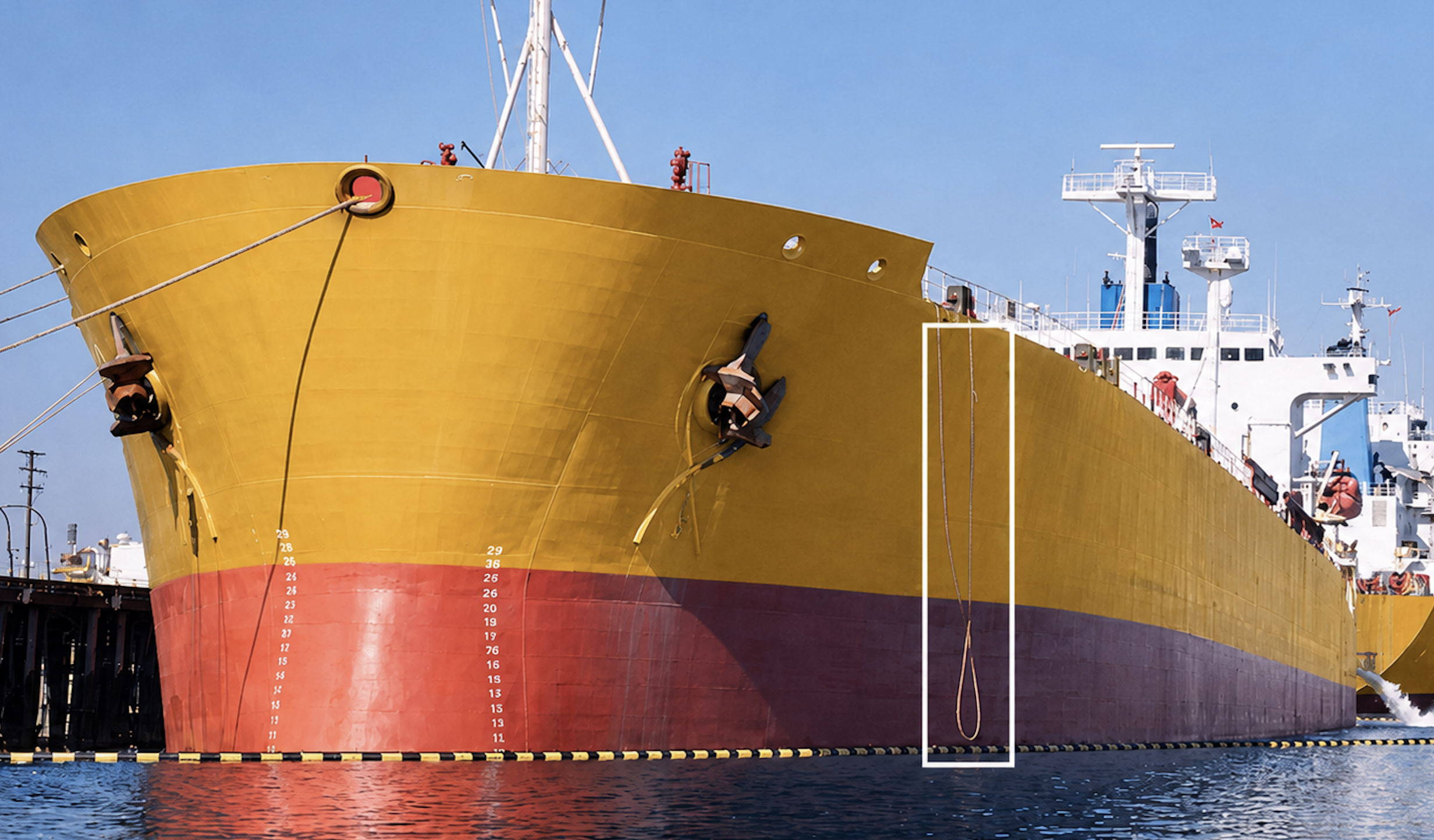
The Deck Seal That Looked Wet
A misidentified tanker deck water seal can turn an HVPQ error into SIRE 2.0 vetting exposure when officers cannot explain the fitted safety barrier’s actual operating principle.
Sources
Gibson Shipbrokers, Hellenic Shipping News Worldwide, U.S. Central Command via Bloomberg/World Oil, IRNA, The DeepDraft
This update is part of the DeepDraft SITREP series covering developing maritime operational situations.



Leave a Reply