
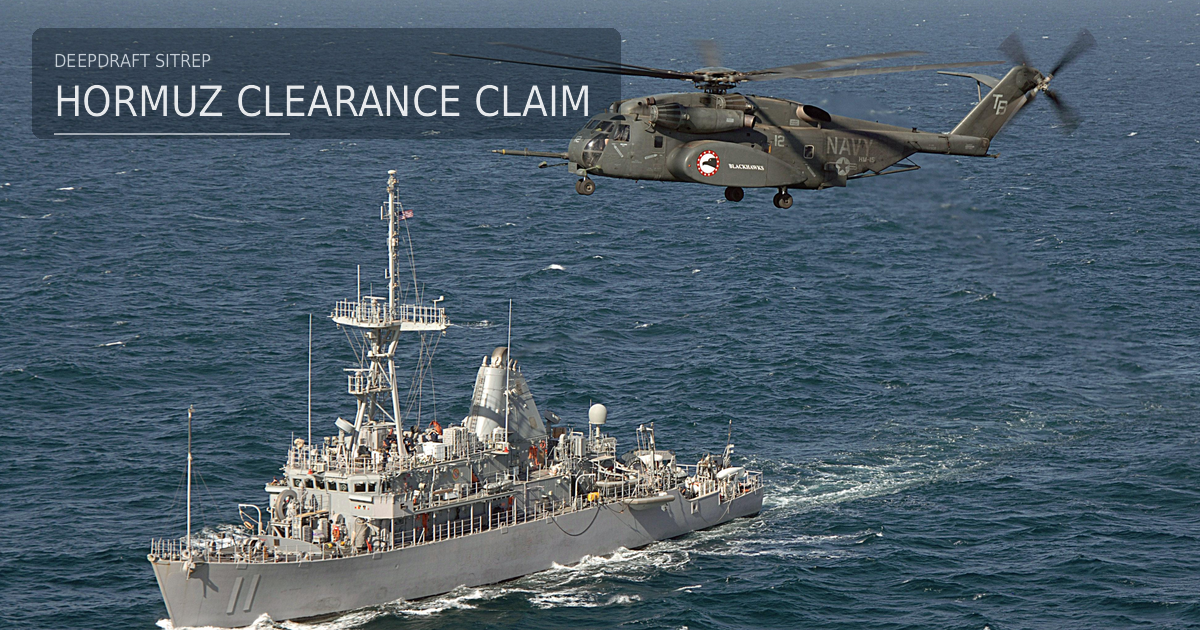
President Trump says the U.S. Navy controls the Strait of Hormuz and has mine-swept the waterway.
For operators, the fresh change is not a confirmed return to normal passage. It is a political opening claim colliding with severe-level maritime guidance, energy transport controls and a widening Oman spill case.
1. Trump Claims U.S. Control of Hormuz After Mine-Sweeping Operation
• President Trump said on August 10 that the United States controls the Strait of Hormuz and that the U.S. Navy has “mine-swept the entire strait.”
• He said the strait is open to vessels not bound for Iranian ports, while Iranian-port traffic remains excluded under the U.S. blockade position.
• The claim creates a fresh operational signal because it may be treated by markets, charterers and some political desks as a reopening marker.
• Maritime operators should not treat the statement alone as a navigational all-clear until NAVCENT, UKMTO, JMIC, flag state, insurer and company route authorities align.
2. JMIC Still Rates Strait of Hormuz Severe
• JMIC Update 082, dated August 9, kept the Strait of Hormuz threat level at SEVERE.
• The advisory said commercial traffic remained reduced, with single-digit tanker numbers in both directions during the reporting period.
• JMIC reported persistent IRGC hailing, UAV overflight, targeted surveillance of merchant shipping and kinetic activity on the southern Omani approaches.
• The same advisory said mine danger areas remained active, drifting or uncharted mine risk continued in and near the TSS, and clearance and mine-surveying operations were still continuing.
• MARAD’s standing U.S. advisory continues to warn that risks of Iranian attacks against commercial shipping remain high in the Persian Gulf, Strait of Hormuz and Gulf of Oman.
3. Energy Transport Pressure Moves Into Jones Act and Oil Pricing
• The White House extended the Jones Act waiver for another 90 days, allowing foreign-flagged vessels to move oil and other commodities between U.S. ports under narrowed terms.
• Reuters reported the extension now requires case-by-case review of individual voyages rather than blanket exemptions.
• U.S. data cited by Reuters showed about 208 Jones Act exemptions had been used in roughly four and a half months through August 3.
• The waiver extension keeps U.S. domestic fuel logistics tied directly to the Hormuz crisis, crude-flow disruption and gasoline-price pressure.
• AP reported that Iran still says it will not reopen the Strait of Hormuz until the U.S. meets conditions including ending the blockade of Iranian ports, lifting sanctions, releasing frozen assets and paying compensation for war damage.
4. Caroline Bezengi Spill Adds Shadow-Fleet Pollution and Salvage Risk
• Oman said leaking crude from the grounded tanker Caroline Bezengi has created an oil slick covering about 390 square kilometres off the Hallaniyat Islands.
• The slick extends northeast of the islands and is within an estimated seven kilometres of the coast.
• Caroline Bezengi is carrying close to one million barrels of Russian oil bound for Asia and first reported difficulty off Yemen on June 8.
• Reuters reported maritime-security sources assessed that a blast may have occurred onboard, although no party has claimed responsibility.
• The tanker is linked to Russia’s shadow fleet, lacks normal Western insurance cover, was de-listed from Cameroon’s registry in June, and is subject to sanctions by the EU, Ukraine, the UK, Canada and Switzerland.
5. Suez Return and Black Sea Constraint Complicate Route Decisions
• Maersk said another Gemini network service with Hapag-Lloyd will resume sailing through the Red Sea and Suez Canal.
• The move is part of a gradual return to the area after earlier Red Sea attacks forced many services around the Cape of Good Hope.
• Operators should treat the Suez restoration as selective route normalization, not proof that regional security exposure has disappeared.
• Black Sea and Danube-linked grain flows remain exposed to drought, river-level pressure, strike risk and terminal disruption, keeping cargo timing and demurrage exposure active on the opposite side of the energy-routing picture.
Strategic Summary & Actions Required
• Masters approaching Hormuz should not interpret political reopening language as route authority. Confirm latest NAVCENT, UKMTO, JMIC, flag, company, charterer and insurer instructions before entering the approach.
• Ship managers should preserve the distinction between mine-sweeping claims and navigational clearance. Passage approval should remain tied to verified coordinates, transit instructions, AIS policy, VHF discipline, war-risk cover and emergency deviation triggers.
• Charterers and operators should review laycan, deviation, off-hire, force majeure, demurrage and Iran-port exclusion language where Gulf cargoes are affected by the U.S. blockade or Iranian reopening conditions.
• Tanker desks should track the Jones Act waiver extension as an energy-logistics pressure valve, especially where domestic U.S. fuel movements, foreign-flag voyage approvals and crude-market volatility intersect.
• Caroline Bezengi should be treated as a pollution, sanctions, salvage and P&I exposure case, not only an environmental story. Managers handling shadow-fleet, Russia-linked or older tanker exposure should recheck casualty-response authority and insurance recoverability.
Operational Status
CRITICAL RED — Hormuz Mine-Sweeping Claim / Severe Advisory Still Active / U.S. Blockade Enforcement / Jones Act Fuel-Control Extension / Oman Shadow-Fleet Spill
Latest DeepDraft Analysis
Airborne Wind Propulsion: The Missing Manual Behind the Fuel-Saving Claim
https://thedeepdraft.com/2026/08/10/airborne-wind-propulsion-missing-manual-fuel-saving-claim/
Excerpt: Airborne kite propulsion may cut fuel use, but DeepDraft argues the real test is launch control, recovery authority, tether safety and SMS integration.
Related DeepDraft Articles & Analysis
Sources
Reuters, JMIC/UKMTO, MARAD, Associated Press, The DeepDraft
This update is part of the DeepDraft SITREP series covering developing maritime operational situations.




Leave a Reply