
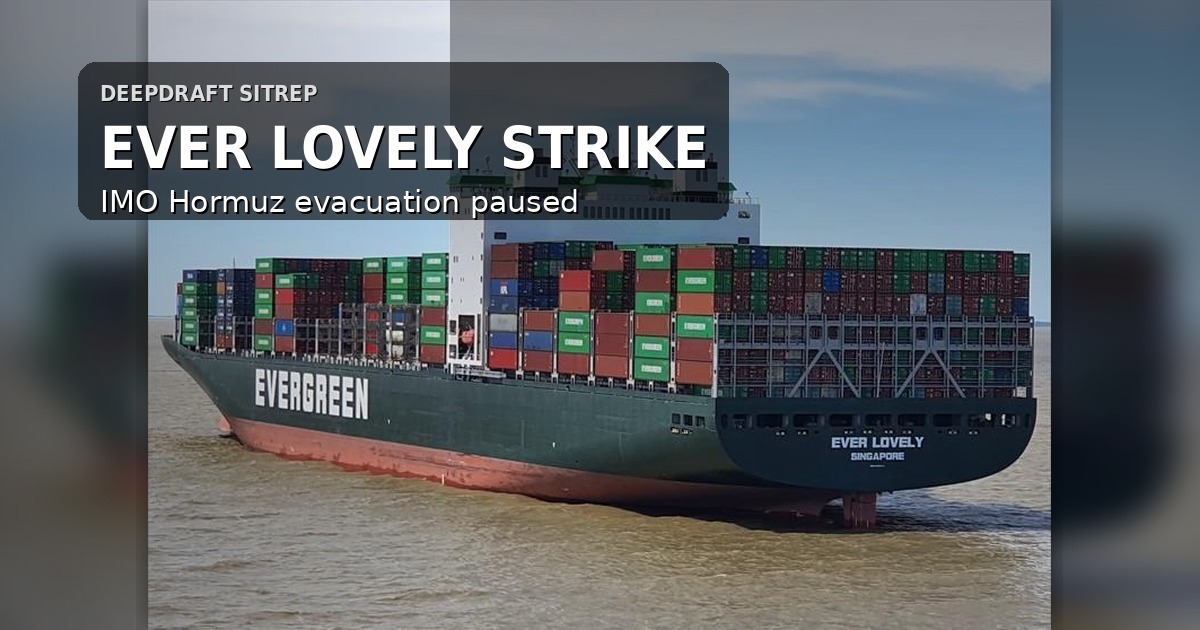
A projectile strike on Ever Lovely has paused the IMO Hormuz evacuation framework.
The same cycle produced a separate shadow-fleet detention, a PGSA liability warning, a Korea SAR case and a Charleston terminal pause.
1. Ever Lovely Strike Forces IMO Pause
• IMO temporarily paused its Strait of Hormuz evacuation operation after an attack on a vessel in the Gulf of Oman. IMO said the vessel had passed through Hormuz but was not transiting under the IMO evacuation framework.
• Reuters reported the ship was hit close to Oman by a projectile, with UKMTO carrying the attack report.
• Four sources identified the vessel as the Singapore-flagged Ever Lovely, and one security source assessed that it was likely targeted by a drone.
• IMO said the pause is intended to reconfirm that safety guarantees remain in place for listed evacuation vessels and other ships in the region.
2. France Detains Deliver in Shadow-Fleet Enforcement Push
• French forces stopped the tanker Deliver off Sicily on June 23 for inspection, with assistance from the Royal Navy and EUNAVFOR MED.
• The 150,284 dwt tanker was boarded and its documents examined; French reporting said the documentation confirmed doubts over the validity of the ship’s flag.
• The vessel was reportedly sailing from Russia’s Primorsk terminal toward Singapore and had been claiming Cameroon registry since the start of the year.
• The vessel was sanctioned by the European Union in March 2025 and listed by the United Kingdom in May 2025 for involvement in Russian oil trade.
Reading this as a maritime insider, seafarer, or enthusiast?
Subscribe to The DeepDraft for maritime analysis, daily SITREP updates, weekly briefings, and operational signals worth watching.
3. PGSA Notice Shifts Liability to Owner, Charterer and Master
• Reuters reported that Iran’s Persian Gulf Strait Authority warned vessels outside its approved routes would not be guaranteed safe passage.
• The PGSA position creates a direct conflict between IMO-coordinated evacuation routing and Iran-designated safe-passage claims.
• Masters should treat any PGSA, coastal-state or naval routing demand as a controlled communication requiring company, CSO, legal and insurer review before compliance.
• Owners and charterers should preserve written voyage instructions where route authority, war-risk cover, deviation, safe-port obligations or sanctions exposure may later be disputed.
4. Ulsan Collision Triggers SAR and LPG Tanker Investigation
• The Ulsan Coast Guard launched a search and rescue operation after the 1,300 dwt LPG carrier Gas Broadway collided with the 79-ton fishing boat Dong-A No. 3 off South Korea.
• The fishing vessel had eight crew aboard and sank quickly in waters of about 140 meters depth.
• Six crew were recovered by the LPG tanker and reported to be suffering from hypothermia.
• Two Indonesian crewmembers remained missing, while the South Korean captain was taken to hospital and later pronounced dead.
5. Charleston Terminal Pause Adds U.S. Port-Rotation Risk
• South Carolina Ports will temporarily pause operations at Charleston’s Hugh K. Leatherman Terminal from August 1, with activity consolidated at Wando Welch and North Charleston terminals.
• The port authority cited low volumes, high operating cost, uncertain trade outlook and tempered volumes.
• Leatherman handled 75,455 containers in the first 11 months of the fiscal year, compared with more than 1 million containers at Wando Welch.
• MSC is expected to relocate services from Leatherman, with five routes affected and one route already scheduled for suspension because of low volume.
Strategic Summary & Actions Required
• Masters in the Hormuz exit queue should not move outside confirmed instructions; preserve UKMTO, MICA, IMO, PGSA, VHF, email and company-routing records.
• Ship managers should treat Ever Lovely as a fresh voyage-risk trigger and revalidate war-risk cover, security instructions, crew exposure and abort criteria before any Gulf movement.
• Owners, charterers and legal teams should document whether route orders rely on IMO, Omani, Iranian or company authority, because liability may attach directly to unauthorized routing.
• Compliance teams should screen Russia-linked tankers for flag validity, class status, sanctions listing, AIS history and registry gaps before fixtures, STS operations or port calls.
• Operators calling Ulsan or Charleston should brief bridge teams on fishing-vessel collision exposure and update U.S. East Coast port rotations before Leatherman’s August 1 pause.
Operational Status
CRITICAL RED — Ever Lovely Strike / IMO Hormuz Evacuation Paused / PGSA Liability Warning / Shadow-Fleet Detention / Korea SAR and Charleston Port-Rotation Risk
Latest DeepDraft Analysis
The Shadow Fleet’s Human Firewall
https://thedeepdraft.com/2026/06/22/the-shadow-fleets-human-firewall/
Sanctions enforcement is reaching the bridge through flag doubt, AIS history, ownership opacity and shipboard records, making Master-level documentation central to defensible voyage authority.
Related DeepDraft Articles & Analysis
Sources
IMO, Reuters, The Maritime Executive, The DeepDraft
This update is part of the DeepDraft SITREP series covering developing maritime operational situations.

Leave a Reply