
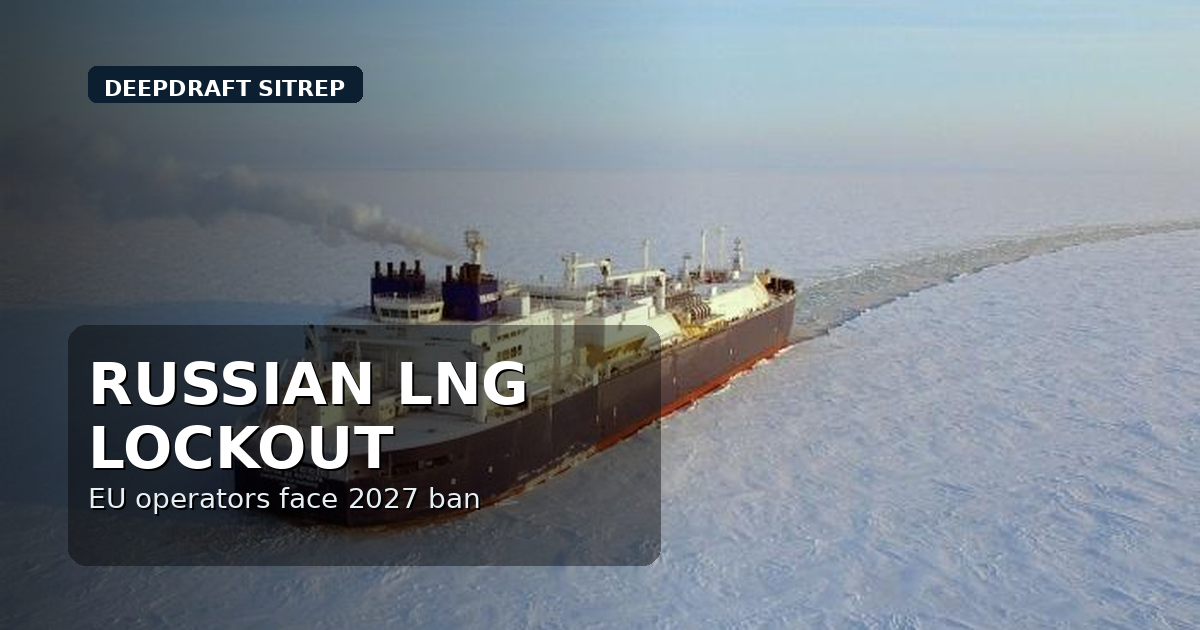
EU guidance has closed the Russian LNG trading route for EU operators from 2027.
The immediate exposure is contract review, ship employment, insurance cover and Yamal-linked cargo authority.
1. EU Russian LNG Trading Ban Becomes the Lead Compliance Signal
• The European Commission has clarified that EU-based companies will be barred from trading Russian LNG from 2027, even when the cargo is destined for non-EU buyers.
• The clarification affects Russian LNG linked to long-term Yamal contracts, including exposure for EU traders, offtakers, shipowners, charterers and insurers.
• Reuters identified TotalEnergies, SEFE and Naturgy among companies with Yamal-linked exposure, with Naturgy warning of purchase commitments valued at €10.95 billion.
• The issue is no longer only import policy. It now reaches global cargo marketing, vessel employment, contract performance, sanctions clauses and cover approval.
2. Hormuz Remains Open in Practice, But Not Normal
• Oil shipments through Hormuz have risen, but Reuters reports that questions remain over Iran’s transit terms and the recovery of normal flows.
• DeepDraft already treated Hormuz as a controlled-passage environment, so today’s operational value is the continuing confirmation that movement is possible but authority, insurance and routing remain unsettled.
• Masters and operators should not treat visible AIS movement as proof of normal navigation conditions.
• Gulf-linked voyages still require voyage-specific approval from owners, charterers, P&I, hull war insurers, CSO/DPA and cargo interests before entering the risk area.
Reading this as a maritime insider, seafarer, or enthusiast?
Subscribe to The DeepDraft for maritime analysis, daily SITREP updates, weekly briefings, and operational signals worth watching.
3. LNG, Charterparty and Insurance Exposure Moves From Policy to Contract Desk
• EU-linked Russian LNG cargoes now require contract-level review before 2027, especially where cargoes could be redirected outside Europe but still traded by EU operators.
• LNG desks should check offtake obligations, destination flexibility, substitution rights, force majeure language, sanctions clauses and termination exposure.
• Shipowners and managers should identify any Yamal-linked employment, Russian LNG fixtures, EU beneficial ownership exposure or insurance nexus before accepting cargo instructions.
• Charterers should avoid assuming that non-EU destination discharge removes the EU compliance problem if the trader, shipowner, manager, insurer or financing link remains inside EU jurisdiction.
4. AIS, GNSS and Bridge Discipline Remain a Gulf Operating Layer
• JMIC advisory material continues to identify sporadic GNSS / AIS interference across the Strait of Hormuz approaches, Gulf of Oman and Arabian Gulf.
• The operational issue is not only whether AIS is switched on. It is whether the bridge team can trust displayed positions, target data and electronic fixes.
• Masters should prepare for radar fixing, visual bearings, parallel indexing, gyro cross-checks, manual plots and ECDIS position verification before entering the Gulf approaches.
• Managers should circulate the latest UKMTO / JMIC bridge guidance and require clear reporting discipline for suspicious activity, interference, route changes and coastal-state communications.
5. Oil Market and Cargo Sourcing Signal Remains Secondary
• Brent crude rose above USD 81 per barrel after renewed U.S.-Iran friction and continuing uncertainty around Hormuz reopening.
• Indian refiners have increased Russian and UAE crude purchases as a hedge while Hormuz recovery remains uncertain, according to Kpler-linked reporting.
• The cargo effect is a hedging pattern rather than a new closure event: buyers are preserving optionality while Gulf passage, insurance and political risk remain unstable.
Strategic Summary & Actions Required
• LNG owners, traders and charterers should map every Russian LNG cargo with an EU nexus before 2027, including Yamal contracts, cargo marketing, financing, insurance and ship employment.
• Masters on Gulf-linked voyages should keep AIS and communications disciplined but navigate on verified bridge inputs, not AIS/GNSS confidence alone.
• Ship managers should issue fleet instructions covering Hormuz reporting, GNSS degradation, suspicious approach procedures and documentation of owner / charterer voyage authority.
• Chartering and legal teams should review sanctions, force majeure, deviation, off-hire, war-risk and cargo-substitution clauses for Russian LNG and Gulf-linked voyages.
• Insurers and compliance teams should treat Russian LNG trading exposure and Hormuz transit authority as separate approval gates, not one general geopolitical-risk file.
Operational Status
RED — Russian LNG Trading Ban Clarification / Hormuz Controlled Passage / AIS-GNSS Interference Layer / Contract, Insurance and Voyage Authority Review Required
Latest DeepDraft Analysis
Settebello Was Not Sacrifice. It Was a Recruitment Failure
https://thedeepdraft.com/2026/06/15/settebello-was-not-sacrifice-it-was-a-recruitment-failure/
Three Indian seafarers died on MT Settebello. The analysis turns the casualty into a recruitment, deployment, sanctions-screening and voyage-authority failure.
Related DeepDraft Articles & Analysis
Sources
Reuters, UKMTO/JMIC, The DeepDraft, Times of India, Kpler
This update is part of the DeepDraft SITREP series covering developing maritime operational situations.



Leave a Reply