
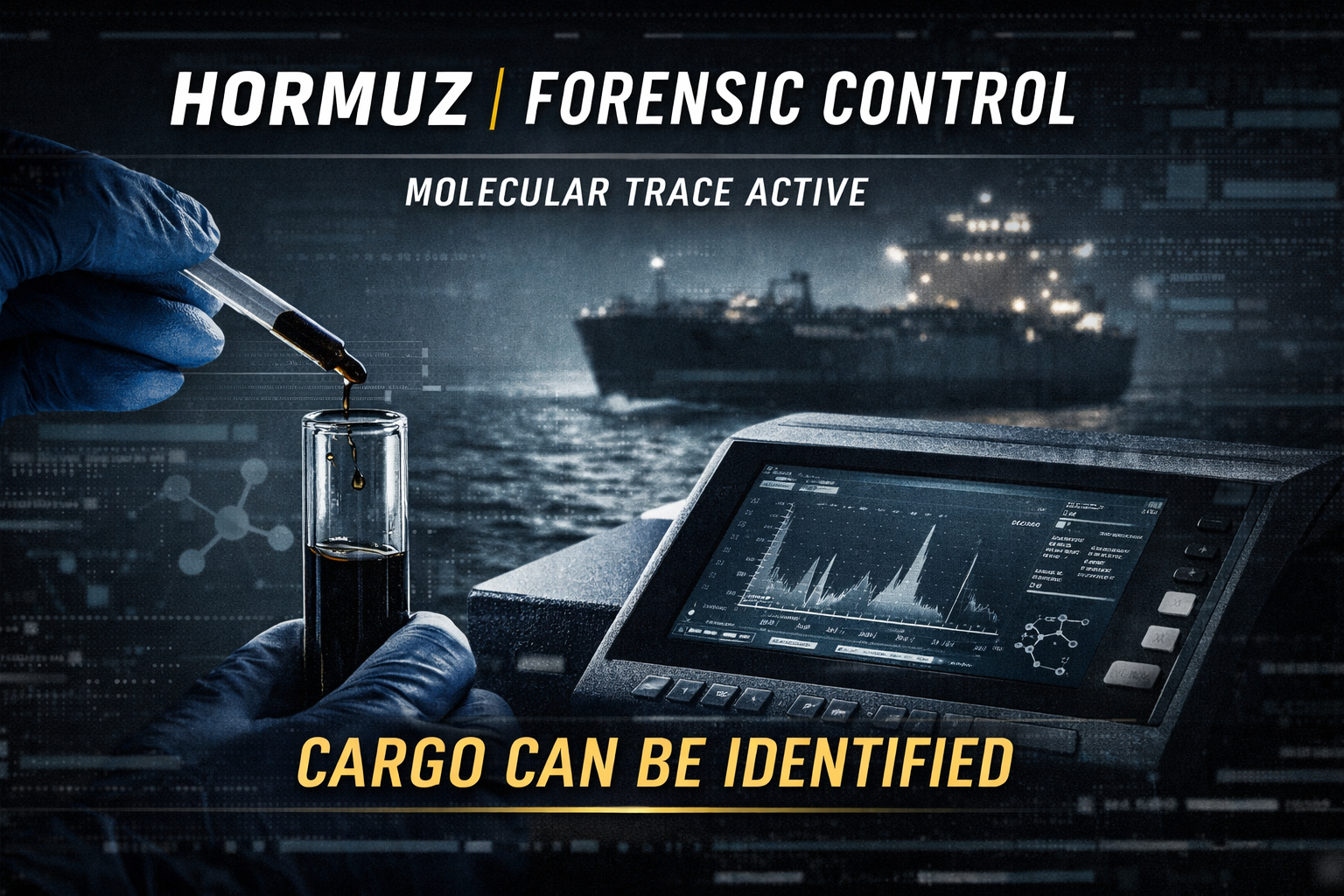
As of April 17, 2026, the Strait of Hormuz has shifted into a forensic enforcement phase, with cargo-origin verification, electronic degradation, and closure threats redefining transit risk across the Gulf.
1. Strategic Trigger: Closure Threat and Enforcement Escalation.
• Iranian command has signaled full closure of the Strait if domestic infrastructure is targeted.
• Threat positioned as countermeasure to expanding US enforcement posture.
• Current transit remains open only under controlled and vetted movement.
• Escalation risk now tied directly to land-based strike developments.
2. Enforcement Shift: DNA-Based Cargo Verification.
• US-led boarding operations now incorporating molecular cargo tracing technology.
• DNA tagging (BunkerTrace) being used to identify Iranian-origin crude within blended cargoes.
• Ship-to-ship transfer “washing” operations effectively exposed through forensic tracing.
• Vessels identified with sanctioned cargo traces being flagged for diversion or expulsion.
• Cargo contamination risk triggering force majeure across affected shipments.
3. Navigational Integrity: GNSS Timing and System Disruption.
• GNSS interference extending into timing desynchronization across bridge systems.
• Precision Time Protocol offsets impacting integrated navigation and engine automation.
• AIS ghosting and false vessel signatures increasing in Kish–Abu Musa sector.
• Digital navigation reliability degraded across key Hormuz approaches.
• Manual navigation methods required for safe transit execution.
4. Operational Impact: Corridor Access and Throughput Constraint.
• Non-Iranian corridor remains functional under full coalition vetting and documentation control.
• Transit dependent on verified cargo origin and clearance compliance.
• Vetting latency extending beyond 40 hours due to inspection and verification procedures.
• Throughput remains constrained despite partial corridor availability.
• Bunker markets tightening as “unverified origin” fuel removed from circulation.
Strategic Summary (For Masters & Ship Managers).
• Treat cargo documentation as primary compliance instrument during transit.
• Ensure full traceability of cargo origin before entering enforcement zones.
• Expect inspection delays linked to forensic verification processes.
• Operate with degraded GNSS reliability; prioritize manual navigation protocols.
• Monitor escalation signals linked to infrastructure targeting risk.
Operational / Market Status: CRITICAL RED – Hormuz: Forensic Enforcement Zone / Transit: Clearance-Dependent / Navigation: Degraded.
DeepDraft Analysis (Latest):
Hormuz routing shift, mine risk, and the cost of transit in 2026.
https://thedeepdraft.com/2026/04/13/hormuz-strait-routing-shift-mine-risk-and-the-cost-of-transit-in-2026/
Sources: US CENTCOM, Regional Maritime Advisories, Lloyd’s List Intelligence, Industry Technical Briefings (as of April 16, 2026).
This update is part of the DeepDraft Live Wire series covering developing maritime operational situations.



Leave a Reply