
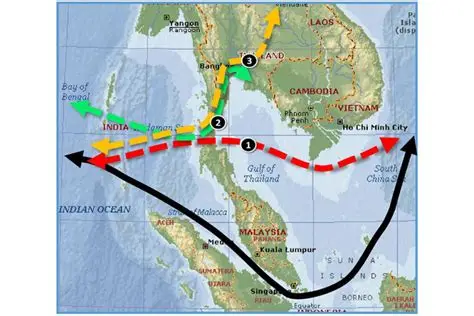
Every day, a quarter of the world’s trade squeezes through the Malacca Strait. But what if there was another way?
Thailand’s Kra Land Bridge promises a bold shortcut across the Isthmus that could reshape Asian trade.
Update, August 2026: Since this article was published in September 2025, Thailand has stepped back from the original full-scale Land Bridge proposal after a government review raised concerns over commercial viability, fiscal exposure and environmental impact. The immediate focus has shifted toward upgrading Ranong Port and completing rail and road links between Thailand’s two coasts. The larger Land Bridge concept has not been permanently abandoned and may be reconsidered if future cargo demand or geopolitical conditions justify it.
What Is the Kra Land Bridge?
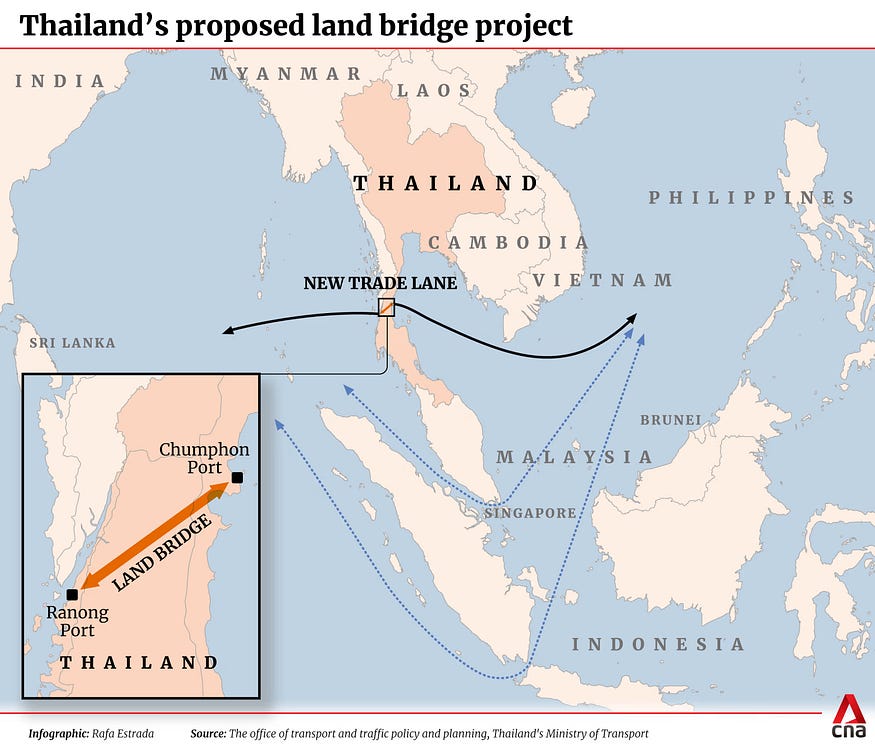
Thailand’s Kra Land Bridge (KLB) project is an ambitious and transformative infrastructure initiative that creates a direct cargo shortcut across Kra Isthmus, linking the Andaman Sea’s deep-water port at Ranong with a matching port at Chumphon on the Gulf of Thailand.
Spanning roughly 80 to 120 kilometers with highways, dual-track railways, and dedicated pipelines, this corridor aims to move cargo overland across the Kra Isthmus rather than ships, carving a significant shortcut for cargo that bypasses the congested Strait of Malacca.
The Canal That Never Was
The Kra Land Bridge is often compared with the long-discussed Kra Canal.
Proposals for the canal date back to 17th century when King Narai asked French engineers to survey the terrain. The idea resurfaced in the 19th century under colonial pressure. Later, a 1970s U.S. feasibility study found the Kra Canal too costly and disruptive. More recently, China promoted it under the Belt and Road Initiative, but fears of geopolitical leverage, separatist unrest, and ecological damage sidelined the canal idea paving the way for the Kra Land Bridge.
While a canal promised a direct maritime shortcut of up to 1,200 nautical miles, it faced barriers: construction costs exceeding $30 billion, severe environmental concerns, risks of dividing Thailand geographically, and fears of foreign dominance. For these reasons, successive Thai governments never advanced beyond studies.
How the Land Bridge Works
Unlike a sea canal allowing vessels to sail through, the KLB is a logistics corridor moving containers and other goods quickly between two ports where they are reloaded onto other vessels. This shifts one long sea voyage into two shorter sea legs plus a land leg. The cargo saves the time, not the ship.
Cargo vs. Ships: The Key Distinction
For example, a voyage from Colombo to Hong Kong usually covers about 2,900 nautical miles via Malacca. Through the land bridge, sea legs total approximately 2,250 nautical miles combined (Colombo → Ranong and Chumphon → Hong Kong), plus around 100 km (About 50 nautical miles) overland, saving cargo roughly 600 nautical miles. At around 13 knots, this can equate to a two-day shipping time advantage for the cargo. However, cargo must be transshipped between vessels at Ranong and again at Chumphon, requiring fast and efficient terminal operations including high-density gantry cranes, robust digital customs clearance, and reliable rail or truck transport to realize these time savings.
Reading this as a maritime insider, seafarer, or enthusiast?
Subscribe to The DeepDraft for maritime analysis, daily SITREP updates, weekly briefings, and operational signals worth watching.
Navigational Impact: A Master Mariner’s View
As the Master of large vessels frequently navigating one of the world’s busiest and most congested waterways, the Singapore Straits, I still see operational merit in the concept behind the Kra Land Bridge. If developed at sufficient scale, such a corridor could divert some container and regional feeder traffic away from the Malacca and Singapore Straits, with potential benefits for congestion and navigational risk. This decongestion can improve navigational safety and lessen bridge watch stress for seafarers.
Fellow seafarers similarly acknowledge that while they don’t gain a direct sailing shortcut, the corridor benefits cargo owners and smaller feeder vessels. It presents an operational and strategic win by easing choke points on critical shipping lanes, contributing to safer and more efficient maritime operations.
The operational consequences of chokepoint disruption were examined further in Hormuz Strait: Routing Shift, Mine Risk, and the Cost of Transit in 2026.

Kra Land Bridge Benefits for Shipowners
Under the original Land Bridge proposal, shipowners and cargo interests were projected to benefit from reductions in transportation costs and transit time on selected Asia–India–East Asia cargo routes bypassing the Malacca-Singapore chokepoint. If those projected efficiencies were achieved, they could translate into lower fuel consumption, reduced port costs and improved operational efficiency.
Even though a ship that might normally sail from Colombo to Hong Kong would instead stop at Ranong, with cargo transferred overland and reloaded at Chumphon, shipowners could still benefit. Shorter voyages could allow faster turnaround, better vessel utilization, and more efficient fleet deployment. The development of Ranong and Chumphon ports, along with feeder vessel networks, also could create new commercial opportunities, enabling shipowners to diversify freight routes and revenue streams in Southeast Asia.
Large-vessel operators who cannot practically use the land bridge model (such as VLCCs and bulk carriers) gain indirectly through reduced congestion and improved navigational safety in the Malacca and Singapore Straits, enhancing the reliability of their long-haul operations.

Advantages for Ship Managers
If a viable coast-to-coast logistics corridor is eventually developed, ship managers could gain additional operational options for port calls, crew changes, stores and services beyond established regional hubs.
Potential savings from shorter cargo transit times and efficient transhipment could reduce fuel consumption and associated emissions. Additionally, alternative routing via the land bridge reduces piracy and operational risks, potentially lowering insurance premiums.
For managers balancing cost, risk, and fleet efficiency, the underlying land-bridge concept represents one possible way to diversify regional logistics and improve resilience.
Why Not a Canal Instead?
The land-bridge concept was designed to avoid many of these pitfalls. Instead of cutting through mountains and jungles, it would use ports, rail, and road to transfer cargo overland between Ranong (Andaman Sea) and Chumphon (Gulf of Thailand). In principle, this could achieve some of the same trade benefitsl like reduced reliance on the congested Strait of Malacca without the geopolitical risks and environmental upheaval of a canal.
A comparable strategic use of infrastructure outside a chokepoint is discussed in UAE Leaves OPEC: From Quotas to Chokepoints in the New Gulf Crude Map.
Geopolitical Stakes
The strategic logic behind the project extends far beyond logistics and commercial interests:
• Thailand’s Rising Regional Influence: Positioning Thailand as an indispensable logistics hub, challenging the dominance of Singapore and to an extent of Malaysia in maritime transshipment.
• Mitigating China’s “Malacca Dilemma”: China’s heavy reliance on the narrow Malacca Strait exposes vulnerabilities to blockades or geopolitical disruptions. A functioning alternative corridor could offer some relief from the vulnerabilities associated with China’s “Malacca Dilemma”.
The wider issue is no longer confined to one infrastructure proposal. In May 2026, I examined how chokepoint exposure can move beyond geography into cargo selection, vessel employment, insurance decisions and ultimately bridge-level operations in Hormuz to Malacca: How Chokepoint Risk Reaches the Bridge.
• Regional Competition and Realignment: This strategic recalibration comes with economic and political reverberations across ASEAN.
• Environmental and Social Concerns: Mangrove loss, fisheries disruption, and community displacement have sparked environmentalist warnings and call for balanced sustainable practices.
• Security Challenges: Southern Thailand’s history of unrest adds complexity to securing this vital infrastructure, demanding strong governance.
•Investment and Viability: The original project carried an estimated cost of around 1 trillion baht. By July 2026, however, Thailand’s review had raised concerns over commercial returns, fiscal risk and environmental impact, leading the government to favour a more incremental infrastructure approach.

Timeline and Outlook
Timeline and Outlook: August 2026 Update
The original timeline described when this article was published has changed materially. In July 2026, Thailand reviewed the full-scale Land Bridge proposal and concluded that current cargo volumes and projected commercial returns did not justify proceeding with the megaproject in its original form. Concerns also included fiscal exposure and environmental impact.
The government is now prioritising a more incremental approach centred on expansion of Ranong Port and completion of missing rail and road links. A 110-kilometre Chumphon-Ranong dual-track railway is being advanced as part of that connectivity, with bidding targeted for 2027 subject to environmental approval.
This does not necessarily close the Land Bridge debate. Thailand has left open the possibility of returning to the larger concept if cargo demand, economic conditions or geopolitical circumstances make the investment more compelling.
The project has therefore changed. The strategic question behind it has not: how much dependence should Asian trade continue to place on a single congested maritime chokepoint?
Conclusion: Kra Land Bridge and the Future of Southeast Asian Trade
From a mariner’s perspective, the operational logic behind the Kra Land Bridge remains worth examining even though the original project has been scaled back. Any credible reduction in concentrated traffic through the Malacca and Singapore Straits deserves attention from those navigating these waters.
Whether those benefits can justify the economics of a full coast-to-coast megaproject is now precisely the question Thailand is reconsidering.
While the Kra Canal once promised dramatic sailing shortcuts, the Kra Land Bridge delivers its gains differently, by cutting inefficiency, not geography.
The original project may have lost momentum. Malacca’s strategic importance has not.
Sources & Further Reading
· SeaTrade Maritime (2024): Thailand revives the Kra Canal, but this time as a land bridge
· Delhi Policy Group (2023): Strategic Dimensions of Thailand’s Kra Land Bridge
· Nation Thailand (2025): OTP targets 2026 for bidding on 997.68 billion baht land bridge
· Channel News Asia (2023): Why Thailand’s proposed land bridge project is more feasible than the Kra Canal
· Eurasia Review (2025): Kra Canal: The Impossible Dream of Southeast Asia Shipping
· Napier University Research (2023): Opportunities and Challenges of the Kra Canal
· Reuters (24 July 2026): Thailand finds low commercial viability in the proposed $30 billion coast-to-coast megaproject, prompting a shift away from the original Land Bridge model
· Nation Thailand (27 July 2026): Thailand Leaves Door Open for $28bn Landbridge Infrastructure Plan. Prime Minister Anutin confirms that the larger project could be revived if future economic or geopolitical conditions justify it.
· Nation Thailand (29 July 2026): Thailand Pushes 27bn-Baht Rail Link Connecting Gulf to Andaman Coast. The 110-km Chumphon-Ranong dual-track railway would connect the national rail network directly with Ranong Port.



Leave a Reply