
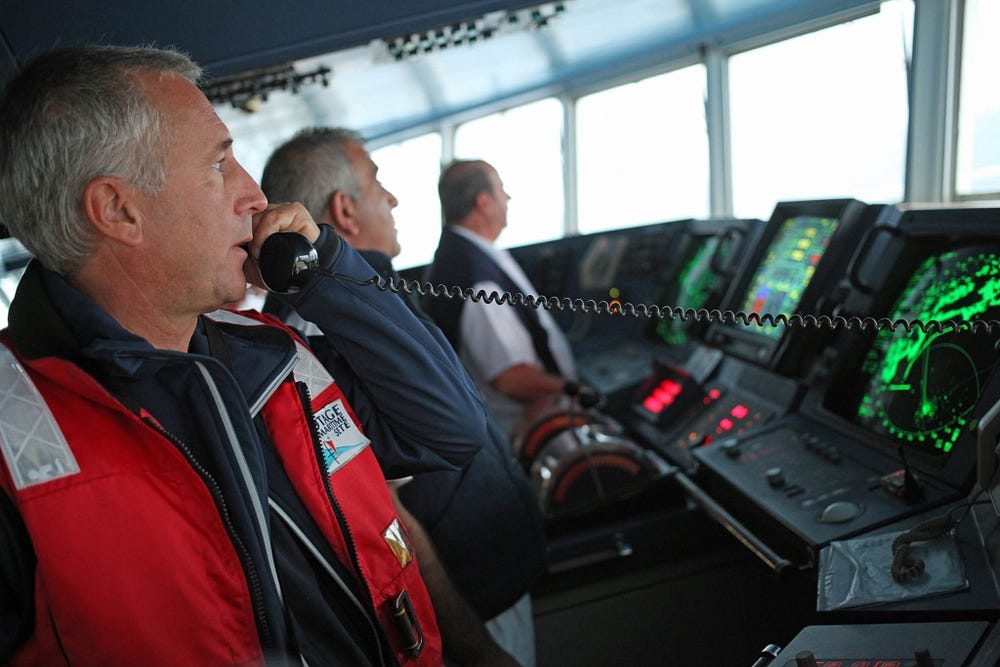
In pilotage waters, a single word can blur the line between conduct, advice, and command and that blur can sink both safety and legal clarity.
After publishing my recent article on SIRE 2.0 , few readers raised an important question. Does the pilot hold the Conn or command of the vessel during pilotage?
Some argue that the pilot “has the Conn” or tactical control, implying a transfer of authority. This confusion is not mere semantics; it directly impacts legal accountability and operational safety.
1. Command: The Master’s Absolute and Continuous Authority
Definition: Command means the Master holds the ultimate and continuous authority and responsibility for the vessel’s safety, navigation, and operation.
Legal Backing:
IMO Resolution A.960 (Annex 2) states, “The master, and not the pilot, is at all times in command of the ship.”
STCW Code, Section A-VIII/2: The Officer of the Watch and Master retain responsibility even when a pilot is aboard.
SOLAS Chapter V, Regulation 34–1: The Master has “overriding authority” to make decisions for the safety of the ship.
Command is indivisible and non-transferable. Local pilotage law may give a pilot conduct, direction, or control of navigation in specific waters, but that is not the same as transferring command of the vessel from the Master.
Every convention, from SOLAS to STCW, treats command as absolute. There is no legal recognition of Conn as a separate or transferable function.
2. The Conn: Clarifying Operational Control and the Pilot’s Role
Common Misconception: The pilot “holds the Conn”, directly commanding helm and engine orders during pilotage.
Reality: In merchant shipping practice, a pilot may in many ports give direct helm, engine, tug, or thruster instructions as part of the conduct of navigation. That practical conduct does not, by itself, transfer command of the vessel from the Master. In naval tradition, particularly in navies such as the US and Royal Navy, Conn is a formal watchstanding designation. In merchant shipping, the casual use of “Conn” during pilotage can create ambiguity because local law may recognise pilot conduct of navigation, while the Master’s command responsibility remains.
In merchant shipping, Conn is never transferred. The full authority to give helm and engine orders remains, both legally and operationally, with the Master or delegated OOW.
Specifically –
1. The pilot provides local expertise and, depending on local law and port practice, may conduct navigation and give direct manoeuvring instructions.
2. The Master/OOW and bridge team must monitor those instructions, verify execution, and challenge any unsafe development.
3. The ship’s SMS should make clear how helm, engine, tug, and thruster instructions are repeated, confirmed, and monitored during pilotage.
4. The Master retains residual command responsibility and the duty to intervene if the vessel is being placed in danger.
Widely accepted international guidance supports the Master’s continuing responsibility. IMO A.960 states that the presence of a pilot does not relieve the Master or officer in charge of the navigational watch from their duties and obligations for the safety of the ship. It also requires the bridge team to support the pilot and monitor the pilot’s actions. Association papers and industry commentary may explain pilotage practice, but they do not replace local statute, pilotage directions, or applicable case law. Any suggestion that a pilot’s conduct of navigation automatically transfers command of the vessel should therefore be treated with caution.
In some jurisdictions, including parts of the United States, Canada, the United Kingdom, Panama Canal waters, and other compulsory pilotage regimes, local law may give the pilot conduct, direction, or control of navigation. Even in such cases, that authority must be read with the Master’s continuing command responsibility, the ship’s SMS, and the bridge team’s duty to monitor and intervene if safety is endangered. International instruments such as SOLAS, STCW, and IMO Resolution A.960 do not use “Conn” as a separate transferable merchant-ship command function. They consistently affirm the Master’s continuing responsibility for the safety of the ship, while recognising that the pilot’s role may vary under local law.
The word “Conn” has no settled place in merchant pilotage law or modern SMS unless a company defines it clearly. It is a naval term that can introduce ambiguity where clarity is needed. The safer distinction is this: local law may give the pilot conduct of navigation, but that is not the same as transferring command of the vessel. By insisting on a casual “Conn handover to pilot,” inspectors and auditors risk inventing a procedure that neither SOLAS, STCW, nor IMO A.960 requires.

3. Why This Distinction Matters in Practice and Inspections
The misconception that the pilot “takes the Conn” introduces operational and legal risks:
– Confusion: It suggests a transfer of control that does not exist in international conventions.
– Contradiction: Safety Management Systems and company procedures deliberately avoid language that implies Conn or command transfer.
– Inspection Errors: Inspectors demanding proof of “Conn handover to pilot” are imposing a non-existent requirement, undermining inspection credibility.
– Legal Liability: In any incident, courts have consistently held Masters and owners responsible, even when pilots were directing navigation. The notion of a pilot ‘holding the Conn’ has never reduced the Master’s liability.
4. The Master-Pilot Relationship: Cooperation, Not Delegation
Navigation in pilotage waters depends on mutual respect and cooperation between Master and pilot:
– The pilot contributes local expertise and may conduct navigation under local law or port practice; the Master retains command responsibility and monitors the safety of the passage.ommands and authorizes.

– The Master monitors the pilot’s actions and is empowered to displace the pilot if safety is compromised (e.g., incompetence or intoxication).
– Practical operation and law vary by jurisdiction, but the pilot’s conduct of navigation should not be confused with command of the vessel. He may direct immediate manoeuvring in some ports, but he does not become the Master.
– In short, command remains with the Master. Pilot conduct, pilot advice, and bridge-team monitoring must be clearly understood and not blurred by loose “Conn” terminology.
This clarification reinforces my original argument. OCIMF inspectors must understand and respect maritime command structures. Inspection criteria must align with international law and practical realities. Instead, inspectors must move beyond rigid SIRE 2.0 tablet prompts. Over-reliance on tablet prompts, without comprehension or context, reduces inspections to box-ticking rather than genuine safety evaluation.
By removing loose “Conn” language from pilotage vocabulary, or defining it precisely in SMS where it is used, we remove ambiguity and that is a win for safety, law, and professional integrity.
For those who prefer video overview –
Editorial clarification: This article has been refined to distinguish more clearly between a pilot’s conduct of navigation under local law or port practice and the Master’s continuing command responsibility under the shipboard safety-management framework.


Leave a Reply