
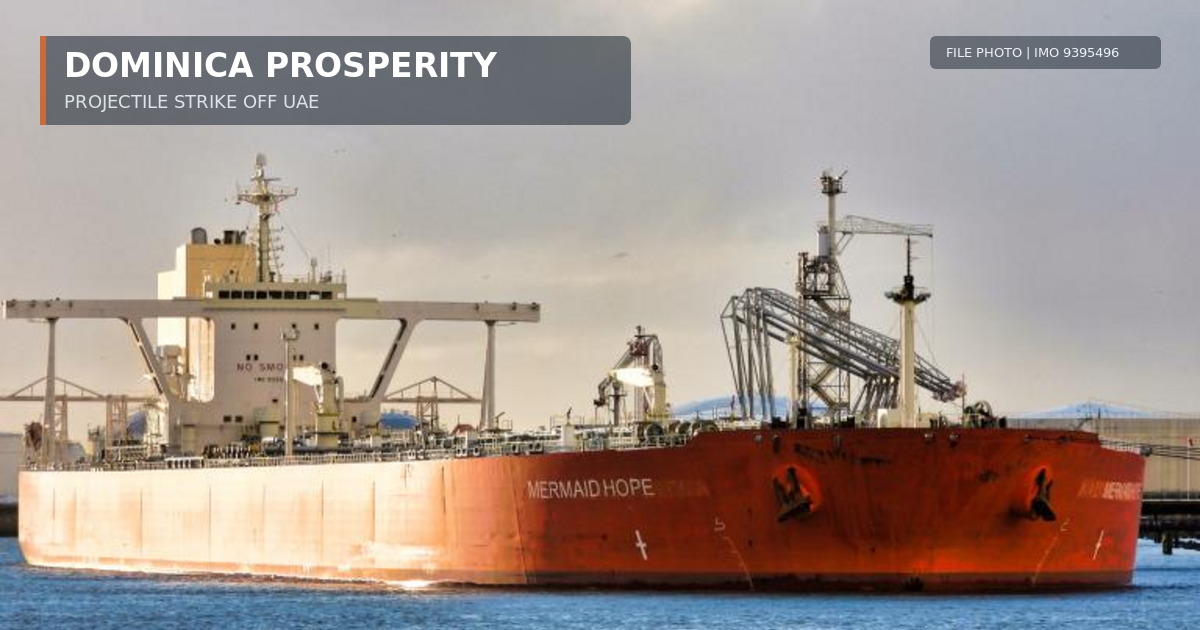
A projectile struck the engine-room area of the crude tanker DOMINICA PROSPERITY northwest of Ras Al-Khaimah, forcing the evacuation of all 22 crew. The late-reported attack adds another confirmed tanker casualty to the Gulf security sequence, while new Baltic damage claims and UK sanctions create separate operational and compliance pressures.
1. DOMINICA PROSPERITY hit off Ras Al-Khaimah
• UKMTO Warning 204-26 records an attack at 1800 UTC on 11 November, approximately 14 nautical miles northwest of Ra’s al Khaymah, United Arab Emirates.
• JMIC identified the vessel as DOMINICA PROSPERITY and reported that an unknown projectile struck its engine-room area.
• Firefighting remained in progress when the warning was issued. The vessel’s propulsion status, machinery damage, pollution condition and salvage arrangements had not been confirmed at the research cutoff.
• DOMINICA PROSPERITY is a Liberia-flagged crude oil tanker, IMO 9395496, built in 2011. Gard records a deadweight of 297,274 tonnes and gross tonnage of 157,589.
• India’s shipping minister said the UAE Coast Guard evacuated the entire 22-member crew. Nineteen were Indian nationals, and no injuries were reported.
• The evacuation removed the immediate personnel exposure, but the unconfirmed machinery and fire condition leaves a significant casualty-management question near Mina Saqr approaches.
2. New damage claims emerge from Ust-Luga
• The drone attack on Russia’s Ust-Luga complex occurred overnight on 10 and 11 November, before the present reporting window.
• A fuller assessment released on 12 November by Ukraine’s General Staff claimed damage to five petroleum-product tanks with combined capacity of 150,000 cubic metres, a hydrocracker, pumping equipment, air-cooling apparatus and a tanker-loading berth.
• The Leningrad regional governor confirmed a port-area fire and injuries to three workers but did not confirm the detailed terminal-damage list.
• Regional authorities reported that power was restored. Russian port and terminal authorities had not confirmed a sustained berth closure, cargo-handling suspension or reduction in vessel movements at cutoff.
• Ust-Luga averaged about 562,000 barrels per day of oil exports during 2026, according to S&P Global data. That figure indicates the terminal’s scale, not a confirmed outage volume.
3. Suez traffic recovers, but diversion remains substantial
• Lloyd’s List Intelligence recorded 1,338 Suez Canal transits representing 125.6 million deadweight tonnes in October.
• Deadweight tonnage increased 18 per cent from September and 63 per cent year on year, but remained 34 per cent below the pre-Houthi-crisis level.
• Bab el-Mandeb recorded 1,363 transits and 112.3 million deadweight tonnes, an increase of 17 per cent month on month but still 46 per cent below the earlier baseline.
• Crude-tanker traffic through Suez reached 47.13 million deadweight tonnes, exceeding the pre-crisis monthly average of 44.35 million.
• More than one-third of the reported large crude-tanker passages involved sanctioned vessels. The headline recovery therefore does not represent a uniform return by mainstream liner and tanker operators.
4. UK expands Russian energy and vessel restrictions
• The United Kingdom announced new sanctions on 12 November covering shadow-fleet vessels, Vostok Oil, Slavneft and additional Russian energy interests.
• The government said Slavneft’s designation made the UK the first country to sanction all ten of Russia’s largest oil producers.
• The official shipping notice identifies oil and LNG vessels including MELICERTES, NELEUS, PERLE, ONEIROI, APEKS, SARA SKY, YVIKA and ALMA.
• Specified vessels are prohibited from entering UK ports and may be detained. The measures also restrict chartering, operation and access to listed technical, crewing, brokering and financial services.
• The practical exposure extends beyond the named owner. Managers, charterers, brokers, insurers and service providers must establish the vessel’s current designation status before accepting an instruction or fixture.
Latest DeepDraft Analysis
Lightning Protection on Ships: Protecting the Equipment We Depend On
Excerpt: A steel hull may carry lightning current to sea without protecting connected circuits. The analysis examines bonding and surge protection for essential navigation and GMDSS equipment.
Related DeepDraft SITREPs
Related DeepDraft Articles & Analysis
Sources
UK Maritime Trade Operations and JMIC, India Ministry of Ports Shipping and Waterways, S&P Global Commodity Insights, Lloyd’s List Intelligence, UK Foreign Commonwealth & Development Office
This update is part of the DeepDraft SITREP series covering developing maritime operational situations.



Leave a Reply