
Gulf of Oman ship-to-ship crude transfer capacity has reached its limit as Saudi export volumes surge through Hormuz.
The constraint is extending STS cycles, absorbing additional VLCCs and pushing buyers toward alternative transfer locations.
1. Gulf of Oman STS Capacity Reaches Its Limit
• Ship-to-ship transfers in the Gulf of Oman for Middle Eastern crude moving through Hormuz have reached capacity limits as Saudi Arabia increases exports from its Gulf terminals.
• Saudi crude exports through Hormuz are on track to reach about 3.6 million barrels per day in September, up from approximately 900,000 bpd in August, according to Kpler data reported by Reuters.
• Saudi Aramco has sold more than 60 million barrels for STS transfer off Sohar, Oman, across September and October after the September 13 attack on the East-West Pipeline halted crude exports from Yanbu.
• Kpler estimates the increase requires an additional 36 to 40 VLCCs. Each VLCC can carry approximately 2 million barrels.
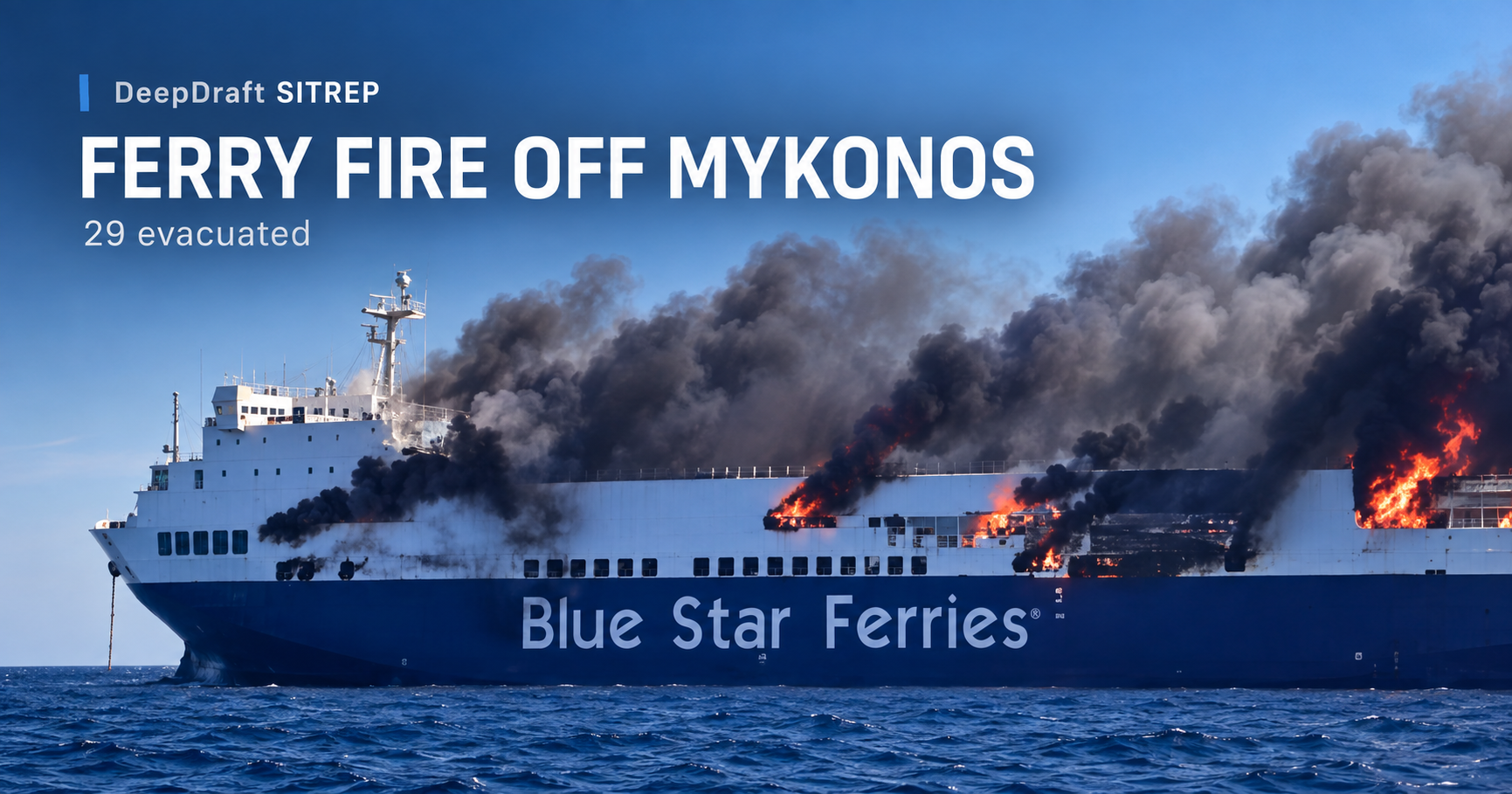
2. BLUE CARRIER 2 Fire Forces Abandonment North of Mykonos
• Fire broke out aboard the Greek-flagged 9,655-dwt RoRo BLUE CARRIER 2 north of Mykonos on September 25 while the vessel was sailing from Syros to Samos.
• Attica reported the fire at 08:57. It spread across large portions of the vessel after apparently developing on deck, possibly in a garage area.
• All 29 people aboard, comprising the crew and one truck driver, abandoned into lifeboats and were recovered by passing vessels. No injuries were reported.
• The vessel was carrying 166 trucks and 29 cars. Firefighting vessels, tugs and a specialist salvage response were deployed, with a towline subsequently reported established.
3. STS Delays and VLCC Demand Reshape Tanker Routing Economics
• The daily time-charter rate for a VLCC carrying Middle East crude to China reached a record USD 1.27 million on September 21 as additional shuttle requirements absorbed available tonnage.
• Gulf of Oman STS operations are now taking nearly 10 days, compared with approximately five to seven days previously, as vessels queue for tugboats, labour and transfer equipment.
• Chinese buyers are asking sellers to consider alternative STS locations off western India and Malaysia or direct delivery to refineries.
• Two VLCCs linked to S-Oil are being sent for STS operations off Vadinar, India, while increased crude-transfer activity has also been reported around Linggi, Malaysia.
• The operational change is therefore spreading beyond freight pricing. STS-slot availability, receiving-vessel positioning, transfer equipment and transfer geography are now part of cargo-performance planning.
4. ARGOS GEORGIA Report Returns Watertight Integrity and Flooding Response to the Safety File
• The UK Marine Accident Investigation Branch published its final ARGOS GEORGIA investigation and safety flyer on September 25.
• The St Helena-registered longline fishing vessel foundered approximately 190 nautical miles east of Port Stanley, Falkland Islands, on July 22, 2024, with the loss of 13 lives.
• MAIB’s accompanying safety guidance focuses on approved vessel operations, watertight integrity and emergency drills for unexpected flooding.
• Fleet safety teams should use the findings as a trigger to review watertight-opening controls, flooding response, emergency organization and whether drills test the practical response expected when conditions deteriorate rapidly.
Strategic Summary & Actions Required
• Masters, POACs and STS providers should confirm transfer slots, tug availability, fendering, hose arrangements, mooring readiness, weather limits and emergency separation capability before committing vessels to Gulf of Oman STS operations.
• Charterers and tanker desks should price longer STS cycles and additional VLCC demand into laycan, demurrage, voyage duration, receiving-vessel availability and replacement-tonnage decisions.
• Operators using Sohar-area transfers should confirm whether nominated STS capacity is physically available rather than treating an agreed cargo programme as confirmation that marine services can support the planned transfer date.
• Cargo interests considering India or Malaysia alternatives should recheck deviation costs, voyage instructions, war-risk cover, STS warranties, local service availability and contractual responsibility for additional steaming and delay.
• Fleet safety teams should separately review BLUE CARRIER 2 and ARGOS GEORGIA for fire-abandonment readiness, watertight integrity, flooding response and the practical standard of emergency drills onboard.
Operational Status
RED – Gulf of Oman STS Capacity Constraint / Additional VLCC Demand / Transfer Cycles Near 10 Days / Tanker Routing, Schedule and Freight Exposure
Latest DeepDraft Analysis
Navigating in a Sea of Visual Pollution
Excessive deck, accommodation and working lights can weaken the visual dominance of navigation lights, complicating aspect recognition and turning onboard lighting management into a collision-avoidance issue.
Related DeepDraft Articles & Analysis
Sources
Reuters, The Maritime Executive, UK Marine Accident Investigation Branch, The DeepDraft
This update is part of the DeepDraft SITREP series covering developing maritime operational situations.



Leave a Reply