
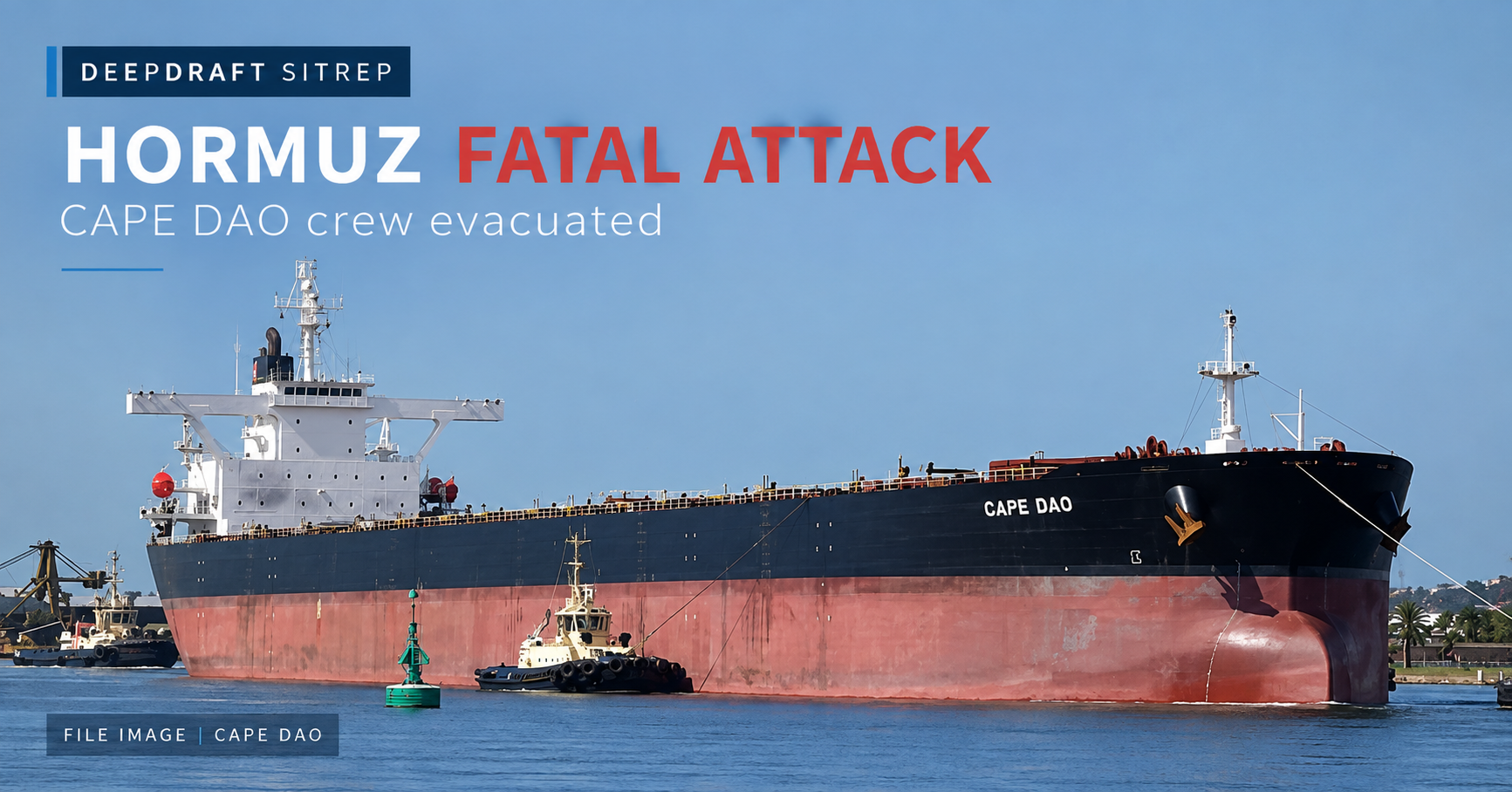
CAPE DAO leads a mixed-risk maritime day after a fatal attack off Musandam, while Black Sea shipping faces another crew casualty and sanctions/cargo-compliance pressure shifts across Europe and North Africa.
1. CAPE DAO Attack: Fatal Strike Off Musandam Raises Hormuz Crew-Risk Level
• The Antigua and Barbuda-flagged bulk carrier CAPE DAO was attacked about 2.5 nautical miles off Oman’s Musandam Governorate, overlooking the Strait of Hormuz.
• Oman’s Maritime Security Centre said the attack caused an engine-room fire and killed one crew member.
• The Royal Navy of Oman evacuated 27 crew members from the vessel in coordination with relevant authorities.
• India’s embassy in Oman confirmed that the dead seafarer was an Indian national and said 19 Indian nationals were on board.
• Indian reporting identified the deceased as Suraj Yadav, a wiper from Deoria, Uttar Pradesh.
2. Black Sea Shipping: Master Killed as Ukraine Offers Maritime Truce
• Ukrainian authorities reported that the master of a cargo ship was killed in a Russian attack on merchant shipping on September 23.
• Seatrade Maritime reported Ambrey analysis that drones and uncrewed surface vessels have overtaken mines as the active floating hazard profile in the Black Sea.
• The same reporting said an Antigua and Barbuda-flagged cargo vessel approaching Odesa was attacked overnight, killing the Ukrainian master and causing a fire on board.
• President Volodymyr Zelenskiy said Ukraine is ready for a Black Sea maritime truce based on proposals from Egypt, India and Turkey, but said Russia must respond before safe-passage conditions can change.
3. Sanctions and Cargo Compliance: EU Russia Backlash Meets Morocco LOI Requirement
• The EU renewed Russia sanctions but removed Russian billionaires Alisher Usmanov and Mikhail Fridman from the sanctions list, triggering backlash from some member states and Ukraine-facing policy voices.
• The change does not remove Russia-linked counterparty risk from shipping files; operators still need to screen cargo interests, beneficial ownership, financing links, insurers and payment chains against current sanctions lists.
• Hapag-Lloyd introduced a Letter of Indemnity requirement for selected commodities imported into Morocco, effective September 23.
• The carrier said the signed LOI must be provided before booking confirmation for affected cargoes, creating a fresh documentation and cargo-acceptance control point for shippers, forwarders and NVOCCs.
4. Market and Routing Cost Layer: Hormuz Traffic, Black Sea Cover and Inland Surcharges
• Visible commodity-vessel traffic through Hormuz fell to two crossings on Monday, down from 10 the previous day and far below the pre-conflict average of about 125 large commercial vessels per day.
• London marine insurers widened the Black Sea high-risk zone after attacks on shipping increased, adding underwriting, voyage notification and war-risk cost pressure to Black Sea fixtures.
• Maersk updated emergency inland fuel and energy surcharge levels for store-door shipments across the Nordic and Baltic region, adding a separate landside cost adjustment to European supply-chain planning.
• Chartering, operations and procurement desks now face parallel cost triggers: Hormuz transit risk, Black Sea war-risk exposure, documentary controls for Morocco imports and inland surcharge movement in Northern Europe.
5. Seafarer Protection and Safety Layer: Fatalities, Abandonment and Crew-Risk Controls
• The CAPE DAO fatality and the Black Sea master’s death put crew deployment, nationality exposure and emergency response back at the centre of voyage approval.
• The Seafarers’ Charity released new abandonment films under its “Smart Seafaring. A Safe Return” campaign, keeping welfare, repatriation and employer accountability in the operational safety frame.
• President Ferdinand Marcos Jr. reaffirmed support for Filipino seafarers at Philmarcon 2026, while Philippine reporting continued to focus on stronger protection for the country’s maritime workforce.
• Ship managers should treat seafarer risk as a live operating control: crew consent, welfare contact chains, emergency funds, family notification and repatriation arrangements must be checked before high-risk voyages.
Strategic Summary & Actions Required
• CAPE DAO is the dominant signal because a named merchant vessel was attacked near Hormuz, one Indian seafarer was killed, the engine room caught fire and 27 crew were evacuated.
• Masters approaching Hormuz or the Gulf of Oman should confirm latest company routing instructions, security levels, muster readiness, firefighting readiness and emergency communications before entering exposed waters.
• Black Sea voyages require separate review of port-approach risk, drone and USV exposure, war-risk cover, deviation rights, crew nationality exposure and safe-passage assumptions.
• Compliance teams should refresh Russia-linked counterparty screening and apply the Morocco LOI requirement before affected bookings are confirmed.
• Charterers and operators should price current voyages against four moving controls: Hormuz casualty risk, Black Sea insurance expansion, sanctions-list movement and inland surcharge changes.
Operational Status
CRITICAL RED — CAPE DAO Fatal Attack / Black Sea Merchant-Shipping Casualty / Sanctions and Cargo Documentation Shift / Insurance, Routing and Crew-Safety Exposure
Latest DeepDraft Analysis
Navigating in a Sea of Visual Pollution
https://thedeepdraft.com/2026/09/21/navigating-in-a-sea-of-visual-pollution/
Excessive working, accommodation and security lighting can overwhelm navigation lights, degrade night vision and turn technically compliant vessels into collision-avoidance hazards.
Related DeepDraft Articles & Analysis
Sources
Oman Maritime Security Centre, Royal Navy of Oman, Indian Embassy in Oman, Reuters, Seatrade Maritime, Maritime Executive, Hapag-Lloyd, The DeepDraft
This update is part of the DeepDraft SITREP series covering developing maritime operational situations.




Leave a Reply