
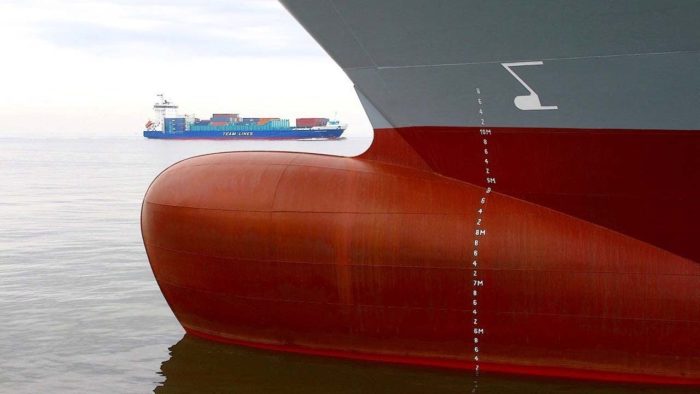
Sometimes, the ship tells you something the paperwork does not.
I don’t usually pay much attention to the bow shape of a vessel.
After years at sea, certain things fade into habit and you see them without noticing. But sometimes, when something is missing, your eyes catch it immediately.
It happened on one of my vessels. While doing a normal round on the forecastle one afternoon, I leaned over the gunwale out of habit and looked down the stem. On ships with a conventional bulbous bow, you can usually see the projection beneath the waterline when the conditions and draft allow.
This time there was none. The forebody looked too fine, the line almost straight. There was no rounded projection or sign of a bulb beneath the surface.
Out of curiosity, I later checked the pilot card, and it was marked “Bulbous Bow – Yes.” That didn’t match what I had seen. So, I decided to check the plans.
The Docking Plan and the Numbers
The docking plan gave a simple answer. The projection ahead of the forward perpendicular was 0.115 metres ie. about 11 cms. For a vessel almost 340 mtrs long, that’s practically nothing.
To put it in perspective, the ship is nearly the length of three and a half football fields placed end to end, while that supposed “bulb” is about the thickness of a notebook or the width of your hand. In my opinion, this was hardly a bulbous form at all. It looked more like a clean, fine stem with only a very small projection ahead of the forward perpendicular.
Still, because the pilot card said “yes,” I sent a short query to the yard. The reply came: “Yes, vessel has normal bulb.” That’s when the question grew larger than just a checkmark in a column.
The Difference Between What’s Drawn and What’s Built
A bulbous bow isn’t an ornament. It’s a defined underwater structure, shaped to interfere with the bow wave in a way that reduces total resistance. For that, it needs size, shape, and volume, typically projecting a metre or more forward and sitting below the waterline.
Looking at this particular vessel, an 11 cm projection on a ship nearly 340 metres long did not resemble the conventional bulbous bow we normally recognise at sea. In my view, whatever hydrodynamic shaping existed in the forebody, it was closer to a very small faired-in form than a distinct projecting bulb.
So, if there is no bulb, why do the documents say there is one?
Over the years, bulbous bows have proved their value in reducing resistance, but with changing operational speeds and environmental rules, their effectiveness is being re-evaluated and in many cases, redesigned or removed.

Why Many New Vessels Are Built Without a Bulb
In recent years, some new tankers and large ships have been designed with either very small bulbs, faired-in bulbs, or in some cases no projecting bulb at all. The reason lies in how ships now operate and how design priorities have changed.
A bulbous bow is most effective when it is matched to the ship’s intended combination of speed, draft, and hull form. It works by reducing wave-making resistance, but its benefit changes when the vessel operates away from those design conditions. When the ship moves slower or at a lighter draft, that same bulb can actually increase drag.
Slow steaming had already become common in shipping well before EEXI and CII. The introduction of the IMO’s EEXI and CII requirements has added further pressure on owners and operators to improve fuel efficiency and reduce carbon intensity. A large bulb that once helped at 16 knots may become less effective, or even a penalty, when the same vessel routinely operates at 12 or 13 knots. A similar gap between design performance and operating reality came up in Flettner Rotors Beyond the Spreadsheet.
To adapt, naval architects have started designing hulls with plumb or straight stems or very small faired-in bulbs tuned for lower speeds. These shapes can provide better performance across the vessel’s intended operating profile, especially when vessels spend long periods in ballast or in varying drafts.
Retrofits and newbuilds now follow the same logic, either resize the bulb for slow steaming or remove it altogether if operations vary too much. Class societies and research institutes have confirmed measurable fuel savings, sometimes up to 5–10% by simplifying the forebody.
So, while older designs carried prominent bulbs as a mark of efficiency, today’s ships are being optimised for a different era. The absence of a bulb is no longer a design omission, it’s often a deliberate choice for efficiency under modern operating realities.

How Errors Like This Happen
In shipbuilding, a lot of data moves forward automatically through templates and standard formats. A pilot card or stability form might have been copied from a sister vessel that had a bulb, or from a general specification where “Bulbous Bow – Yes” was already pre-filled. Once the same entry starts appearing in shipboard documents, it can continue without much rechecking. Unless someone notices, it quietly becomes fact by repetition.
To be fair, the yard may not be entirely wrong either. In shipyard terminology, “normal bow” can mean not ice-strengthened, not axe-type, not special form. If that’s what they meant, they could be right from their point of view.
But in my reading of the IMO pilot card, the field “Bulbous Bow – Yes/No” is there for an operational reason. It tells the pilot whether there is a bulbous form forward that needs to be understood as part of the vessel’s actual bow geometry. On a vessel almost 340 metres long, a forward projection of only 0.115 mtrs did not, in my opinion, represent what a pilot or seafarer would normally understand from a simple “Bulbous Bow – Yes” entry.
For that reason, my view was that the entry should either have been “No,” or at least qualified to show that this was only a very small faired-in form rather than a conventional projecting bulb.
So maybe everyone was right in their own context. The yard, by definition and the ship’s record, by habit. But what went missing was the alignment between language and steel.

Why It Matters
For those at sea, the bow shape is not an academic detail, it quietly influences how a ship behaves.
- Trim: A real bulbous bow adds underwater volume forward, giving slightly more buoyancy at the fore end. This can affect trim, especially when light or in ballast.
- Maneuvering: Bow form changes how water flows along the hull. Ships with pronounced bulbs may handle a bit differently in shallow or confined waters.
- Squat: In narrow channels, the flow around a bulb can alter how the vessel settles, while a fine straight stem behaves more predictably.
- Docking: Docking plans depend on actual bow geometry. A bulb requires extra clearance and adjusted block positions below the forefoot.
If a vessel is recorded as having a bulb when it doesn’t, pilots and docking masters may expect handling or trim behaviour that isn’t there. Keeping the documentation aligned with the actual hull prevents that confusion.
What Research Shows
To check whether my understanding matched modern data, I referred to a study published in Maritime Technology and Society (Vol. 2, Issue 1, February 2023). The paper compared two common bow shapes, the faired-in bulb, which blends smoothly into the hull, and the ram-type bulb, which projects more distinctly forward. Using computational fluid dynamics (CFD) simulations, the researchers found that:
- The faired-in bulb performs better at lower speeds (lower Froude numbers), reducing total resistance more effectively within its tuned range. The Froude number is simply a way of relating a ship’s speed to her length , in other words, how fast the vessel moves compared with the natural wave it creates.
- The ram-type bulb performs better at higher speeds, offering a measurable power advantage when operated near its design point.
However, bulb performance is strongly dependent on the vessel’s operating condition, particularly speed and draft. When a ship operates off-design, for example, during slow steaming or in ballast, a conventional bulb can lose its effectiveness and may even become a penalty, adding frictional resistance through its extra surface area and producing wave interference at the wrong point.
In contrast, a vessel with no bulb or a very small faired-in forebody may avoid some of those off-design penalties. While it may forgo the small fuel savings that a tuned bulb can provide at one ideal speed, it can provide more consistent efficiency across a wider operating profile.
That observation aligns with what we see at sea. A straight-stem or plumb-bow vessel can run efficiently across a range of operating conditions, even if it doesn’t gain the slight calm-water advantage that a well-tuned bulb offers at its design speed.
A Matter of Verification
This case was never about finding fault. It’s about how information quietly travels through the system, from design to approval to operation and how a single unchecked entry can stay unchallenged for years.
In shipping, small assumptions often turn into long-standing facts.
If a pilot believes the vessel carries a bulb, he may make allowance for a forward underwater projection that, in reality, is hardly there. If a drydock team prepares keel blocks expecting a bulb, the clearances may not match the actual forebody. That’s why even a single line in the pilot card deserves to be correct. The same need for clear information before pilotage was discussed in Pilotage Without Surprises: Why Japan’s Methods Stand Apart.
In this case, the response confirming “Yes, normal bulb” came through the normal communication chain, and the instruction was to retain it as such. There was no disagreement recorded, and the matter was considered closed.
However, based on the as-built drawing and actual hull observation, it was clear that the projection was only 0.115 mtrs, effectively a very small faired-in form with no distinct projecting bulb.
As a good practice, we now record it as “Bulbous Bow – Yes (faired-in type, 0.115 m projection).” This keeps the documentation aligned with reality and satisfies the reporting format without contradicting official communication.
It’s a small adjustment, but it ensures the paperwork reflects the ship as she truly is,quietly setting the record straight.
The Lesson
This incident reminded me that we often take documentation at face value. But when the paperwork and what we see on the ship do not seem to agree, the ship itself is a good place to start asking questions.
It takes only a few minutes to cross-check the drawing with what we actually see at sea. That simple habit can prevent years of wrong information being circulated.
It’s a bit like the old story of the “dead horse on the table” where a rule or practice continues long after its purpose has disappeared, simply because nobody remembers to ask why. In shipping too, forms get copied, data gets carried forward, and habits remain unquestioned until someone finally looks back at the source. A similar question about an unusual ship design later came up in When Bridge Windows Look the Wrong Way.
For a Master or Chief Officer, it’s worth remembering that what’s written in a file may have been copied from a previous ship, and what the yard calls “normal” may not match how we define it operationally.
So, when something doesn’t look right, even something as ordinary as a bow, it’s worth asking the question.

Perhaps the yard’s definition of “normal” is correct in its own context, but in practical seamanship it’s not what we would recognise as a bulbous bow.
It’s a quiet reminder that even in well-built ships and well-documented systems, small details can drift away from accuracy until someone looks a little closer and asks the simple question.
Originally published: 19 October 2025 | Updated: 27 August 2026
References
- Ba Naga, M. H. (2023). Comparative Analysis of Faired-In Bulb and Bulbous Bow Ram Bow’s Shape on Total Ship Resistance. Maritime Technology and Society, 2 (1).
- DNV (2022). Hull Form Optimisation for Slow-Steaming Operations.
- MARIN (2020). Bulbous Bow Design in a Slow-Steaming World.
- ABS (2020). Hydrodynamic Optimisation for Energy Efficiency.
- Fujii H. & Takahashi T. (2018). Added Resistance in Waves of Modern Hull Forms. J. Marine Science & Technology, 23 (6).
- Lloyd’s Register (2022). Ship Design for EEXI and CII Compliance.



Leave a Reply