
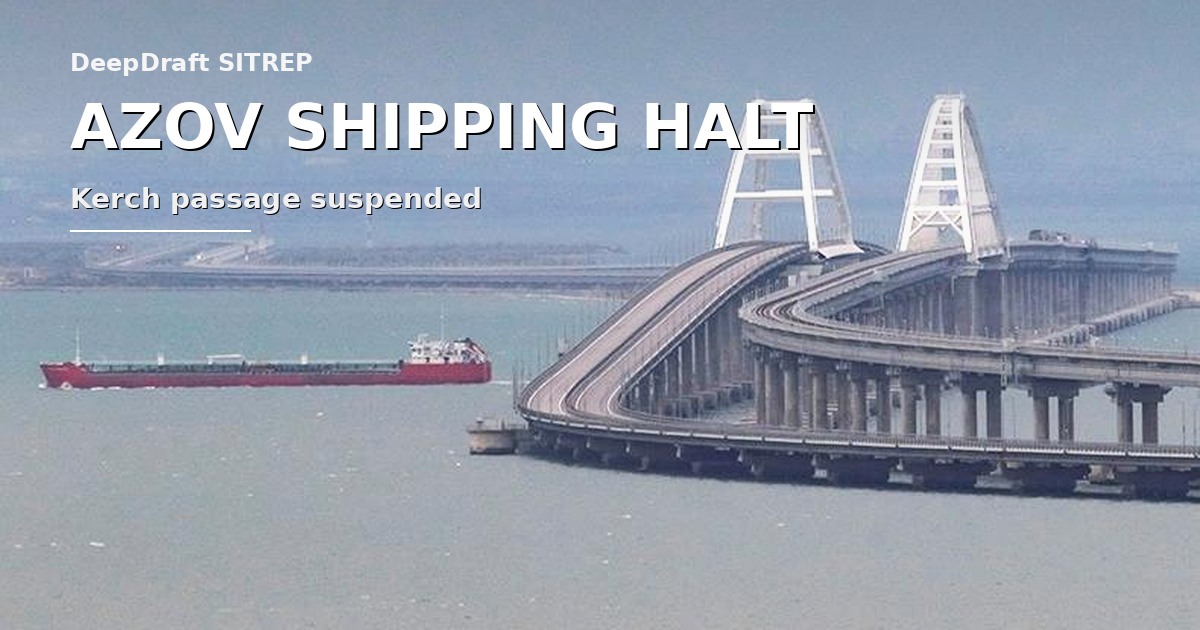
Russia has temporarily stopped Don-Azov Channel shipping after attacks on 13 Russian vessels in the Sea of Azov.
The halt turns Kerch passage, grain stems and tanker routing into immediate operational checks.
1. Don-Azov Channel Shipping Halt
• Russia temporarily stopped shipping through the Don-Azov Channel, the navigable waterway linking the Don River with the Sea of Azov.
• The halt followed attacks on 13 Russian vessels in the Sea of Azov, including 10 tankers.
• Russia’s border guards notified shipping companies that requests for passage through the Kerch Strait would not be accepted from 6:10 p.m. local time on Friday.
• The notice did not state when passage acceptance would resume, leaving vessels, agents and cargo desks without a confirmed reopening window.
2. Kerch Passage Risk Moves Into Grain and Port Planning
• The Sea of Azov route carries material Russian grain exposure, with market analysts noting that up to one-quarter of Russian wheat exports may pass through the area.
• Rostov and Krasnodar, two leading Russian grain-producing regions, lie along the Sea of Azov.
• Russia’s second-largest Black Sea regional port is located on the Kerch Strait, making the passage halt a port-access and cargo-flow issue, not only a security headline.
• Euronext wheat rose as much as 4% to a six-week high as market talk spread around possible Sea of Azov shipping disruption.
3. Hormuz Legal Layer Hardens as IMO Council Rejects Iran Control Claim
• The IMO Council agreed that states should reject Iran’s effort to impose sovereignty over the Strait of Hormuz and its unilateral decision to create a traffic-control body.
• The non-binding decision strongly condemned Iran’s entity purporting to control traffic through the Strait.
• The Council urged member states not to recognize Iranian measures aimed at closing, obstructing, hampering or otherwise interfering with international navigation and transit passage.
• Iran’s Persian Gulf Strait Authority had previously said no vessel was permitted to pass through Hormuz without a valid passage permit, keeping legal, insurance and Master-authority exposure active for Gulf voyages.
4. Urals Freight Reset Adds a Commercial Layer to Russian Export Risk
• Freight for Aframax Urals cargoes from Primorsk to India has fallen to about USD 7 million to USD 8 million, down from USD 10 million to USD 11 million in June.
• Suezmax shipments from Novorossiisk to India have fallen to about USD 10 million, down from USD 15 million.
• The rate decline reflects higher tanker availability and softer seasonal demand, but the Don-Azov halt adds a fresh Russian export-routing variable on the Black Sea side.
• Charterers should avoid treating the July freight reset as stable where Kerch passage, Black Sea war-risk language, port calls, laycan terms and voyage deviation exposure remain unsettled.
Strategic Summary & Actions Required
• Masters and operators with Sea of Azov, Kerch Strait or nearby Black Sea exposure should confirm passage acceptance, VTS instructions, agent updates and port-entry status before closing the area.
• Grain desks should review Rostov, Krasnodar and Kerch-linked cargo stems for loading windows, documentary readiness, laytime, demurrage, cancellation and force majeure exposure.
• Tanker operators should separate the Urals freight softening from the routing-risk picture, because cheaper tonnage does not remove Kerch, Black Sea or Hormuz disruption exposure.
• Gulf-linked voyages should continue treating any Hormuz permit, clearance or traffic-control instruction as a controlled legal, insurance and company-authorization matter.
• Fleet teams should preserve voyage orders, charterer instructions, AIS records, VDR data, agent messages and risk-assessment approvals for any affected Azov, Kerch, Black Sea or Hormuz transit.
Operational Status
RED — Don-Azov Shipping Halt / Kerch Passage Requests Suspended / Russian Grain and Tanker Export Exposure / Black Sea Routing Uncertainty
Latest DeepDraft Analysis
Similar-Size VLCC STS: The Risk After All Fast
https://thedeepdraft.com/2026/07/06/similar-size-vlcc-sts-the-risk-after-all-fast/
Similar-size VLCC STS shifts control from size advantage to mooring geometry, anchored-vessel movement and POAC judgement when two hulls stop moving as one system.
Related DeepDraft Articles & Analysis
Sources
Reuters, International Maritime Organization, The DeepDraft
This update is part of the DeepDraft SITREP series covering developing maritime operational situations.




Leave a Reply