
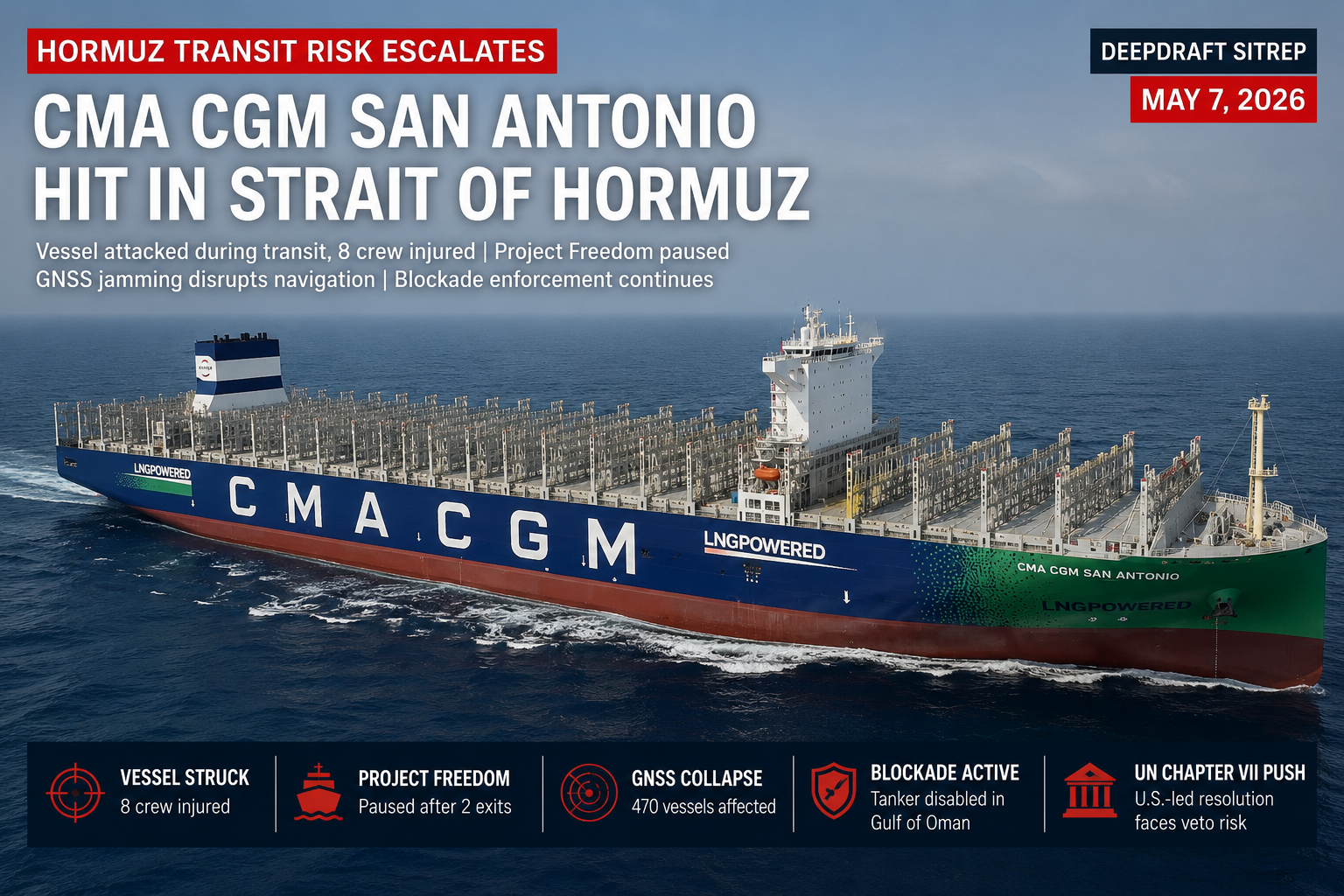
Hormuz remains the dominant maritime risk signal today after a CMA CGM vessel was struck during transit and U.S. escort activity was paused.
Bridge teams now face a combined kinetic, navigational, sanctions and routing-risk environment.
1. Hormuz Primary Signal: CMA CGM San Antonio Hit During Transit
• CMA CGM San Antonio was attacked while transiting the Strait of Hormuz, injuring crew members and damaging the vessel.
• The IMO said eight crew members were wounded, and Reuters reported they were Filipino seafarers evacuated for medical treatment.
• The attack was reported as the 32nd vessel incident since the start of the U.S.-Iran conflict, with Reuters noting disruption to traffic linked to 20% of global oil trade.
• A maritime security source cited by Reuters said the vessel was struck by an Iranian projectile during a night transit near Oman.
2. Escort Pause and Gulf Exit Constraint
• Washington launched Project Freedom on May 4 to help escort commercial ships through Hormuz, allowing two U.S.-flagged vessels to exit the Gulf before the operation was paused.
• Reuters reported the pause was linked to talks aimed at a broader arrangement with Iran, leaving uncoordinated transits exposed to elevated risk.
• CMA CGM Saigon exited the Gulf and was tracking south of Muscat toward Colombo, becoming the second CMA CGM vessel to leave from an initial group of 14 stranded vessels.
• Tehran has issued a map expanding a zone it claims is subject to its control, increasing uncertainty for vessels attempting independent or night transits.
3. Commercial, Insurance and Routing Impact
• Owners and charterers should treat Gulf exit planning as conditional on verified security clearance, not vessel readiness alone.
• The San Antonio strike confirms that container tonnage is exposed alongside tankers, LNG, product carriers and bulk cargoes linked to Gulf ports.
• Fixtures involving Gulf load or discharge should review war-risk clauses, deviation rights, off-hire language, delay allocation, crew-risk provisions and refusal-of-orders thresholds.
• OFAC warns that Iranian demands for “toll” or safe-passage payments may create sanctions exposure for U.S. and non-U.S. persons, including payments through fiat, digital assets, offsets, swaps or in-kind channels.
4. Navigation, Compliance and Enforcement Layer
• Windward reporting indicates a major maritime-visibility collapse near Hormuz, including approximately 470 vessels affected by GPS jamming near Fujairah and a large cluster of dark or stationary commercial-size vessels near the Strait.
• Masters in the area should treat GNSS-based position fixing as unreliable and increase use of radar ranges, parallel indexing, visual bearings, echo sounder cross-checks and manual position verification.
• CENTCOM said U.S. forces disabled the Iranian-flagged M/T Hasna in the Gulf of Oman after it attempted to reach an Iranian port and failed to comply with warnings, confirming blockade enforcement continues despite the escort pause.
• France has moved the Charles de Gaulle carrier group toward the Red Sea and Gulf of Aden for planning around a possible Hormuz maritime-security mission, adding a separate European naval posture layer.
5. Secondary Operational Signal: Legal and Coalition Track
• Reuters reports U.S.-backed diplomatic activity around Hormuz continues while operational risk at sea remains unresolved.
• South Korea suspended review of participation in Project Freedom after the U.S. put the initiative on hold, reducing near-term coalition clarity for merchant escort planning.
• The French proposal is being framed as a defensive maritime-security mission designed to rebuild shipowner and insurer confidence, but not as an immediate open-transit guarantee.
Strategic Summary (For Masters & Ship Managers)
• Hormuz transit is no longer a single-threat environment. Vessels face projectile risk, escort uncertainty, GNSS degradation, blockade enforcement and payment-related sanctions exposure.
• Masters should not attempt independent transit based only on AIS tracks of vessels that exited successfully. Clearance, coordination, threat window and navigation integrity must be verified.
• Ship managers should issue bridge guidance covering GNSS-denied navigation, night-transit risk, reporting thresholds, emergency medical evacuation and minimum manning for high-threat watches.
• Chartering and operations desks should price delay, deviation, insurance escalation and sanctions-screening risk before accepting Gulf-linked voyage orders.
Advice / Actions Required
• Masters: confirm latest UKMTO, flag-state, company security and naval guidance before entering the Gulf of Oman, Fujairah approaches, Strait of Hormuz or Arabian Gulf.
• Bridge teams: shift to GNSS-denied navigation procedures, increase radar and visual fixing frequency, record position-source discrepancies and preserve ECDIS, AIS and VDR data.
• Owners and charterers: review war-risk, unsafe-port, deviation, force majeure, off-hire, demurrage and crew-risk clauses for all Gulf-linked fixtures.
• Compliance teams: reject any informal safe-passage payment, “toll,” donation, offset, swap or guarantee request unless cleared through sanctions counsel and applicable authorities.
Operational Status
CRITICAL RED – Active Chokepoint Disruption / Escort Pause and Blockade Enforcement / Kinetic, GNSS and Sanctions Risk / Independent Transit Not Operationally Reliable
DeepDraft Update
Latest Weekly Analysis: https://thedeepdraft.com/2026/05/04/uae-leaves-opec-gulf-crude-map-fujairah-hormuz-tanker-routes/
Sources
Reuters, CENTCOM, OFAC, Windward, AP
This update is part of the DeepDraft SITREP series covering developing maritime operational situations.



Leave a Reply