
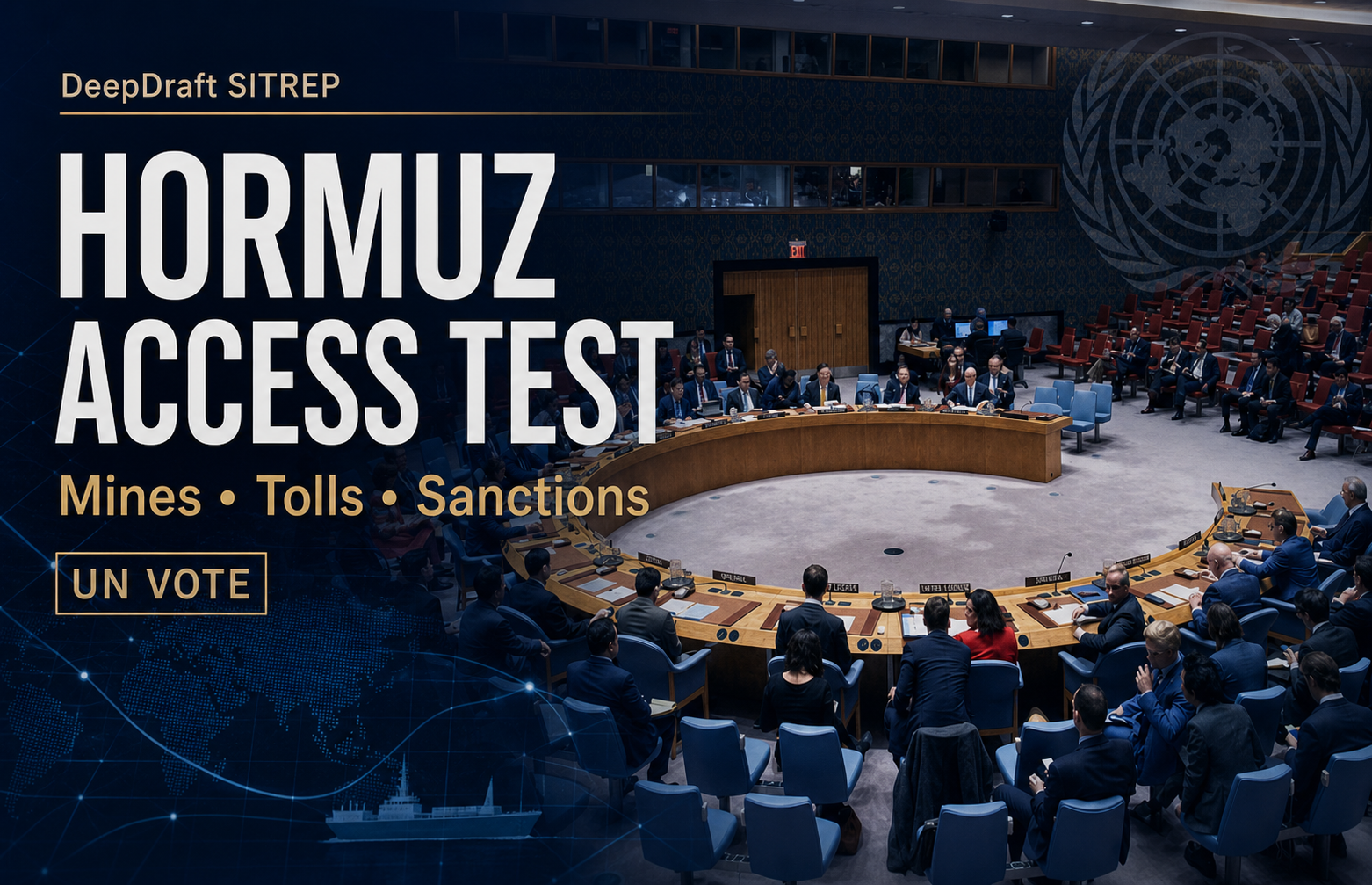
Hormuz is no longer only a security transit problem.
The new operational question is whether a ship can legally, commercially and physically pass.
1. UN Draft Turns Hormuz Into a Shipping Access Test
• The U.S. and Gulf allies have submitted a UN Security Council draft resolution demanding that Iran stop attacks on shipping, halt mine-laying and end illegal toll demands in the Strait of Hormuz.
• The draft is framed under Chapter VII of the UN Charter, which can support sanctions and other Security Council measures if Iran does not comply.
• The text reportedly avoids direct “all necessary means” language, but keeps Hormuz inside a sanctions and enforcement pathway.
• For shipping, this makes access to Hormuz dependent on more than weather, routeing and naval protection. Vessel history, payment exposure, cargo documents, counterparties and Iranian links now matter.
2. Mines and Tolls Are Now the Maritime Trigger
• The draft’s core maritime demands are operational: stop attacks, stop mine-laying, disclose mine locations and stop charging ships for passage.
• OFAC says payments to the Government of Iran or the IRGC for safe passage through Hormuz are not authorised for U.S. persons, U.S. financial institutions or U.S.-owned or controlled foreign entities.
• OFAC’s warning covers direct and indirect payments, including fiat currency, digital assets, offsets, informal swaps, in-kind payments and other routed payment structures.
• This converts any Iranian safe-passage demand into a sanctions issue for owners, managers, charterers, banks, brokers and insurers.
3. Project Freedom Remains a Controlled Corridor, Not Normal Passage
• CENTCOM says Project Freedom began on May 4 to restore freedom of navigation for commercial shipping through the Strait of Hormuz.
• The U.S. military support package includes guided-missile destroyers, more than 100 aircraft, unmanned platforms and around 15,000 personnel.
• Project Freedom is a protective framework for commercial movement, not a return to routine peacetime traffic management.
• Masters should treat any Hormuz movement as a controlled security transit with legal and compliance screening, not a simple reopening of the Strait.
4. Blockade Exposure Moves Into Charterparty and Insurance Risk
• Project Freedom operates alongside continued U.S. blockade measures affecting ships entering or exiting Iranian ports.
• A vessel may be physically ready to sail but commercially blocked if its last port call, cargo origin, ownership chain, charterer, insurer, bank or payment route creates Iranian or sanctioned-party exposure.
• War-risk review must now cover four connected risks: mine threat, missile or drone threat, blockade screening and sanctions exposure from toll or safe-passage payments.
• Chartering desks should treat Gulf fixtures as conditional on transit eligibility, not only vessel position, laycan, freight level and bunker economics.
5. Maritime Freedom Construct Raises the Long-Term Access Question
• Washington is also proposing a Maritime Freedom Construct as a wider security framework for Hormuz and regional shipping lanes.
• Some states may require a UN mandate before contributing military support to a Hormuz security mission.
• A mandate could broaden protective coverage beyond the current U.S.-led framework, while a veto could leave shipping dependent on narrower national arrangements.
• Owners should not price this as an immediate return to normal. The practical issue remains who qualifies for protected passage, who is delayed and who carries sanctions or blockade exposure.
Strategic Summary (For Masters & Ship Managers)
• The lead is not UN process. The lead is that Hormuz passage is becoming a security, sanctions and eligibility test.
• Masters should expect non-standard routing, reporting, naval coordination and changing transit instructions before any Gulf entry or exit.
• Ship managers must prepare clean documentation before movement, including AIS history, last port calls, cargo origin, charterparty chain, sanctions screening and insurance approval.
• Charterers and operators should price the risk that a seaworthy and available vessel may still be delayed or blocked because of legal, payment or blockade exposure.
Advice / Actions Required
• Masters should not initiate Hormuz transit without company approval, flag-state guidance, current UKMTO/JMIC updates and confirmed coordination instructions.
• Ship managers should update voyage risk assessments for mine threat, missile or drone threat, naval engagement risk, toll-payment exposure and blockade screening.
• Charterers should review safe-port warranties, war-risk clauses, deviation rights, force majeure language, off-hire exposure and who bears delay from security or compliance clearance.
• Compliance teams should reject Iranian or IRGC-linked toll or safe-passage payment requests and escalate any dark-fleet contact, sanctioned counterparty, unclear cargo origin or recent Iranian terminal exposure.
Operational Status
CRITICAL RED – Sanctions-Linked Hormuz Access / Mine and Toll Trigger / Transit Conditional on Security, Legal and Compliance Clearance / Commercial Movement Remains Restricted
DeepDraft Update
Latest Weekly Analysis: UAE’s OPEC exit would redraw Gulf crude flows, shifting more tanker focus toward Fujairah storage, Hormuz exposure, alternative loading options and charterparty risk.
Sources
Reuters, AP, U.S. Central Command, OFAC, UKMTO/JMIC
This update is part of the DeepDraft SITREP series covering developing maritime operational situations.



Leave a Reply