
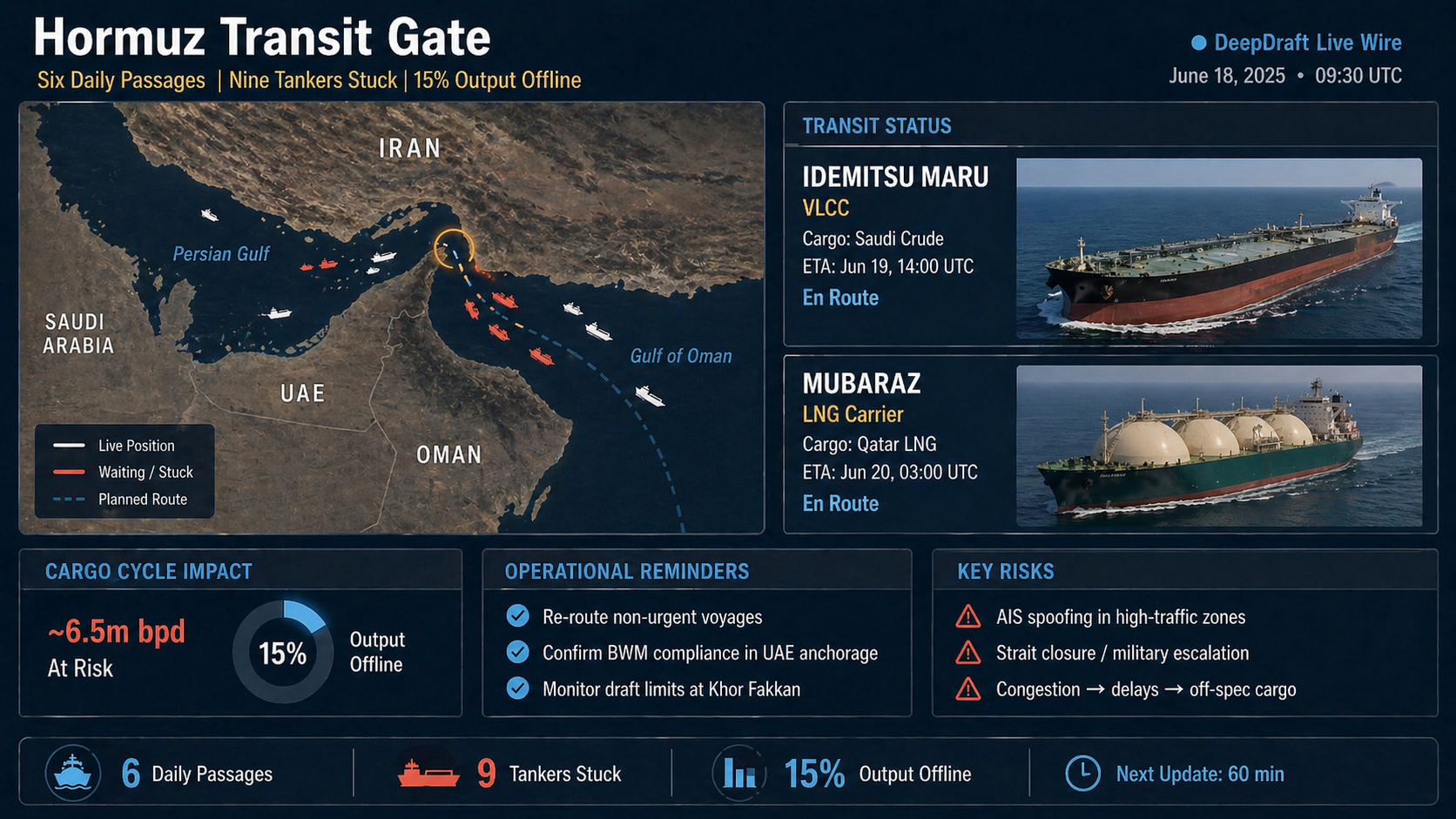
Hormuz is not reopened as a commercial corridor.
Transit remains selective, insurance-gated and too unstable for normal cargo-cycle planning.
1. Strait Access Remains Severely Restricted
• Only about six vessels transited the Strait of Hormuz in the latest 24-hour reporting window.
• Normal pre-war traffic was approximately 125–140 daily passages.
• Recent movements were limited mainly to dry bulk carriers and isolated sanctioned or vetted tonnage.
• The corridor remains a controlled-access route, not an open maritime lane.
2. Cargo Cycle Failure Hits Production
• TotalEnergies says around 15% of its upstream oil and gas output remains offline due to Hormuz transit disruption.
• Nine TotalEnergies tankers remain stuck in the region.
• Loaded cargoes must discharge before affected wells can restart.
• The company expects a 2–3 month restart window after stable transit resumes.
3. Selective Transits Do Not Signal Normalization
• LNG carrier Mubaraz, 136,357 cbm, appears to have crossed Hormuz after going dark on March 30 and reappearing off India.
• VLCC Idemitsu Maru crossed with approximately 2 million barrels of Saudi crude.
• These movements show controlled testing of the corridor, not full market return.
• Masters should treat each passage as case-specific and dependent on routing clearance, cover, flag, cargo and threat picture.
4. Insurance Is Now a Voyage-Control Checkpoint
• DFC-backed maritime reinsurance capacity of up to USD 40 billion is active for qualifying vessels and cargoes.
• War-risk cover remains a pre-sailing operational requirement, not a post-fixture formality.
• Uncovered or non-vetted hulls face commercial immobilization even where physical passage appears possible.
• Owners should verify war hull, war P&I, cargo cover and route approval before accepting sailing orders.
Strategic Summary (For Masters & Ship Managers)
Do not treat isolated successful passages as corridor reopening.
Confirm written route approval, insurance status, flag clearance and charter-party authority before committing to Hormuz movement.
Loaded vessels trapped inside the region create discharge, production and demurrage exposure beyond the transit delay itself.
Fleet managers should plan on controlled convoy-style access, selective clearances and unstable ETAs until daily traffic returns toward normal operating levels.
Operational Status
CRITICAL RED – Controlled-Access Transit / Six daily passages / Nine tankers stuck / Output restart blocked by discharge failure
DeepDraft Update
Latest Weekly Analysis: https://thedeepdraft.com/2026/04/27/vdes-and-ais-what-actually-changes-on-the-bridge/
Sources
Reuters, DFC, Chubb, JMIC, TotalEnergies, IMO, Lloyd’s Register
This update is part of the DeepDraft Live Wire series covering developing maritime operational situations.



Leave a Reply