

Why oil never exited the system, and why markets, not seminars, still decide careers.
As a cadet, I was told clearly and confidently that gas was the future. Oil was crowded, old, and something you outgrow.
Twenty-five years later, VLCC spot earnings crossed the USD 100,000 per day level during late-2025 market tightness. Some owners who previously reduced crude exposure are now returning through ethylene and specialised gas segments. Entering 2026, global oil demand is near 105 million barrels per day.
This is a logistical argument, full stop.
Headlines focus on the “Green Transition.” The operating reality is “Energy Addition.”
In 2026, a new source of demand is quietly reshaping energy reality. AI data centres and hyperscale computing are adding baseload electricity demand faster than power grids can expand. Renewable capacity is growing, but it cannot absorb the scale or the speed of this load on its own. Stability still comes from the existing energy backbone. For anyone working inside energy transport rather than policy language, the signals have been visible for a long time. Oil kept its seat at the table, regardless of how often someone wrote an obituary.
The Promise vs What Actually Played Out
What cadets were told vs what the world kept doing
The advice I received early in my career was simple and consistent. Gas offered growth, scarcity, and early advantage. Oil was crowded and mature.
If you were serious about longevity, you planned your move early.
Yet the world kept telling a different story. The United States went into Iraq, and crude oil sat uncomfortably close to the centre of the outcome, whether anyone said it aloud or not. Russia’s war in Ukraine turned crude and product flows into strategic tools. Sanctions did not target abstract energy, they targeted barrels, tankers, insurers, and routes.
In the Middle East, shipping lanes are guarded to protect the flow of crude oil to global markets. In South America, Venezuela remains relevant because oil never stopped mattering. Even today’s flashpoints revolve around control of crude supply, protection of product movement, and the ability to absorb disruption when oil tightens.

In my early years, LNG was still uncommon. LPG was the fashionable segment, with limited ships, higher perceived risk, and visibly higher salaries. As fleets expanded and the officer supply caught up, that premium flattened and quietly converged with oil. LNG is now passing through a similar phase. The systems are advanced, standardised, and automated, and are designed to absorb risk through layers of protection rather than individual mystique.
Through all of it, the crude oil market did not fade. The VLCC fleet simply remained one of the tools the system continued to rely on. Companies that exited VLCCs early, convinced they were being visionary, are in uncomfortable positions today. Some are now rebranding themselves around ethylene or “advanced gas exposure,” trying to re-enter scarcity rather than openly admit a misread of oil’s staying power.
This was a strategic mistake with a fiscal cost. Entering 2026, owners and operators who stayed exposed to crude are benefiting from a market in contango, with future prices above spot. That structure has pushed VLCC spot earnings on benchmark routes back toward the USD 100,000 per day level. One-year time charters are being fixed at levels last seen decades ago.
So while classrooms and seminars pointed officers toward gas, the real world kept reorganising itself around hydrocarbons. The market enforced an old rule: relevance, pay, and opportunity follow demand and supply.
Why the “Gas Replaces Oil” Story Never Holds
1) Gas Was Presented as Succession
Gas was presented as the next chapter, and the story was simplified into a linear handover: cleaner fuel arrives, older fuel steps aside. That logic reads well on conference slides. It collapses under real energy systems at scale.
2) Oil Functions as Embedded Infrastructure
Oil is embedded infrastructure. Refineries, storage, pipelines, ports, tanker fleets, financial instruments, and geopolitical leverage are already built, paid for, and operational. Gas requires specialised containment, cryogenics, shore-side compatibility, and contract discipline. Oil moves with fewer constraints, across more destinations, in more flexible volumes.
3) Transition Behaves Like Addition
In practice, new energy layers on top of existing systems. Demand shifts geographically, trade routes stretch, arbitrage increases, and crude remains the base-load mover when disruption hits. War, sanctions, chokepoints, and price shocks still route through oil.
This additive reality is clearer in 2026. AI computing, hyperscale data centres, and digital infrastructure are driving a surge in baseload electricity demand. Renewables expand, and the legacy system still carries the stabilisation load.
Both fuels have futures, and both will coexist far longer than transition narratives suggest. The error was treating oil as obsolete.
Entering 2026, global oil demand is projected at about 105 million barrels per day, with annual growth close to 1 million barrels per day, driven largely by non-OECD economies and petrochemical feedstocks. That is persistence at scale which keeps crude logistics structurally relevant.
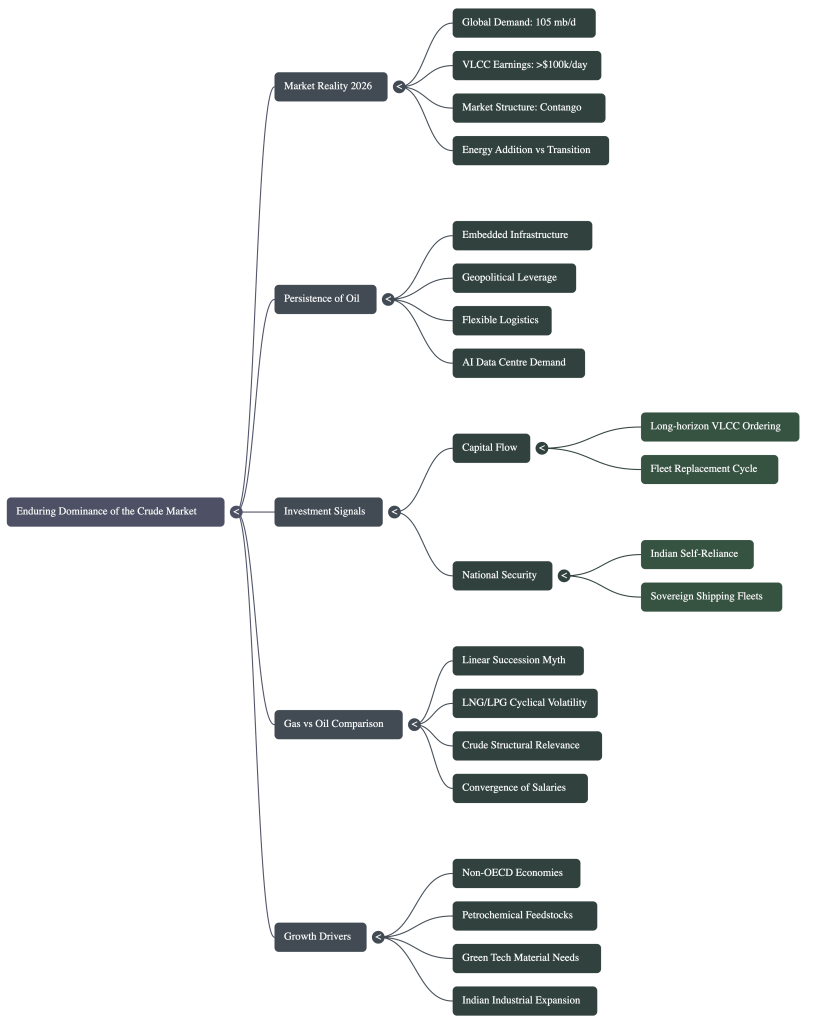
At this point, the picture becomes clearer when the system is viewed as a whole.
What the Market Is Actually Ordering
3 Signals Owners Ignore Gas Hype
Signal 1: Long-horizon capital keeps flowing into VLCCs
Capital keeps moving into crude tonnage. VLCC ordering has resumed as deliberate, long-horizon investment. Owners are committing to ships that will trade well into the 2040s. These are long-cycle assets, and people are buying them. This capital commitment is reinforced by fleet reality, with roughly 30 to 35 percent of the VLCC fleet projected to be over 18 years old by H2 2026, making replacement unavoidable.
This is not speculative noise. It is capital committing across regulatory cycles, fuel transitions, and geopolitical uncertainty. When investors believe a cargo is fading, they shorten duration. Here, they are extending it.

Signal 2: Crude Shipping Has Re-Entered National Security Planning
An even clearer signal comes from governments, particularly large crude importers that treat oil as an economic lifeline rather than a policy variable. India consumes roughly 5.3 million barrels per day of crude and imports more than 85 percent of that volume. That level of exposure has pushed maritime capacity into national strategy.
Indian policy now explicitly links crude imports with nationally controlled shipping under its broader “Make in India” and maritime self-reliance framework. The objective is straightforward: reduce exposure to freight volatility, sanctions risk, and foreign tonnage during periods of disruption. This includes plans to expand Indian-flagged crude carriers across all segments.
Shipyards such as Cochin Shipyard Limited and Garden Reach Shipbuilders & Engineers are expanding capacity to support this direction, laying industrial groundwork for future crude fleets. States do not invest in sovereign shipping capability for fuels they expect to fade. They do it for cargoes they expect to rely on under stress.
China provides the parallel case from the opposite end of the spectrum. As the world’s largest crude importer, China never outsourced strategic control of its oil logistics. It built it. Over the last two decades, Chinese state-linked owners and shipyards have steadily expanded crude-carrying capacity across VLCC, Suezmax, and Aframax classes, supported by domestic financing, yard capacity, and long-term cargo visibility.
Today, China dominates global shipbuilding by output and delivery speed, and that dominance is not accidental. It reflects a policy choice to align crude imports, fleet ownership, and industrial capacity under one system. This is not about chasing freight cycles. It is about ensuring that when oil tightens, ships, yards, and cargo control remain aligned.
India is moving toward this model. China has operated it for years. Both point to the same conclusion: states do not invest in sovereign shipping capacity for fuels they believe are fading. They do so for cargoes they expect to remain strategic under stress.
Signal 3: Gas ordering runs in cycles, crude ordering runs structurally
LNG and LPG ordering surges when scarcity appears, then cools as capacity catches up. The volatility is sharper and the confidence horizon is shorter. It reflects base-load demand and replacement necessity rather than episodic shortage. Crude ordering is quieter, steadier, and persistent. Markets price risk, resilience, and demand. Orderbooks leak the truth.
What the Numbers Actually Say About Oil’s Staying Power
Market Snapshot – Oil in 2026
- Global demand: ~105 mb/d (record)
- Annual growth: ~0.9–1.1 mb/d
- Non-OECD share of growth: >90%
- Petrochemicals share of growth: ~50–65%
- VLCC fleet over 18 years by H2 2026: ~30–35%
- Market structure: Contango (security-driven)
- Freight reality: VLCCs repeatedly above USD 100k/day
Over the last year, the freight tape has been more honest than the narratives. VLCC spot earnings repeatedly crossed USD 100,000 per day in late 2025, reflecting genuine tightening in effective supply.
LNG freight showed a two-speed pattern. Rates collapsed to USD 4,000 to 5,000 per day when tonnage arrived early, then rebounded sharply to USD 60,000 to 100,000 per day when seasonal tightness returned. LNG still spikes on scarcity. VLCC freight returns to a base-load trade.
By late Q3 2025, the oil market moved decisively into contango, with future prices above spot. September 30 sits at the collision point between paper and physical markets. Trading books reset, refinery cycles become visible, and inventory reality asserts itself. The 8,030 million barrels of observed inventories functioned as a safety net for 2026. It acted as the world’s insurance policy in a landscape shifting from “just-in-time” supply to “just-in-case” security.
Demand explains why. India alone accounts for roughly 0.3 mb/d of incremental growth, while China continues to reinforce energy security through stockpiling alongside electrification.
Petrochemicals now drive half to two-thirds of oil demand growth. Plastics, electronics, medical equipment, and grid infrastructure depend on oil-derived materials. The green transition itself is petrochemical-intensive. The more aggressively renewables are built, the more oil-based materials are required.
This comes down to how different cargo systems behave, and how markets price them.

Physical transport, storage, and forward curves reflect security, scale, and persistence.
Relevance Follows Demand
By 2026, the centre of gravity has shifted decisively. India is now the single largest contributor to global oil demand growth, and OPEC projects Indian oil consumption to rise by 8.2 million barrels per day by 2050. When the world’s fastest-growing major economy chooses oil as its industrial heartbeat, the story of hydrocarbons’ decline reads like a Western myth rather than a global reality.
Markets have been signalling this quietly for years. Oil endured, even as many were told otherwise.
Final Note
Whether you are a cadet joining your first ship, an officer choosing your next contract, or someone watching energy markets from ashore, the lesson is the same.
You do not build a career by chasing slogans. You build it by learning the job in front of you, doing it well, and staying alert to how the world around that job actually moves.
Ships trade. Cargo flows. Markets adjust.
Over time, the signal becomes clear without anyone having to sell it to you.
Sources include IEA, EIA, OPEC, Clarksons Research, BIMCO, Baltic Exchange, Reuters, BloombergNEF, and S&P Global Commodity Insights (2025–26).



Leave a Reply