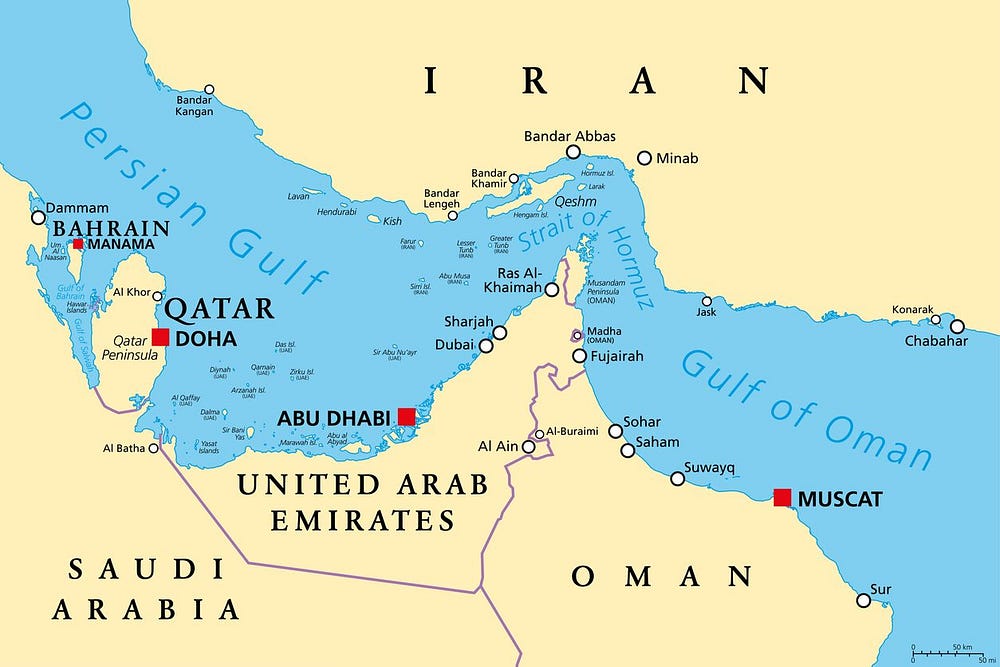
Masters navigating the Strait of Hormuz today face a paradox often raised in audits and discussions, compliance itself can create risk. Since late 2023, BIMCO together with ICS, INTERCARGO, INTERTANKO, OCIMF and others introduced voluntary transit corridors through the Persian Gulf and Strait of Hormuz, explicitly noting that these “may not be suitable for all vessels.” The guidance stressed that Masters and companies should perform vessel-specific risk assessments before transit.
These were meant to offer predictability, reduce naval misunderstandings, and enhance safety amid growing regional conflict.
But after the Iran–Israel flare-up in early 2025, many operators went a step further. Voluntary guidance became enforced policy. In many fleets, Masters are now instructed to keep within these narrow lanes, regardless of real-world conditions on the bridge.
Ironically, the ‘safe corridors’ often feel more dangerous than the threats outside them.

⸻
The Hidden Dangers of a “Safe” Corridor
The Persian Gulf is no open ocean. It’s one of the most congested maritime theaters in the world.
• Fishing dhows and small craft swarm unpredictably, often unlit at night.
• Offshore rigs, pipelines, and buoys clutter the waters.
• Wrecks and underwater obstructions leave little margin for error.
• GNSS jamming and spoofing are now routine, hundreds of vessels report position jumps, false AIS plots. Maritime information and cooperation centers reporting nearly 1000 vessels per day by GPS interference in June 2025 alone.
For a VLCC drawing draft of over 21 meters, and confined to a narrow corridor, the risks multiply. In summer, visibility in the Gulf often deteriorates sharply due to dust storms and Shamal-driven haze, reducing lookout effectiveness just as traffic density peaks. When combined with GNSS disruptions and unpredictable small craft, Masters face conditions where situational awareness is degraded and the margin for safe maneuvering is minimal.
The Front Eagle Collision: A Wake-Up Call
On 17 June 2025, the VLCC Front Eagle, laden with Basrah crude and bound for China, collided with the Suezmax Adalynn in ballast within the BIMCO transit corridor, about 15 nautical miles off Fujairah.
• Front Eagle was laden with crude from Iraq, bound for China.
• Adalynn was in ballast.
The collision, aggravated by GNSS spoofing and the compression of traffic density, sparked a fire on Front Eagle’s deck and caused significant hull damage to Adalynn. Investigators highlighted navigational misjudgment under hostile electronic conditions, but the deeper problem was systemic. Concentrating large vessels in narrow corridors amplifies risk rather than reducing it.
This incident is not an outlier, it’s a symptom of what Masters have long feared ie. the corridor itself introduces systemic risk.

Regional Escalation Adds to Maritime Risk
The Israel–Qatar skirmish of 9 September 2025, when Israel struck Hamas leaders in Doha, is a reminder that Gulf security can shift overnight. Even conflicts ashore create ripple effects at sea military activity, electronic interference, and sudden escalations, all of which compound the risks Masters already face when confined to “safe” corridors in the Strait of Hormuz.
⸻
“Everyone Else Is Passing……What’s Your Problem?”
Shore offices, often led by capable managers but with limited recent sea-going exposure, may focus more on demonstrating that risk assessments have been completed to satisfy insurers and senior leadership. In doing so, they sometimes counter a Master’s objection with a dismissive line – ‘All other vessels in the fleet pass through without incident, why can’t you?’
This argument doesn’t hold water:
1. Accident statistics aren’t predictive. A hundred uneventful voyages don’t guarantee the next one will be safe. Maritime disasters are often preceded by long stretches of “nothing happened.”
2. Near-misses are invisible. Many Masters avoid reporting close calls to prevent paperwork, scrutiny, or blame. Silence doesn’t mean safety.
3. Different ships, different risks. A product tanker or LNG carrier may have more flexibility than a fully laden VLCC with huge stopping distances. Comparing them is misleading.
4. Law is clear: Master’s discretion is paramount. Under SOLAS Regulation 34.1. “The owner, the charterer, the company shall not prevent or restrict the master from taking any decision necessary for the safety of life at sea.”
Safety is not measured by how many ships transit, but by whether the next ship completes its passage safely. When companies override a Master’s judgment, they not only endanger ships but also breach international law.”
⸻
The Safety Paradox
• Intent: Keep ships safe from geopolitical threats.
• Reality: Increased collision risk, navigational stress, and crew fatigue, especially under electronic warfare conditions and restricted visibility.
Corridors designed in boardrooms do not reflect the chaos of crowded waters, failing electronics, restricted visibility and split-second decisions on a bridge at 0200 hrs.
⸻
A Call to Shore Leadership in Shipping Risk Management
One-fifth of global oil trade flows through the Strait of Hormuz and Persian Gulf. The stakes are too high to let rigid rules override human judgment. With nearly 20% of global supply dependent on this chokepoint, the consequences of a major incident extend far beyond shipping, they threaten global energy security.
What must change:
• Corridors should remain guidelines, not shackles.
• Empower Masters to deviate when necessary without fear of reprimand.
• Invest in electronic warfare awareness.
The sea does not reward blind obedience to rigid routes. It rewards experience, adaptability, and sound judgment. The Master & not a corridor plotted in a committee, remains the best defense against disaster.
Conclusion
The BIMCO corridors were created with good intentions. But when turned into mandatory, inflexible orders, they risk undermining the very safety they were meant to enhance. The Front Eagle incident has shown the consequences.
If the shipping industry truly values safety, it must respect what international law already affirms: the Master’s authority is absolute when it comes to the safety of ship and crew. Anything less isn’t safety, it’s negligence.
⸻
References
• BIMCO, ICS, INTERCARGO, INTERTANKO, OCIMF — Joint Industry Guidance: Voluntary Reporting and Transit Corridors in the Persian Gulf (2023).
• UKMTO Notices (2024–2025): reports of small craft interference in Hormuz Strait.
• Financial Times — “GPS interference raises risk of accidents in Strait of Hormuz,” July 2025.
• Windward.ai — “GPS jamming falsely placed Front Eagle in Iran prior to collision,” June 2025.
• Lloyd’s List — “Tankers collide in Strait of Hormuz,” June 18, 2025.
• The Straits Times — “Navigational error caused oil tanker collision near Strait of Hormuz, says UAE,” June 19, 2025.
• SOLAS Consolidated Edition 2020, Regulation 34–1.
• U.S. EIA — World Oil Transit Chokepoints, updated 2024.
 The Deep Draft
Leave a comment