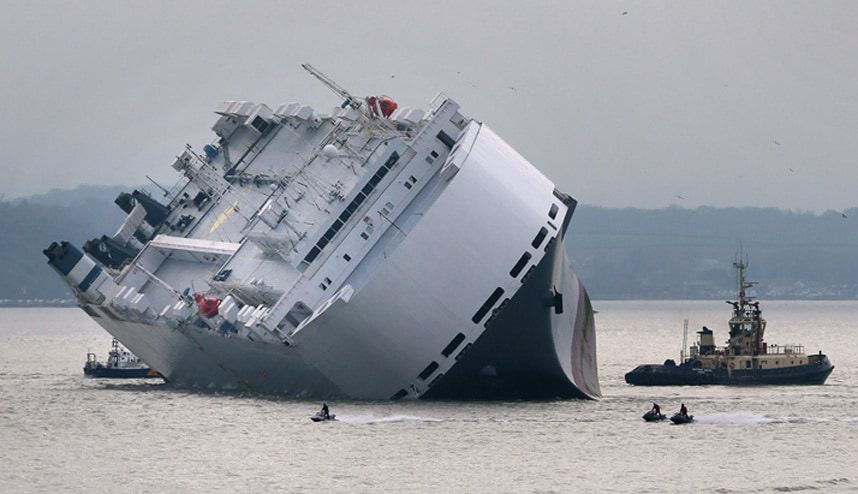

Dear friends, its an established fact that seafaring is a risky profession. We try our best to prevent recurrence of similar personal accidents, incidents or major near-misses by identifying root causes and recommending remedial action.
Our main intention is to ensure:
1. That all personal accidents, incidents and major near misses are promptly reported and investigated.
2. The methods employed to investigate incidents and the subsequent reporting formats are uniform and standardized.
3. Any breaches of regulations are identified.
4. Follow through of personal accidents, incidents, major near-misses and that the post investigation management is well defined and consistent across the industry.
5. Closure of incidents are managed and documented in a proper manner.
6. Dissemination of lessons learned from these personal accidents, incidents, major near-misses to the fleet, other business units, industry groups, customers, charters and oil majors.
Below is a very informative video from KVH Videotel, which will make you principally aware of techniques of investigating, analyzing and how to make reports.
We will now discuss the steps as guidelines when conducting an investigation.
1. Secure the area
Priority must be given to securing of the immediate area to preclude any recurrence of the incident or of injury to assisting personnel.
2. Advise and form the investigation team
For the majority of incidents (Minor injury requiring medical treatment or a negligible injury requiring first aid) it is the responsibility of the Safety Officer to progress the investigation and reporting process. In order to accomplish this task it may be deemed appropriate by the Safety Officer to seek assistance from personnel who possess specialist knowledge or expertise particular to the nature of the circumstances surrounding the incident. In the case of serious incidents and Near Misses with the same potential, it may be the decision of the Master to head the investigation team. Senior officers on the vessel should be capable of conducting an incident investigation. No person that is part of the team shall be connected with the incident.
3. Attend the accident scene as soon as it is safe
The investigation must be commenced as soon as possible after the incident. This will reduce the chances that the scene has been disturbed. It will also help to ensure that the incident is still fresh in the minds of any witness.
A significant factor to consider is recent change. It may be found that some change in state occurred prior to the accident which, combined with other causal factors already present, served to initiate the accident. Changes in personnel, procedures and equipment should be looked into thoroughly, particularly the hand-over of controls and instructions, and the communication of information.
The investigators should be looking for any conditions in the immediate environment which could have contributed to the accident. Items to check include:
the position of all equipment in relation to other equipment/facilities;
the position of valves, spades, set points, recorders, override switches etc.;
the condition of the load-bearing surface;
accessibility/evidence of congestion;
illumination of the location/site;
state of house keeping;
the condition of all equipment/facilities;
presence (absence) of warning signs/notices;
effects of weather;
presence of witnesses;
evidence of spills or release;
odours, discolouration;
presence of unauthorised people;
evidence of excessive forces.
4. Interview the injured or involved person(s), if possible
Witnesses must be interviewed one at a time and not in the presence of any other witnesses to avoid influencing subsequent statements.
It is important to identify the true causes of the incident and not superficial ones. In order to do this the investigator should ask probing questions provided these do not try to put words in the witnesses’ mouth.
Approach the witness with an open mind and only ask questions to determine the extent of his information and to clarify and confirm data as required.
With these points in mind, it is essential that the witness answers questions in an open manner and avoids voicing opinions unless requested.

5. Reconstruct the incident
Important evidence can be gained from observations made at the scene of the incident, particularly if equipment remains as it was at the time of the incident. Similarly, witnesses’ statements can usually be better understood and verified if discussed at site. As far as possible the site should be kept ‘as is’ until at least a preliminary investigation has taken place. This is not always feasible, as rescue operations or the presence of residual hazards and/or congestion may justify moving some of the equipment.
Local legislation may prescribe that for certain classes of incident e.g. fatality, nothing may be moved without prior permission from nominated persons.
Photographs and/or video film will assist investigation and may have use later for training purposes.

6. Complete report
The investigation report is a presentation of the findings and recommendations of the investigation team.
Each accident report must consist of the formalized Accident Report, Accident Report Summary, Accident Investigation and Root Cause Analysis together, and backed up with the relevant witness statements, log book entries, sketches, photographs and medical reports as appropriate.

The ultimate objective of the investigation process is to identify and recommend actions to prevent recurrence. Not all causes can be completely eliminated, and some may be eliminated only at prohibitive cost. Some recommendations will therefore be aimed at reducing a risk to an acceptable level, some will be aimed at improving protective systems to limit the consequences, while others will recognize and recommend necessary improvement to the Safety Management System.
To prevent a single factor holding up the reporting, a recommendation could be to investigate further in that specific area.
7. Implement recommendations
Review of the investigation report by the involved parties should be on a formal basis, with an agreed time schedule to ensure effective follow-up.
Disciplinary actions, where appropriate, should be initiated by line management and implemented following Personnel Procedures.
8. Follow Up
Much of the value of an accident investigation will be lost if the implementation of agreed recommendations is not closely followed up. Where recommendations cannot be fully implemented at once, it will be necessary to have a system for monitoring follow-up.
Hardware related items are normally easy to identify as having been completed, e.g. when the modification has been effected or when the new equipment has been received or installed. This is not always the case with items such as training or changes to procedures or supervision, and particularly when action is described as “ongoing”. A precise description of the action item will be necessary if it is to be effective.
It is suggested that a procedural action point is considered to have been completed when:
Written instruction has been issued and circulated to all staff concerned, and
When the change in procedures has been monitored and found to be effective. It will be necessary to set a deadline to ensure implementation of recommendations. The schedule for implementation should take both of these progress points into account.
Items involving training or changes in supervision should be handled in a way similar to procedures. The changes must be planned, circulated as necessary, and monitored until they are seen to have taken effect.
Shiphappens !




Leave a Reply