
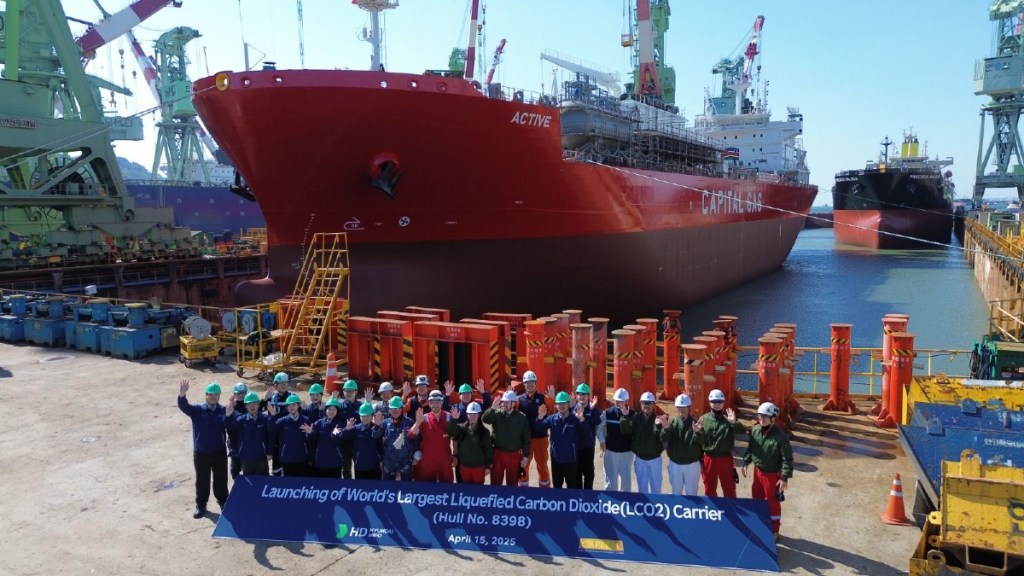
The world’s first large-capacity multi-gas carrier, M/T Active, was delivered on 6 January 2026, marking a new commercial segment in gas shipping. The vessel is designed to transport liquid CO₂ (LCO₂) alongside multiple other liquefied gases within a single hull and cargo system.
Vessel profile
- Vessel: M/T Active
- Capacity: ~22,000 cbm
- Owner / Manager: Capital Gas Ship Management (Capital Maritime Group)
- Builder: Hyundai Mipo Dockyard
- Cargo types: LCO₂, LPG, ammonia (NH₃), and selected petrochemical gases
The vessel represents the first commercially sized, non-dedicated LCO₂ carrier, moving beyond earlier small, project-specific CO₂ ships tied to individual carbon capture schemes.
Technical significance
M/T Active is fitted with a low-pressure cargo containment system and specialised tank technology capable of maintaining LCO₂ carriage conditions while remaining adaptable for LPG, ammonia, and other liquefied gases. This flexibility allows the vessel to operate across multiple markets without being locked into a single cargo type.
The design supports commercial charter employment, rather than being restricted to a single carbon capture and storage (CCS) project.
The vessel was recognised at the Lloyd’s List Greek Shipping Awards as Ship of the Year (2025) for opening a new pathway in carbon and multi-gas transportation.
Sister ships and delivery schedule
M/T Active is the first of a four-ship series, all sharing the same 22,000 cbm multi-gas design:
- M/T Amadeus — expected Q2 2026
- M/T Alkimos — expected Q3 2026
- M/T Athenian — expected Q4 2026
Commercial deployment
Given that large-scale CCS shipping demand is still developing, the vessels are positioned with a flexible employment strategy:
- Active has commenced service on a short-term LPG charter, generating immediate revenue
- The design aligns with emerging CO₂ logistics hubs, including planned Northern European export terminals feeding North Sea storage sites
- The ships are ammonia-ready, allowing future conversion for ammonia cargoes and potential fuel use as the industry transitions toward low-carbon fuels
Bottom line:
M/T Active establishes a new class of commercially flexible gas carriers, bridging today’s LPG trade with future CO₂ and ammonia logistics, and offering owners optionality as carbon transport markets scale.
 The Deep Draft
Leave a comment