
There was a time when by design, ship–shore communication was used sparingly.
Messages came through telex, and they came infrequently. Urgent navigational warnings. Critical operational or voyage instructions. Every message carried weight and if a message arrived, it mattered.
As technology improved, communication expanded. Email systems became reliable, efficiency improved, and instructions could be explained, documents shared, and decisions recorded. Importantly, email preserved sequence, authorship, and intent. It created a traceable layer between ship and shore without collapsing authority.
Then came instant messaging.
WhatsApp entered into ship operations in the name of digitization and efficiency, not as a system, but as a habit. No policy introduced it, and no Safety Management System defined its role, but it just came to fill the space between urgency and convenience.
In this context, “instant messaging” refers to chat-based platforms such as WhatsApp, Telegram, and similar services now routinely used for ship–shore communication.
What followed was anything but digital transformation. It was informalisation.
Communication became constant. Visibility increased. Discipline quietly eroded.
Today, WhatsApp sits uncomfortably close to inspections, safety approvals, crew matters, and commercial decisions. Not because it was designed to, but because it was allowed to. The communication that was once deliberate has now become impulsive, while the responsibility remains the same.
The article is not about technology. It is about how informality migrates into areas that were deliberately constructed to be formal.

Convenience as a Substitute for Process
Instant noodles solved a real problem. They were fast, cheap, and required minimal effort to prepare. Eaten occasionally, they were harmless. Eaten day after day, they replaced discipline with convenience.
Instant messaging has followed a similar trajectory in shipping.
It offers immediacy and reach, but not structure. Inspections, voyage orders, and safety-critical decisions depend on structure.
Speed replacing sequencing creates an appearance of control, while actual control weakens.
WhatsApp did not make shipping unsafe. It made it casual. In a high-consequence industry, casual processes tend to fail later, under conditions where there is little time or space left to correct them.
PSC and Vetting – The Loss Of Sequencing
Port State Control and vetting inspections are structured assessments. Observation comes before explanation & explanation comes before judgement. That is an important order:
Instant messaging collapses this sequence.
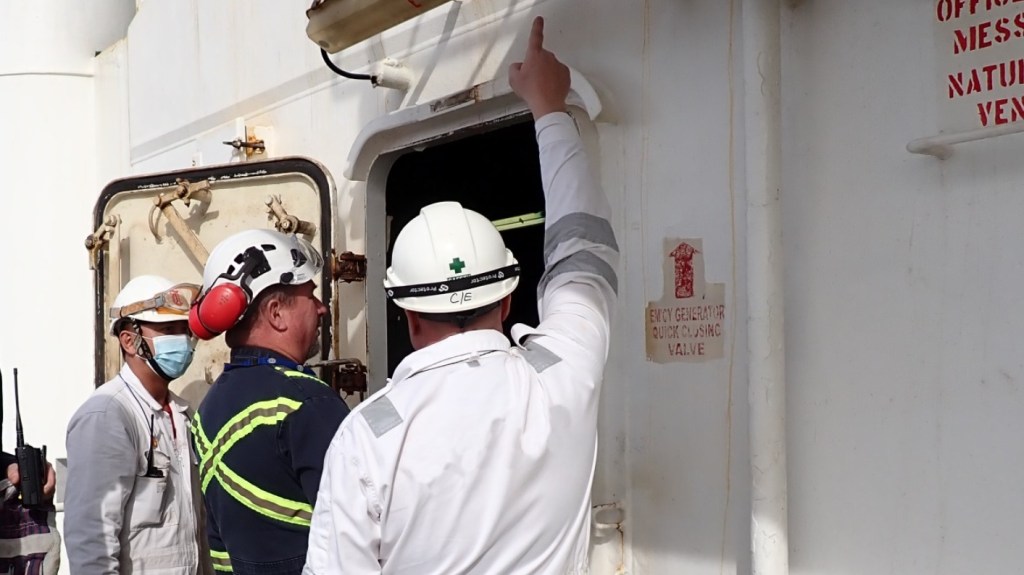
Live WhatsApp groups encourage reporting before facts stabilise. Explanations are typed while inspections are still unfolding. Shore reactions are triggered by fragments rather than conclusions. The inspection itself becomes secondary to the commentary surrounding it.
The contrast is familiar. Inspectors, often methodical and restrained, take time to form conclusions. Offices, reacting through instant messaging, form conclusions immediately.
Operationally, the ship undergoes one inspection. Administratively, the Master is often required to explain the same situation twice. The second explanation is not for the inspector. It is for a narrative that formed before the inspection concluded.
Narrative Drift After the Inspection
What follows inspections is a recurring feature of this communication pattern. Post-inspection correspondence often carries unease despite acceptable outcomes. Issues already discussed and resolved onboard reappear as concerns. Explanations accepted by inspectors require revalidation ashore.
Instant messaging captures fragments without context. Those fragments later appear in emails, stripped of sequence and assembled into conclusions that appear coherent but remain incomplete.
The inspection ends. The pressure does not.
Crew Matters and the Quiet Loss of Visibility
The WhatsAppisation of ship operations has enabled increasingly direct interaction between individual crew members and shore offices, often outside the knowledge of the Master. Routine matters such as early relief requests, wage queries, and contract clarifications are now frequently handled through instant messaging rather than through the established command loop.
Beyond administration, instant messaging is also used informally to understand what is happening onboard. Junior officers or ratings may be contacted directly. Information moves upward in fragments, shaped by partial knowledge, personal interpretation, and incomplete context, without passing through the ship’s command structure.
This creates parallel visibility ashore without corresponding responsibility.
It also alters onboard dynamics. Direct access to the office can create a misplaced sense of authority, where individuals believe proximity to shore equates to operational standing. Decisions are not challenged through experience or hierarchy, but reinforced through perceived backing.
The Master no longer has a complete picture of what information has left the vessel or how it has been interpreted. Discrepancies between shipboard reality and office understanding surface late, while accountability remains fixed with the Master.
Instant messaging does not create this imbalance. It enables it.

Safety-Critical Work and the Collapse of the Risk Assessment Chain
Probably the most serious consequence of informal communication is found in time-critical, safety-critical operations that nominally require shore approval.
Such tasks in theory are controlled by a formalized process: the identification of hazards, risk assessment, review, and formal authorization. That process exists to ensure urgency does not override judgment.
In practice, instant messaging often short-circuits it.
A task becomes time-sensitive. Shore review is requested. The response comes back informally: the assessment will be approved shortly, but the job can proceed in the meantime. The assurance is verbal or typed casually, sometimes through channels configured for autodeletion.
By that time, it has already collapsed.
If a shore-approved risk assessment carries value, work should not proceed without it. If work can proceed without it, the assessment has become ceremonial – produced after the decision rather than before it.
This is not risk management; this is risk displacement.
The job proceeds under informal assurance. Formal approval comes later. Responsibility remains on board. Evidence does not.

Commercial Voyage Orders: Informality as Exposure
WhatsApp being used to direct commercial voyages represents the same structural failure, with higher stakes.
Voyage orders have contractual and safety implications, as they affect routing, speed, fuel strategy, weather exposure, port rotations and crew workload. These decisions were never meant to be transmitted in an ad hoc way.
WhatsApp gives no indication of authority, nor clarity of contract, and no audit-grade record. A blue tick conveys urgency, not legitimacy.
If outcomes are questioned, the informality of the channel works unevenly. The ship executes. The Master commits. The office retains distance. The record rarely reflects how the decision actually evolved.

Records, Deletion, and Legal Fragility
Instant messaging platforms were never designed to serve as operational or safety records. Their increasing use in these roles weakens evidentiary reliability.
Unless formally captured, such communication does not sit within the Safety Management System. Authority is rarely clear. Version control is absent.
The growing use of disappearing messages and timed deletions adds another layer of fragility. Decisions take shape through channels built for impermanence, leaving little that can be reconstructed later with confidence.
Incomplete records shift responsibility rather than resolving it. In practice, accountability settles with the Master.
Courts and arbitral tribunals increasingly treat instant messages as admissible records of intent and decision-making. The informality of the medium offers no insulation once outcomes are questioned.
Informalization Is Not Digitalization
True digitalization reinforces systems. It integrates the records, enforces discipline, and clarifies authority. Now, informalization bypasses systems.
WhatsApp has become an operating space parallel to, yet outside of, formal frameworks and it certainly influences decisions made within these frameworks. Shipping is still governed by conventions, codes, and contracts, but many decisions form elsewhere and are justified later.
That gap is where exposure accumulates.
The Argument for WhatsApp and Where It Fails
WhatsApp can be useful in day-to-day ship operations. For routine coordination, crew welfare matters, and simple clarifications, instant messaging reduces delay and makes communication easier. It helps people stay connected in ways earlier systems could not.
Used with care and kept away from decisions, approvals, and formal instructions, this kind of communication can sit alongside structured systems. Many ships use instant messaging daily without difficulty, largely because experienced Masters understand its place and prevent it from influencing decisions.
Problems emerge gradually. What begins as coordination starts to influence expectations. Informal exchanges begin to carry weight. Conversations intended to clarify are later treated as direction. Boundaries that were never clearly defined weaken further under time pressure and commercial demands.
Policies, training, and systems can provide limits, but they do not apply themselves. They only work when deliberately built into everyday practice and consistently maintained.
Without that discipline, informal communication drifts into areas where structure exists for a reason.
A DeepDraft Position
WhatsApp has a place in ship operations, but a limited one. It works for coordination, notification, and non-interpretive updates. It is not suited for inspections, decisions, safety approvals, voyage orders, or employment commitments.
Where instant messaging does enter operational discussions, discipline matters. Informal exchanges may help clarify or accelerate understanding, but actions should not rest there. When a conversation over WhatsApp leads to a decision or a course of action, that response deserves to be anchored in a formal channel. A brief follow-up email noting that “further to our earlier discussion” restores sequence, authorship, and intent without slowing operations.
This is not duplication for its own sake. It is recognition that speed and traceability serve different purposes. One moves work forward. The other protects it.

Convenience is not governance. Speed is not competence.
The instant noodles are not harmful because they are fast. They become harmful when they replace real meals.
Instant messaging is no different.
It’s not the lack of communication that makes shipping fail, it’s when communication escapes discipline that makes shipping fail.
WhatsApp did not alter the fundamentals of ship operations. It revealed how easily formality can be set aside in the name of convenience. Responsibility, however, remains exactly where it always has.
That decision has consequences.
 The Deep Draft
Leave a comment