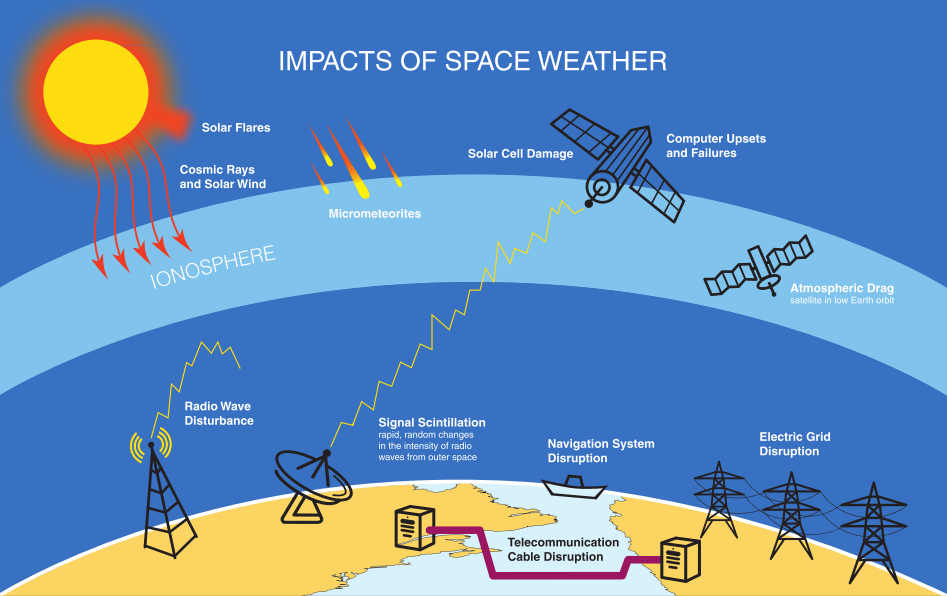
It may go unnoticed but space weather can directly impact the mariner in several ways of which they should be aware. Space weather generally begins at the sun, which produces several different phenomena which can disrupt radio and satellite communications on Earth. The most notable effects include:
The Solar Wind:
A continuous stream of charged particles release by the sun, produced as a result of its ‘normal’ nuclear reaction process. These particles travel at several hundred kilometers per second and can take 2-3 days to reach Earth.
Sunspots:
The Sun follows an approximate 11-year cycle of sunspots, the visible signs of an increased solar magnetic field. The period during which sunspots occur are referred to as the ‘maxima’ and generally last somewhere between 3-5 years, although this can vary considerably. During a sunspot maximum, solar flares can erupt.
Solar Flares:
Strong magnetic field loops often extending outside the surface of the sun which, when they break up, release huge amounts of charged matter e.g. ultraviolet light, x-rays and various other charged particles into space, at speeds much larger than the solar wind. These are called Coronal Mass Ejections or CMEs and when they are directed towards the Earth can trigger a ‘geomagnetic storm’.
Electromagnetic Radiation:
Besides the outflow of the above highly charged particles, the Sun also continually emits electromagnetic radiation which travels at the speed of light, reaching the Earth in a little under 8 minutes. The extreme end of the UV and X-ray parts of the spectrum are responsible for breaking apart, or ‘ionising’ the molecules which form part of the upper atmosphere, into positively and negatively charged particles. This layer of the atmosphere is unsurprisingly named the ‘Ionosphere’ and the free charges it contains can have a major influence on radio/GPS signal paths, depending on the time of day, season and solar cycle.
Low level space weather events occur on a regular basis and usually have only minor effects. However, severe cases can cause major disruption and risk, such that most governments view it as one of the highest priority natural hazards, due to our increasing dependence on technology and the effects space weather can have on it. Space weather events have the potential for widespread failure of power supplies, radio and satellite communication blackouts, compass fluctuations, GPS navigation errors and the subsequent havoc that would be inflicted on aviation and marine traffic worldwide if one or more of the GNSS satellites were to be damaged. In 2012 the Earth had a near miss when the largest solar storm since 1859 was directed towards its orbit. If it had occurred only one week earlier, the planet would have been directly in its path .
Practical Effects on the Mariner:
At frequencies in the 1 to 30 MHz range, solar flares can cause changes in ionospheric density and structure, thereby modifying the path of radio signals, causing ‘fading’, interference and even blocking HF transmissions completely (radio blackout). Additionally, the speed at which VHF GPS signals travel through the ionosphere can be affected. The resulting delay and refraction (scintillation) of the signal’s path, can lead to a decreased in the accuracy of GPS receivers of up to 100m and/or temporary loss of satellite ‘lock’. This has obvious consequences for the mariner, particularly for those using dynamic positioning or navigating an area congested with hazards.
Whilst most radio frequencies will be affected to some degree by space weather, HF radio communications (and MF at night), are particularly susceptible. In a typical sequence of space weather storms, the first impacts are felt during the solar flare itself. The solar x-rays from the sun penetrate to the bottom of the ionosphere (to around 80 km), where the atmosphere is ionised and creates an increased, thicker, ‘D layer’. The D-layer acts both as a reflector of radio waves at some frequencies and an absorber of waves at others. The ‘radio blackout’ associated with solar flares, occurs on the dayside region of Earth and is most intense when the sun is directly overhead.
Another type of space weather, the radiation storm, is caused by energetic solar protons and can also disrupt HF radio communication. The protons are guided by Earth’s magnetic field so that they collide with the upper atmosphere near the north and south poles. The fast-moving protons have a similar affect to the x-ray photons and create an enhanced D-Layer, thus blocking HF radio communication at high latitudes. During aurora displays, the electrons can affect other layers of the ionosphere and have similar disrupting and blocking effects, which occur mostly on the night side of the polar regions of Earth, where the aurora is most intense and most frequent.
Satellite communications tend to use high frequency signals: Ultra High Frequency (UHF), 300 MHz to 3 GHz and Super High Frequency (SHF), 3–30 GHz. Radio signals propagating to and from a satellite in orbit are similarly affected and the results are highly variable. Up to a point, the effects of space weather on satellite communications can be mitigated through engineering design solutions, but even so, space weather can lead to a total loss of communication.
Considering that the Global Maritime Distress and Safety System relies on effective radio and satellite communication, the mariner is well advised to take space weather conditions into account.
Space Weather Forecast Scales:
NOAA (the USA’s National Oceanic and Atmospheric Administration), has developed a range of scales which are sometimes referenced by other meteorological services around the world when it comes to issuing space weather predictions. These scales were developed as a way of describing the likely environmental disturbances for three main solar weather event types: radio blackouts, geomagnetic storms and solar radiation. The scales have numbered levels, similar to hurricanes and earthquakes, in order to convey their severity and may be more easily interpreted than the standard scientific technical descriptions.


ShipHappens !
 The Deep Draft
Leave a comment