A lot has been written about pilot boarding arrangement but the fact remains a number of pilots have died as a result of accidents while boarding/disembarking from ships, and many more have been seriously injured.
Pilots come aboard ship to assist the crew during the most critical and potentially hazardous phases of a voyage. Qualified pilots possess particular local knowledge and have the necessary ship-handling skills to assist the safe arrival and departure of vessels.
Normally, pilots board and disembark using a traditional rope ladder from and to a pilot boat. However, this can be a very dangerous procedure if those involved do not adhere to International Maritime Organization (IMO) standards or fail to practice acceptable seamanship skills.
Furthermore, deficiencies with regard to boarding arrangements and unsafe rigging of pilot ladders continue to be detected during port state control inspections, resulting in delays and financial penalties for the ship operator.
Nevertheless, pilot ladders remain the most safe and efficient way to board ships at sea and there is usually no alternative, except on occasions when a helicopter is used.
The following guidance is intended to remind seafarers and shipping companies of the vital importance of adhering to the rules and established procedures concerning the provision of safe boarding arrangements for pilots.
Ensuring Safe Rigging for Pilots
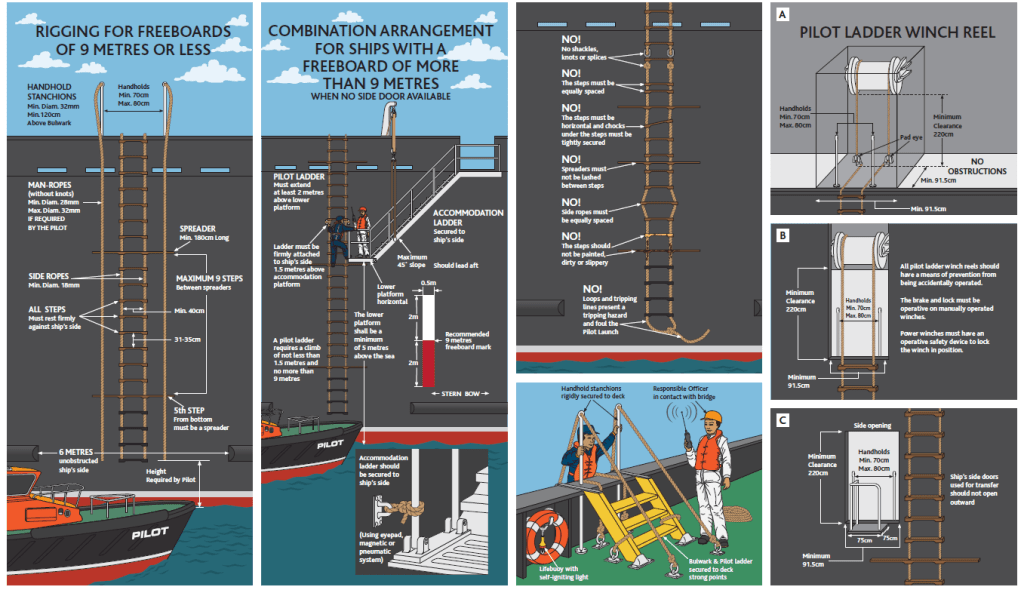
The IMO Convention for Safety of Life at Sea (SOLAS Chapter V, Regulation 23) sets out the principal requirements for the rigging of pilot ladders. These provisions are set out in the diagram contained in this brochure. This diagram can be downloaded at
http://www.impahq.org (on home page, click ‘Downloads’). It is also reproduced in the ICS Bridge Procedures Guide.
There is further detailed technical specification for pilot ladders in IMO Resolution A.1045(27). Shipping companies have a legal obligation to provide a conforming ladder and ship-borne fittings. If seafarers are uncertain about any of the requirements, they should always ask their supervising officer for advice.
The two major causes of accidents are defects in the ladder treads or sideropes or a lack of proper attachment of the ladder to the vessel.
Seafarers should always check the condition of the ladder before it is rigged and also ensure it is secure to the ship. Whilst this is done, seafarers should always take care of their own safety, wearing a life jacket (and a life-line if appropriate).
Management Issues
Shipping companies should ensure that:
• Ladders are SOLAS compliant
• The inspection regime and records are adequate
• Replacement ladders are quickly and readily available on board
• Seafarers involved receive the necessary training and have a full understanding of the requirements.
On Board Issues
The Master and officers should:
• Closely supervise the rigging of pilot ladders
• Closely observe the shipping/landing of pilots from ladders, ensuring that SOLAS requirements are met.
• Maintain a lee until the pilot vessel is well clear.
At all times during the rigging, use and de-rigging of any pilot transfer arrangements there should be no risk to the ship’s crew. Crew members should not normally be required to leave the protection of the ship’s safety rails or bulwarks. A life line or safety harness should be worn if there is any risk of falling.
Summary
Pilots have the right to decline to board vessels offering defective ladders, which can result in serious delay. Pilots are also entitled to report defects in boarding ladders to port state control authorities, which could lead to a full PSC inspection with the risk of delay and financial penalties.
A pilot who has climbed a sound ladder, well rigged, and attended by an officer and a deck party will be in the right frame of mind to give his best attention to the safety of the vessel.
Source –
BIMCO, INTERTANKO, INTERCARGO, NAUTICAL INSTITUTE, SIGTTO, ICS
 The Deep Draft
Leave a comment